
Gynaephora rossii
(Curtis, 1835)
Ross' tussock moth
Gynaephora rossii is a cold-adapted tussock distributed across the Holarctic tundra and alpine regions. The is notable for its extended larval development period of 7–11 years and its ability to survive freezing temperatures. are active during daylight hours in summer, with males actively searching for females while females are largely sedentary. The caterpillars feed primarily on Saxifraga species and certain willows.
Pronunciation
How to pronounce Gynaephora rossii: //ˌɡaɪniˈfɔːrə ˈrɒsaɪ//
These audio files are automatically generated. While they are not always 100% accurate, they are a good starting point.
Identification
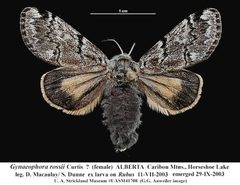
Distinguished from the sympatric Gynaephora groenlandica by: more patterned forewings in ; presence of a broad dark band along the hindwing margin (absent in G. groenlandica); and caterpillars with finer, feather-like () hairs versus the stiffer, unbranched (spinulose) hairs of G. groenlandica. Cocoons are single-layered versus double-layered in G. groenlandica. May be confused with Polia richardsoni in British Columbia, which differs in wing pattern, presence of hair on , and much thinner .
Images
Habitat
Arctic and subarctic tundra, rocky alpine tundra on high mountains, and muskeg with scattered trees. Occurs from sea level to at least 2,400 m elevation. Survives extreme environments including temperatures that freeze caterpillars solid.
Distribution
Holarctic: North America (Alaska, Canada, Rocky Mountains, Appalachians), Russia (Siberian Arctic from Urals to Chukchi Peninsula, Buryatia, Kamchatka, Magadan Oblast), and Japan (Hokkaido). Includes isolated alpine in Colorado, Wyoming, New Hampshire, and Maine.
Seasonality
active May to August in North America; primarily July in northern British Columbia. Large emergences occur for one to two days in June on Somerset Island, Nunavut. Caterpillars observed making cocoons in August in northwestern Chukotka.
Diet
Caterpillars feed on Saxifraga tricuspidata, S. oppositifolia, Salix arctica, Dryas, and potentially Potentilla. Also recorded on Rubus acaulis. Laboratory rearing successful on Rubus idaeus, Rosa, and Taraxacum. In Northern Yakutia, reported on Salix polaris, S. boganidensis, and S. pulchra.
Host Associations
- Saxifraga tricuspidata - primary food plantMain food plant on Somerset Island
- Saxifraga oppositifolia - primary food plantMain food plant on Somerset Island
- Salix arctica - food plant
- Dryas - food plant
- Rubus acaulis - food plant
- Salix polaris - food plantNorthern Yakutia
- Salix boganidensis - food plantNorthern Yakutia
- Salix pulchra - food plantNorthern Yakutia
- Chetogena gelida - Tachinid fly, appears -specific to G. rossii
Life Cycle
Extended development with caterpillar stage lasting 7–11 years. Caterpillars survive freezing and can resume activity after thawing. occurs in silk cocoons. has been documented in females from eastern Yakutia and northwestern Chukotka, producing viable offspring without mating; however, this was not observed on Ellesmere Island.
Behavior
activity. Females have fully developed wings but rarely fly, instead remaining stationary and emitting to attract males. Males fly rapidly during daylight searching for females. Caterpillars and pupae practice behavioral by basking in sunshine to elevate body temperature. Caterpillars show avoidance responses to bat sounds despite absence of bats in their range. On Ellesmere Island, females typically lay in masses on or inside their cocoon; in Hokkaido, females fly and deposit eggs on upright woody stems.
Ecological Role
Herbivore in tundra . Serves as for flies including Chetogena gelida. Prey for birds including small foraging birds that tear open cocoons to consume masses.
Human Relevance
Named for John Ross, leader of the Arctic expedition during which the was discovered. Subject of physiological research on cold and freezing survival. MONA (Hodges) number 8290.
Similar Taxa
- Gynaephora groenlandicaSympatric in Arctic Canada and Wrangel Island; distinguished by less patterned wings, absence of hindwing marginal band, spinulose (not ) caterpillar hairs, and double-layered cocoons.
- Polia richardsoniSimilar wing coloration and period in British Columbia; distinguished by different wing pattern, hairy , and much thinner .
More Details
Taxonomic history
Originally described as Laria rossii by John Curtis in 1835. Transferred through Dasychira and Byrdia before placement in Gynaephora. include G. r. rossii (North America) and G. r. relictus (Asia), with G. r. daisetsuzana and G. r. lugens sometimes recognized.
Conservation notes
Recorded as common historically on Somerset Island (1832) but appears rare in Hokkaido (only two specimens collected 1920s–1950s). Present in multiple protected areas including Rocky Mountain National Park, Kenai National Wildlife , and Sirmilik National Park.
Sources and further reading
- BugGuide
- Wikipedia
- GBIF taxonomy match
- iNaturalist taxon
- NCBI Taxonomy
- Catalogue of Life
- To Be an Underwing Underfoot | Bug Squad
- New data on the distribution of the Gynaephora (rossii) species group in Northern Yakutia
- Body Temperatures and Behavioral Thermoregulation of High Arcitc Woolly-Bear Caterpillars and Pupae (Gynaephora rossii, Lymantriidae:Lepidoptera) and the Importance of Sunshine
- Body Temperatures and Behavioral Thermoregulation of High Arctic Woolly-Bear Caterpillars and Pupae (Gynaephora Rossii , Lymantriidae: Lepidoptera) and the Importance of Sunshine
- REPRODUCTIVE ISOLATION IN ARCTIC SPECIES OFGYNAEPHORAHÜBNER (LEPIDOPTERA: LYMANTRIIDAE)
- Diet breadth ofGynaephora groenlandica(Lepidoptera: Erebidae): is polyphagy greater in alpine versus Arctic populations?