
Lophocampa roseata
Walker, 1866
Rosy Aemilia
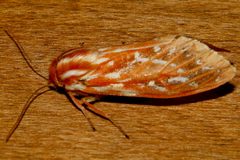
Lophocampa roseata, commonly known as the rosy aemilia, is a small in the Erebidae. It was described by Francis Walker in 1866. The is restricted to the Pacific Northwest region of North America, where it inhabits coniferous forests and has adapted to urban environments. The forewings measure 14–15 mm in length. Larvae have been successfully reared on Douglas-fir (Pseudotsuga menziesii), indicating a relationship with this conifer species.
Pronunciation
How to pronounce Lophocampa roseata: //ˌloʊfoʊˈkæmpə roʊˈziːətə//
These audio files are automatically generated. While they are not always 100% accurate, they are a good starting point.
Identification
The can be distinguished from other Lophocampa species by its restricted Pacific Northwest distribution. Two are recognized: L. r. roseata and L. r. occidentalis (French, 1890), the latter occurring in the Rocky Mountains of Colorado. Separation from the spotted tussock moth (Lophocampa maculata), which has a much broader North American distribution, likely involves differences in wing pattern and coloration, though specific diagnostic characters require examination of or detailed original descriptions.
Images
Appearance
have forewings 14–15 mm in length. The exhibits the typical with scaled wings. Specific coloration and pattern details are not well-documented in available sources, though the 'rosy aemilia' suggests pinkish or rose-colored tones. Larval morphology has not been described in detail in accessible literature.
Habitat
Conifer forests and urban landscapes. The shows adaptability to human-modified environments while maintaining in natural coniferous forest .
Distribution
to the Pacific Northwest of North America. Recorded from western Oregon, Washington, and southwestern British Columbia. The L. r. occidentalis occurs in the Rocky Mountains of Colorado.
Diet
Larvae feed on Douglas-fir (Pseudotsuga menziesii). feeding habits are not documented.
Host Associations
- Pseudotsuga menziesii - larval plantDouglas-fir; larvae successfully reared on this
Similar Taxa
- Lophocampa maculataSimilar with overlapping range in western North America; distinguished by distribution pattern and likely wing markings
- Lophocampa ingensCongeneric found in western North American conifer forests; larger size and different larval may separate them
More Details
Subspecies
Two are recognized: Lophocampa roseata roseata (nominate subspecies, Pacific Northwest) and Lophocampa roseata occidentalis French, 1890 (Rocky Mountains, Colorado). The geographic separation of these subspecies suggests potential ecological or morphological differentiation, though specific differences are not detailed in available sources.
Taxonomic history
Originally described as Halesidota roseata by Walker in 1866 (or 1868 in some sources), later transferred to Lophocampa. The has been classified in in older literature, now placed in Erebidae following modern molecular phylogenetic revisions of Lepidoptera classification.