
Lambdina
Capps, 1943
Species Guides
9- Lambdina fervidaria(curve-lined looper)
- Lambdina fiscellaria(Hemlock Looper Moth)
- Lambdina flavilinearia
- Lambdina laeta
- Lambdina pellucidaria(pitch pine looper)
- Lambdina phantoma
- Lambdina pultaria(southern oak looper)
- Lambdina punctata
- Lambdina vitraria
Lambdina is a of geometrid moths comprising approximately ten described distributed in North America. Several species are significant forest defoliators, particularly the hemlock looper (L. fiscellaria) and its , which cause economically damaging in coniferous forests. The genus exhibits typical geometrid with larvae commonly referred to as loopers due to their characteristic looping gait. Species within Lambdina can be distinguished by associations, periods, and stages.
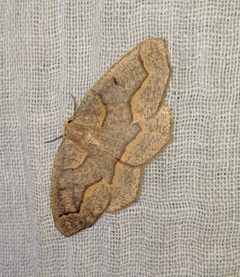
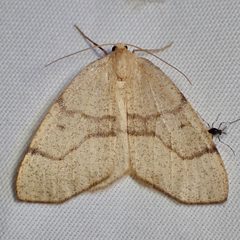
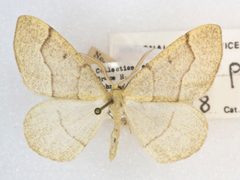
Pronunciation
How to pronounce Lambdina: //læmˈdaɪnə//
These audio files are automatically generated. While they are not always 100% accurate, they are a good starting point.
Identification
-level identification requires examination of genitalia, wing pattern details, and association with plants. Larval capsule width measurements and instar counts aid in distinguishing congeneric species. Lambdina athasaria can be differentiated from other conifer-feeding by its with pupal and specific period in May-June. Adult timing and larval development schedules differ among species and .
Images
Habitat
Coniferous forests; specific associations include eastern hemlock (Tsuga canadensis), balsam fir (Abies balsamea), and pine .
Distribution
North America; documented from Canada (Newfoundland, New Brunswick, eastern provinces) through the United States (Vermont, Connecticut, Utah, southern California, Pacific coast). Two major of L. fiscellaria occur along a latitudinal gradient in eastern Canada.
Seasonality
of L. athasaria emerge during four weeks in May and June following hemlock budbreak. Males emerge earlier than females and fly for 4–5 weeks annually. Larvae feed from June to October, descending from trees in September and October to pupate.
Host Associations
- Tsuga canadensis - Eastern hemlock; primary for L. athasaria larvae
- Abies balsamea - Balsam fir; mortality reported during in Newfoundland
- Pinus - Pine ; for L. pellucidaria (pitch pine looper)
Life Cycle
with pupal in L. athasaria. Larvae have five or six instars based on capsule width measurements. Early instars feed on new growth; older instars feed on old growth. occurs in the duff beneath trees.
Behavior
Female calling begins the first evening after , commencing 15 hours after light onset. Calling involves protraction of terminal abdominal segments 8–10, exposing paired ventrolateral on the eighth segment—a structure differing from other Lepidoptera. Males are attracted to virgin females primarily during the first half of the period. may function as an excitant stimulating male searching activity rather than solely as an attractant. Mated females initiate oviposition rapidly after a short pre-oviposition period, with peak -laying in the first three days. Unmated females exhibit more uniform daily oviposition patterns throughout life.
Ecological Role
Major defoliator of North American coniferous forests; economically damaging cause high mortality of balsam fir and other trees. Serves as host for including Pimpla sanguinipes (Ichneumonidae), which attacks L. punctata larvae. of L. pellucidaria have been investigated as factitious hosts for agents such as Ooencyrtus ennomophagus.
Human Relevance
Significant forest pest requiring management intervention during . Subject of research including screening of for introduction to Newfoundland. Susceptibility to has been investigated for potential biocontrol applications.
Similar Taxa
- EnnomosBoth are geometrid with loop-forming larvae and conifer-feeding ; distinguished by wing pattern and genitalia
- CaripetaGeometrid containing forest loopers; L. fiscellaria were tested for susceptibility to C. divisata viruses, indicating ecological overlap
Sources and further reading
- BugGuide
- Wikipedia
- GBIF taxonomy match
- iNaturalist taxon
- NCBI Taxonomy
- Catalogue of Life
- Bug Eric: Wasp Wednesday: Pimpla sanguinipes
- SUSCEPTIBILITY OF LAMBDINA FISCELLARIA SOMNIARIA (HULST) (GEOMETRIDAE) AND LAMBDINA FISCELLARIA LUGUBROSA (HULST) (GEOMETRIDAE) TO VIRUSES FROM SEVERAL SPECIES OF LEPIDOPTEROUS INSECTS
- Daily oviposition pattern of Lambdina fiscellaria (Lepidoptera: Geometridae) under laboratory conditions
- REPRODUCTIVE BIOLOGY OFLAMBDINA FISCELLARIA LUGUBROSA(LEPIDOPTERA: GEOMETRIDAE)
- Factors Affecting Calling Behavior by Lambdina fiscellaria fiscellaria (Lepidoptera: Geometridae), Under Field Conditions
- Life History of a Looper, Lambdina punctata, in Utah (Lepidoptera: Geometridae)
- THE AEROBIC BACTERIA ASSOCIATED WITH THE EASTERN HEMLOCK LOOPER LAMBDINA FISCELLARIA (GN.)
- SEX ATTRACTION AND COURTSHIP BEHAVIOR IN LAMBDINA FISCELLARIA LUGUBROSA (LEPIDOPTERA: GEOMETRIDAE)
- LIFE CYCLE OF LAMBDINA ATHASARIA (WALKER) (LEPIDOPTERA: GEOMETRIDAE) DEVELOPING ON HEMLOCK IN CONNECTICUT
- History of the Hemlock Looper, Lambdina fiscellaria fiscellaria (Guen.), (Lepidoptera: Geometridae) in Newfoundland, and Notes on Its Biology
- SUBFREEZING EGGS OF LAMBDINA PELLUCIDARIA (LEPIDOPTERA: GEOMETRIDAE) ALTERS STATUS AS FACTITIOUS HOST FOR OOENCYRTUS ENNOMOPHAGUS (HYMENOPTERA: ENCYRTIDAE)
- INCIDENCE OF LEIDYANA CANADENSIS (APICOMPLEXA: EUGREGARINIDA) IN LAMBDINA FISCELLARIA FISCELLARIA LARVAE (LEPIDOPTERA: GEOMETRIDAE)
- An ultrastructural study of the development of a nuclear polyhedrosis virus of the eastern hemlock looper, Lambdina fiscellaria fiscellaria
- SCREENING FOUR EXOTIC PARASITOIDS AS POTENTIAL CONTROLS FOR THE EASTERN HEMLOCK LOOPER,LAMBDINA FISCELLARIA FISCELLARIA(GUENÉE) (LEPIDOPTERA: GEOMETRIDAE)
- Correction: Zhou et al. Modular Stereoselective Synthesis of Sex Pheromone of Lambdina fiscellaria lugubrosa (Hulst) and Discovery of Cross-Species Attraction in Semiothisa cinerearia (Bremer & Grey). Molecules 2025, 30, 4216.
- Modular Stereoselective Synthesis of Sex Pheromone of Lambdina fiscellaria lugubrosa (Hulst) and Discovery of Cross-Species Attraction in Semiothisa cinerearia (Bremer & Grey).