
Lambdina pellucidaria
(Grote & Robinson, 1867)
pitch pine looper, eastern pine looper, yellow-headed looper, yellow-headed looper moth
Lambdina pellucidaria is a geometrid found in eastern North America, commonly known as the pitch pine looper or yellow-headed looper. The is associated with pine and has been documented feeding on pitch pine, red pine, and other hard pines, as well as oak. are active from March to June with regional variation, and exhibit -mediated mating activity between midnight and 3 AM. Larvae are distinctive loopers that mine needles rather than consuming them completely, a trait that aids in identification.


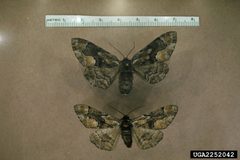
Identification
Larvae are best identified by their feeding : they mine needles rather than eating them completely, unlike most other loopers. This needle-mining habit distinguishes them from congeneric and other geometrid larvae. may be difficult to separate from related Lambdina without dissection or analysis; they share components and stereoisomers with L. athasaria, contributing to ongoing taxonomic questions about their status.
Images
Habitat
Pine-dominated forests, particularly pitch pine (Pinus rigida) stands. Associated with eastern North American forest where hard pines and oak occur.
Distribution
Eastern United States, from New York west to Illinois and south to Georgia. Distribution records include Vermont.
Seasonality
period from March to June depending on location. Larval feeding continues until late September in the northeastern United States, with timing varying by region.
Diet
Larvae feed on needles of pitch pine (Pinus rigida), red pine, other hard pines (Pinus spp.), and oak (Quercus spp.).
Host Associations
- Pinus rigida - larval food plantpitch pine, implied by and association
- Pinus resinosa - larval food plantred pine
- Quercus spp. - larval food plantoak
- Ooencyrtus ennomophagus - (factitious under laboratory conditions) can develop in subfreezing-treated stored at −10°C, but not in fresh eggs; not a natural relationship
Life Cycle
are laid on both sides of pine needles. Larvae hatch and feed on needles through late summer. Full-grown larvae drop to the ground in late September (northeastern US), overwinter in the duff layer beneath trees, and pupate there. timing varies geographically from March to June.
Behavior
-mediated mate location occurs between 24:00 and 03:00 hr. Larvae exhibit characteristic looping locomotion and distinctive needle-mining feeding .
Ecological Role
Defoliator of pine and oak forests. Larval feeding can impact needle of trees. Serves as host for including Pimpla sanguinipes (recorded as attacking Lambdina punctata, with potential for related ).
Human Relevance
Occasional forest pest due to larval defoliation of economically important pine . have been investigated as a potential factitious for laboratory rearing of the agent Ooencyrtus ennomophagus, though fresh eggs do not support development.
Similar Taxa
- Lambdina athasariaShares identical components (7-methylheptadecane and 7,11-dimethylheptadecane), same stereoisomers (7S and meso-7,11), identical diel periodicity of communication (24:00–03:00 hr), and overlapping seasonal periods in June. These similarities have led to suggestions of potential synonymy between the two .
- Lambdina punctataCongeneric oak looper with similar larval and ; may be difficult to distinguish without detailed examination.
More Details
Taxonomic Uncertainty
studies indicate that L. pellucidaria and L. athasaria may be , given their identical pheromone profiles, stereochemistry, and temporal communication patterns. The two were historically separated by plant association (pitch pine vs. hemlock) and minor morphological differences, but reproductive isolation via pheromone channels appears absent.
Identification Caution
Larval coloration varies considerably and is not a reliable diagnostic feature alone; needle-mining is the most consistent field character for distinguishing this from other loopers.
Sources and further reading
- BugGuide
- Wikipedia
- GBIF taxonomy match
- iNaturalist taxon
- NCBI Taxonomy
- Catalogue of Life
- Bug Eric: Wasp Wednesday: Pimpla sanguinipes
- Does Pheromone Biology of Lambdina athasaria and L. pellucidaria Contribute to Their Reproductive Isolation?
- SUBFREEZING EGGS OF LAMBDINA PELLUCIDARIA (LEPIDOPTERA: GEOMETRIDAE) ALTERS STATUS AS FACTITIOUS HOST FOR OOENCYRTUS ENNOMOPHAGUS (HYMENOPTERA: ENCYRTIDAE)