
Ennomos
Treitschke, 1825
thorn moths, spanworms
Species Guides
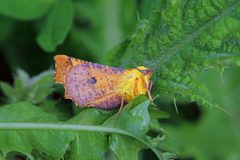
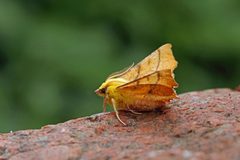
3- Ennomos alniaria(Canary-shouldered Thorn)
- Ennomos magnaria(Maple Spanworm Moth)
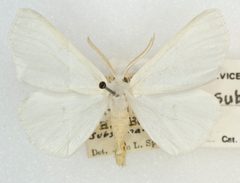
- Ennomos subsignaria(Elm Spanworm Moth)
Ennomos is a of geometrid moths established by Treitschke in 1825, commonly known as thorn or spanworms. The genus includes approximately 12 described distributed primarily in the Northern Hemisphere, with several species known as significant defoliators of deciduous trees. Species such as E. subsignaria (elm spanworm), E. magnaria (maple spanworm), and E. erosaria (September thorn) are among the most studied due to their economic and ecological impacts.
Pronunciation
How to pronounce Ennomos: //ˈɛn.nə.məs//
These audio files are automatically generated. While they are not always 100% accurate, they are a good starting point.
Images
Habitat
Deciduous forests and woodlands; associated with trees including maple (Acer), elm (Ulmus), oak (Quercus), and hickory (Carya).
Distribution
Northern Hemisphere; records from Denmark, Norway, Sweden, and North America including Vermont and other parts of the United States.
Diet
Larval feeding on foliage of deciduous trees; specific associations documented for E. subsignaria include sycamore maple (Acer pseudoplatanus), pignut hickory (Carya glabra), and southern red oak (Quercus falcata).
Host Associations
- Acer pseudoplatanus - sycamore maple; primary study for E. subsignaria
- Carya glabra - pignut hickory; documented for E. subsignaria
- Quercus falcata - southern red oak; documented for E. subsignaria
Life Cycle
Complete with , larval, pupal, and stages. E. subsignaria exhibits clumped intra-tree distribution: eggs concentrated on lower bole, early instars on lower crown branches, late instars and pupae on lower crown branches.
Behavior
Larval movement between tree regions during development; attracted to light and sugar .
Ecological Role
herbivore; periodic causing defoliation of deciduous forests. Defoliation affects tree and growth, reducing radial bole growth and altering stomatal . Serves as host for including Telenomus alsophilae.
Human Relevance
Several are forest pests of economic concern, particularly E. subsignaria (elm spanworm) and E. magnaria (maple spanworm). cause significant defoliation impacting timber production and forest health. Subject of research.
More Details
Research significance
sequences published for E. erosaria (September thorn) and E. fuscantaria (dusky thorn) as part of the Darwin Tree of Life project.
Sources and further reading
- BugGuide
- Wikipedia
- GBIF taxonomy match
- iNaturalist taxon
- NCBI Taxonomy
- Catalogue of Life
- Bug Eric: National Moth Week Recap, 2015
- Spectral Variation on the Trojan Asteroid 4709 Ennomos
- Some Effects of Defoliation by Gypsy Moth (Porthetria dispar L.) and Elm Spanworm (Ennomos subsignarius Hbn.) on Water Balance and Growth of Deciduous Forest Trees
- Observations on the Life History of Telenomus alsophilae, an Egg Parasite of the Elm Spanworm, Ennomos subsignarius
- Some Relationships between Host, Egg Potential, and Pupal Weight of the Elm Spanworm, Ennomos subsignarius (Lepidoptera: Geometridae)
- Effects of Larval Host Plant Species on Fecundity of the Generalist Insect HerbivoreEnnomos subsignarius(Lepidoptera: Geometridae)
- Life History and Habits of the Elm Spanworm, Ennomos subsignarius, in the Southern Appalachian Mountains (Lepidoptera: Geometridae)1
- Seasonal Changes in Foliar Fatty Acids and Sterols in Carya glabra (Mill.) Sweet and Quercus falcata Michx., Two Hosts of the Elm Spanworm, Ennomos subsignarius (Hübner)12
- Influence of intra‐tree variation in phenology and oviposition site on the distribution and performance of Ennomos subsignaria on mature sycamore maple
- The genome sequence of the Dusky Thorn moth, Ennomos fuscantarius (Haworth, 1809).
- The genome sequence of the September Thorn moth, Ennomos erosaria (Denis & Schiffermüller), 1775.