
Ennomos subsignaria
(Hübner, [1823])
Elm Spanworm Moth
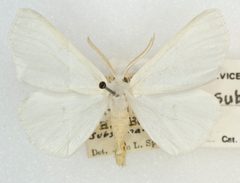
Ennomos subsignaria is a geometrid native to North America, commonly known as the elm spanworm moth. have a wingspan of 35–40 mm and fly from late May to August, with one per year. The is a herbivore whose larvae feed on elm, apple, birch, maple, and oak. Research has documented its clumped intra-tree distribution on mature sycamore maple, with oviposition concentrated on the lower bole and larval development progressing from to branches of the lower crown.

Pronunciation
How to pronounce Ennomos subsignaria: /ˈɛnəˌmoʊs ˌsʌbsɪɡˈnɛəriə/
These audio files are automatically generated. While they are not always 100% accurate, they are a good starting point.
Identification
The can be distinguished from similar spanworm by its specific association with North American broadleaf forests and its documented period from late May to August. Ennomos magnaria (maple spanworm moth) is a related species with similar associations but differs in distribution and . Precise identification requires examination of genitalia or molecular confirmation.
Images
Appearance
have a wingspan of 35–40 mm. The exhibits typical geometrid with relatively broad wings.
Habitat
Mature broadleaf forests and woodlands. Larvae develop on mature deciduous trees including elm, apple, birch, maple, and oak. Research on sycamore maple (Acer pseudoplatanus) demonstrates that larvae exhibit clumped intra-tree distribution, with highest densities in the lower crown on branches where budburst timing synchronizes with hatch.
Distribution
Native to North America from Texas south to Alberta northwest and east to the Atlantic coast. Recorded in Canadian provinces including Alberta, Manitoba, and Saskatchewan, and in Vermont, USA. Infrequently recorded in Great Britain through accidental importation in asparagus.
Seasonality
are on wing from late May to August. One per year. hatch occurs approximately two weeks after peak budburst of trees, with timing synchronized to availability of foliage with three pairs of leaves expanded per bud.
Diet
Larvae feed on leaves of elm (Ulmus), apple (Malus), birch (Betula), maple (Acer), and oak (Quercus). Survival is strongly influenced by : more than 90% of larvae survive to adulthood when feeding on foliage with three pairs of leaves expanded per bud, whereas survival drops by over 45% on younger foliage.
Host Associations
- Ulmus - larval food plantPrimary , reflected in
- Malus - larval food plant
- Betula - larval food plant
- Acer - larval food plantIncludes A. pseudoplatanus (sycamore maple) in European research ; North American maple inferred from distribution
- Quercus - larval food plant
Life Cycle
One per year. are laid on the lower bole of trees. Larvae hatch approximately two weeks after peak host budburst and initially feed on branches of the lower crown. Early instars occur on lower crown proximal branches; late instars and pupae are found on lower crown branches. emerge from late May to August.
Behavior
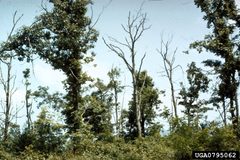
Females exhibit selective oviposition , depositing masses at higher on the lower bole than in the crown. Larvae display intra-tree movement during development, progressing from to branches within the lower crown. This spatial stratification results in high defoliation levels in the lower crown, especially on proximal branches.
Ecological Role
herbivore contributing to defoliation of broadleaf deciduous trees. Intra-tree distribution creates concentrated feeding damage in lower crown regions. The functions as a model for studying phenological synchronization between herbivores and plants, with survival tightly coupled to leaf developmental stage.
Human Relevance
Occasional accidental import to Great Britain via asparagus, where it is recorded infrequently. The is not known to cause significant economic damage to orchards or timber stands despite its larval diet.
Similar Taxa
- Ennomos magnariaSimilar (maple spanworm ) and associations with maple; differs in distribution and , with E. magnaria recorded later in the season in Colorado Front Range
- Ennomos autumnariaCongeneric spanworm with similar ; precise differentiation requires genital dissection or molecular analysis
More Details
Phenological Synchronization
Research on sycamore maple demonstrates that E. subsignaria survival is critically dependent on synchrony between hatch and budburst. Peak egg hatch occurs approximately two weeks after peak budburst, coinciding with optimal foliage development on lower crown branches where most larvae initiate feeding.
Intra-Tree Distribution Pattern
mass is 85% higher on the lower bole than in the crown. This oviposition pattern, combined with acropetal budburst progression, creates a predictable spatial structure in larval distribution that does not appear driven by natural enemy avoidance or variable foliage quality independent of .