
Ennomos alniaria
(Linnaeus, 1758)
Canary-shouldered Thorn
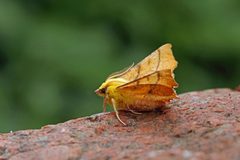
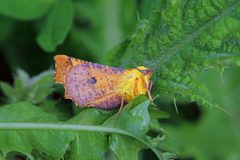
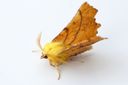
Ennomos alniaria, commonly known as the canary-shouldered thorn, is a in the Geometridae. It is distinguished from related by its bright yellow . The species is widespread across Europe and has been introduced to British Columbia. are active from July to October and are attracted to light.
Pronunciation
How to pronounce Ennomos alniaria: /ˈɛn.nʊ.mɔs ælˈniː.aɹi.a/
These audio files are automatically generated. While they are not always 100% accurate, they are a good starting point.
Identification
The canary-yellow distinguishes this from Ennomos quercinaria and other similar Ennomos species. Forewing scalloping and grey discal spots (small on forewing, larger on hindwing) provide additional diagnostic characters. Larval identification relies on the dead-twig mimicry and four raised cross-bands.
Images
Appearance
have a wingspan of 34–42 mm and forewing length of 16–20 mm. The is bright canary-yellow, a diagnostic feature. Wings are ochre yellow with greyish flecking; forewings are scalloped with two cross lines. Bands and discal spots are grey. The larva is brownish-grey, elongated and slender, with four raised cross-bands on the surface, closely resembling a dead twig.
Habitat
Occurs in diverse containing deciduous trees, including deciduous forests, gardens, and mixed woodlands. Larval development requires presence of trees.
Distribution
Native range extends from the Caucasus and Russia across western Europe, with northern limit at Fennoscandia and southern limit at the northern Mediterranean. Introduced to British Columbia, Canada. GBIF records confirm presence in Belgium and other European countries.
Seasonality
fly in one from July to October in the British Isles; timing may vary across the range. Larvae present during spring and early summer.
Diet
Larvae feed on deciduous trees including downy birch (Betula pubescens), silver birch (Betula pendula), alder (Alnus spp.), and goat willow (Salix caprea). feeding habits not documented.
Host Associations
- Betula pubescens - larval food plantdowny birch
- Betula pendula - larval food plantsilver birch
- Alnus - larval food plantalder
- Salix caprea - larval food plantgoat willow
Life Cycle
(one per year). stage not specified in sources. Larvae develop on trees during growing season; emerge mid-summer through autumn.
Behavior
are and attracted to light. No other documented.
Ecological Role
Larval herbivore on deciduous trees; contributes to nutrient cycling in woodland . Dead-twig mimicry in larvae suggests anti- .
Human Relevance
Subject of citizen science and -watching events. No documented economic or agricultural significance.
Similar Taxa
- Ennomos quercinariaResembles E. alniaria but lacks the diagnostic canary-yellow ; distinguished by thorax coloration
- Other Ennomos speciesGeneral morphological similarity; E. alniaria distinguished by yellow , wing pattern, and larval banding
More Details
Introduction history
Introduced in British Columbia represents a non-native range expansion, though establishment details are not documented in provided sources.
Taxonomic history
First described by Carl Linnaeus in the 10th edition of Systema Naturae (1758), making it one of the earlier described geometrid moths.