
Scrobipalpa
Janse, 1951
Species Guides
6- Scrobipalpa acuminatella(pointed groundling)
- Scrobipalpa artemisiella(thyme moth)
- Scrobipalpa atriplicella(goosefoot groundling moth)
- Scrobipalpa macromaculata
- Scrobipalpa obsoletella(summer groundling)
- Scrobipalpa scutellariaeella
Scrobipalpa is a of small in the Gelechiidae, established by Janse in 1951. The genus contains over 100 described distributed across Africa, Asia, Europe, and introduced in North America and Australasia. Several species are economically significant agricultural pests, particularly of sugar beet, quinoa, tobacco, and eggplant. The genus was historically split with Euscrobipalpa treated as a subgenus or separate genus, but this distinction is no longer recognized as valid.
Pronunciation
How to pronounce Scrobipalpa: /ˌskroʊbɪˈpalpə/
These audio files are automatically generated. While they are not always 100% accurate, they are a good starting point.
Identification
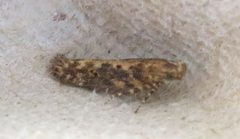
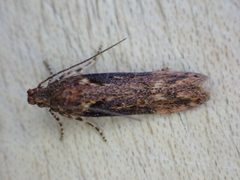
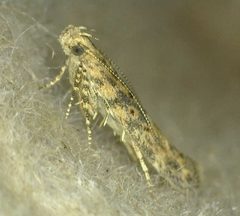
Small gelechiid moths with wingspans typically under 20 mm. identification requires examination of genitalia; male genitalia feature distinctive valvae and structures, while female genitalia normally include a signum (a sclerotized structure in the corpus bursae), though this is absent in some species. often exhibit mottled gray-brown coloration with variable forewing patterns. Larvae are stem- and leaf-miners with cylindrical bodies and reduced .
Images
Distribution
Widespread across the Palearctic, Afrotropical, Oriental, and Australasian regions. Documented from Europe (including Scandinavia, Mediterranean islands, and eastern regions), North Africa, the Middle East, Central Asia (Kazakhstan, Uzbekistan, Turkmenistan), East Asia (China, Mongolia, Korea, Japan), South and Southeast Asia (India, Pakistan, Myanmar, Thailand, Vietnam, Indonesia, Philippines), sub-Saharan Africa (South Africa, Namibia, Kenya, Ethiopia, Tanzania, and other nations), and introduced to North America (Canada, United States) and Oceania (Australia, New Zealand, Pacific islands).
Host Associations
- Beta - herbivoresugar beet and related Chenopodiaceae; primary for S. ocellatella
- Chenopodium quinoa - herbivorequinoa; association in North America for S. atriplicella
- Nicotiana - herbivorecultivated and wild tobacco; for S. heliopa
- Solanum melongena - herbivoreeggplant; for S. heliopa
- Atriplex - herbivoresaltbush; native for S. atriplicella
Behavior
Larvae are internal feeders, mining within stems, leaves, or seed panicles of plants. Feeding damage creates entry points for secondary fungal and bacterial . Some exhibit polyvoltinism with multiple per year under favorable conditions.
Ecological Role
Herbivore and agricultural pest. Larval feeding damage facilitates secondary by rot-causing . Serves as for including Diadegma aegyptiator and D. oranginator (Ichneumonidae).
Human Relevance
Several are significant crop pests. Scrobipalpa ocellatella (beet ) is a major pest of sugar beet in Europe, North Africa, and Asia, causing direct feeding damage and indirect losses through promotion of root rot. Scrobipalpa heliopa damages tobacco and eggplant across tropical and subtropical regions. Scrobipalpa atriplicella, introduced to North America, threatens quinoa production with potential for 100% yield loss. Management requires integrated pest control strategies including using Diadegma .
Similar Taxa
- PhthorimaeaFormerly included some Scrobipalpa ; distinguished by genitalia structure and associations
- GnorimoschemaHistorical synonymy and similar ; separated by genitalia characteristics and larval
- EphysterisSome transferred from Scrobipalpa; differs in genitalia and wing venation
- Schizovalva transferred from Scrobipalpa in recent revisions; distinguished by male genitalia and forewing pattern
- MicrolechiaNew combination for former Scrobipalpa ; differs in genital
Sources and further reading
- BugGuide
- Wikipedia
- GBIF taxonomy match
- iNaturalist taxon
- NCBI Taxonomy
- Catalogue of Life
- Scrobipalpa heliopa . [Distribution map].
- Scrobipalpa ocellatella . [Distribution map].
- The genus Scrobipalpa Janse (Lepidoptera, Gelechiidae) in China, with descriptions of 13 new species
- Beet moth (Scrobipalpa ocellatella [Boyd]): a review of bionomics, distribution, harmfulness, and control strategies
- A review of the genus Scrobipalpa Janse, 1951 (Lepidoptera, Gelechiidae) in the Afrotropical region
- Scrobipalpa atriplicella(Lepidoptera: Gelechiidae), an invasive insect attacking quinoa (Amaranthaceae) in North America
- New record of Diadegma oranginator Aubert as a parasitoid of Scrobipalpa ocellatella Boyd. in Egyptian sugar beet fields.
- Diadegma aegyptiator Shaumer 1966 (Hymenoptera: Ichneumonidae): New Record Parasitoid on the Rib Miner, Scrobipalpa ocellatella Boyd. (Lepidoptera: Gelechiidae) in Egyptian Sugar Beet Fields