
Scrobipalpa atriplicella
(Fischer von Röslerstamm, [1841])
goosefoot groundling moth
Scrobipalpa atriplicella is a small gelechiid native to Eurasia, now established as an introduced in North America. have a wingspan of 10–14 mm and exhibit two per year. The species has emerged as a significant agricultural pest on quinoa (Chenopodium quinoa) in both Europe and North America, where larval feeding on seeds and foliage can cause complete crop loss. Originally associated with wild Chenopodiaceae including Chenopodium album and Atriplex species, its range has expanded to include cultivated crops.

Pronunciation
How to pronounce Scrobipalpa atriplicella: //ˌskroʊbɪˈpælpə əˌtrɪplɪˈsɛlə//
These audio files are automatically generated. While they are not always 100% accurate, they are a good starting point.
Identification
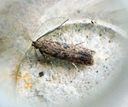
Distinguished from similar Scrobipalpa by forewing pattern: dark fuscous ground color with pale ochreous longitudinal streaking, ill-defined blackish stigmata with first discal beyond plical, and characteristic dark spot on at one-quarter. The faint pale fascia at three-quarters with associated blackish spots in the angle is also diagnostic. Larvae are recognized by greenish-yellow to green coloration with rosy line. can confirm identification where morphological examination is uncertain. In North America, it is the primary gelechiid pest associated with quinoa and Chenopodium crops.
Images
Appearance
Small with wingspan 10–14 mm. Forewings dark fuscous with whitish speckling, mixed or streaked longitudinally with pale ochreous; area lighter. Dark spot on at one-quarter; stigmata blackish and ill-defined, with first discal stigma positioned slightly beyond plical. Indistinct blackish spots on fold before and beyond plical, and in angle of faint pale fascia at three-quarters. Hindwings single (not divided), light grey with darker terminal area. Terminal joint of labial palpi as long as second joint. Larva greenish-yellow to green with rosy-suffused dorsal line and yellowish .
Habitat
Agricultural fields, arable land, and disturbed containing Chenopodiaceae plants. In native range, occurs in coastal and inland areas where Atriplex and Chenopodium grow. In North America and Europe, strongly associated with cultivated quinoa fields and beet crops, as well as weedy areas containing Chenopodium album. Laboratory rearing successful at 22°C day/12°C night with long-day (L:D 20:4).
Distribution
Native to Eurasia: Europe from British Isles and Scandinavia south to Mediterranean, east through Asia to Kamchatka and Japan. Introduced and established in North America: recorded from Ohio, USA; Prairie region of western Canada (Manitoba, Saskatchewan, Alberta); and Mexico. In Europe, expanding range to follow quinoa .
Seasonality
. active in two periods: first from May through June, peaking in May; second generation from July through August, peaking in August. Larvae present in June and from September to October. as pupae requires cold period (approximately 7°C) before adult ; laboratory rearing produces adult emergence in mid-January following simulated winter conditions.
Diet
Larvae feed on Chenopodiaceae: Chenopodium quinoa (quinoa), C. album, C. ficifolium, C. hybridum, C. murale, C. nuttalliae (huauzontle in Mexico); Atriplex laciniata, A. patula, A. prostrata, A. tatarica, A. longipes praecox, A. littoralis; Beta vulgaris (beet); and Halimione portulacoides. Young larvae are leaf miners; older larvae feed externally and construct silken galleries between leaves, flowers, and seeds in inflorescences.
Host Associations
- Chenopodium quinoa - primary (agricultural)Cultivated quinoa; introduced in Europe and North America; can suffer 100% yield loss from larval feeding on seeds
- Chenopodium album - native Common lambsquarters; widespread weed facilitating persistence near crops
- Chenopodium ficifolium - native Fig-leaved goosefoot
- Atriplex prostrata - native Spear-leaved orache; coastal and inland
- Beta vulgaris - agricultural Beet; established pest on this crop in native range
Life Cycle
with winter . laid on plants; larvae hatch and initially mine leaves, later feeding externally and constructing silken galleries. Larvae feed on foliage, stems, and seeds. occurs in soil or plant debris; pupae enter diapause requiring cold period (winter conditions, approximately 7°C with short-day L:D 8:16) to break dormancy. emerge after return to warmer conditions (22°C/12°C). Two complete per year in temperate climates.
Behavior
Larvae construct silken galleries by spinning together young leaves, flowers, and seeds, feeding within these protected structures. In quinoa, larvae feed directly on developing seeds within panicles, causing economic damage. Heavy can destroy all seeds in an inflorescence. No significant difference in damage severity observed across different quinoa breeding lines. are and attracted to light.
Ecological Role
Herbivore and agricultural pest. Native Eurasian herbivore that has expanded range to include introduced crop , particularly quinoa. Potential to become established pest on quinoa in northern Europe and North America due to close phylogenetic relationship between C. quinoa and native host C. album. Serves as example of native herbivore adapting to novel crop introduction. similarity to major Andean quinoa pests (Eurysacca species) suggests significant pest potential in new cultivation areas.
Human Relevance
Emerging pest of quinoa in Europe and North America. First recorded causing serious on cultivated quinoa in Denmark in 2006; subsequently identified as pest in western Canada with potential for up to 100% yield loss. Also known pest on beet (Beta vulgaris) in native range. Requires monitoring and potential management to maintain sustainable quinoa production. used for identification in pest detection programs.
Similar Taxa
- Eurysacca melanocamptaAndean quinoa pest with similar larval feeding on quinoa seeds; differs in native range (South America) and
- Scrobipalpa costella with similar associations on Chenopodiaceae; distinguished by forewing pattern details and genitalia
- Cassida nebulosaTortoise beetle also recorded as new herbivore on quinoa in northern Europe; differs in order (Coleoptera), feeding damage type, and
More Details
Invasion History
First recorded in North America from Ohio; established in western Canadian Prairies by 2017. Represents range expansion from native Chenopodium album to cultivated C. quinoa, facilitated by close phylogenetic relationship and physical resemblance between host .
Laboratory Rearing
Successfully reared under controlled conditions: 22°C day/12°C night with long-day (L:D 20:4) for development, 7°C with short-day photoperiod (L:D 8:16) for , returning to 22°C/12°C for . At least 100 adults emerged from rearing boxes in laboratory studies.
Pest Status Assessment
Authors of 2008 study noted biological and similarities to major Andean quinoa pests (Eurysacca ), suggesting significant pest potential for European quinoa . By 2017, confirmed as causing up to 100% yield loss in Canadian quinoa fields.
Sources and further reading
- BugGuide
- Wikipedia
- GBIF taxonomy match
- iNaturalist taxon
- NCBI Taxonomy
- Catalogue of Life
- Scrobipalpa atriplicella(Lepidoptera: Gelechiidae), an invasive insect attacking quinoa (Amaranthaceae) in North America
- Quinoa,Chenopodium quinoa, Provides a New Host for Native Herbivores in Northern Europe: Case Studies of the Moth,Scrobipalpa atriplicella, and the Tortoise Beetle,Cassida nebulosa