
Scrobipalpa artemisiella
(Treitschke, 1833)
thyme moth
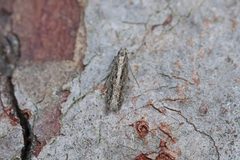
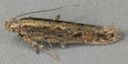
Scrobipalpa artemisiella, commonly known as the thyme , is a small gelechiid moth with a wingspan of 10–12 mm. The is widely distributed across Europe, Asia, and has unconfirmed records from North America. are active in summer, and larvae are specialized feeders on thyme and related aromatic herbs.
Pronunciation
How to pronounce Scrobipalpa artemisiella: /skroʊbɪˈpælpə ɑrtɛmɪziˈɛlə/
These audio files are automatically generated. While they are not always 100% accurate, they are a good starting point.
Identification
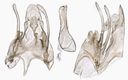
The combination of small size (10–12 mm wingspan), dark brown forewings with whitish speckling and ferruginous longitudinal streaking, elongate black stigmata with first discal beyond plical, and black fold mark distinguishes this from most similar Scrobipalpa . Palpal proportions and specific wing pattern elements require comparison with .
Images
Habitat
Associated with dry, rocky, or calcareous grasslands and heathlands where plants (thyme ) occur. include Mediterranean scrub, alpine meadows, and temperate grasslands.
Distribution
Europe (absent from Portugal and Norway), Turkey, Syria, Caucasus, Central Asia to Irkutsk and Mongolia. North American records require confirmation. oreocyrniella restricted to Sardinia and Corsica.
Seasonality
on wing June to July. Larval stage timing not specified in sources.
Diet
Larvae feed on Thymus praecox arcticus, Thymus pulegioides, Thymus serpyllum, and Satureja montana. feeding habits not documented.
Host Associations
- Thymus praecox arcticus - larval foodplantarctic thyme
- Thymus pulegioides - larval foodplantlarge thyme
- Thymus serpyllum - larval foodplantwild thyme
- Satureja montana - larval foodplantwinter savory
Ecological Role
Larval herbivore on aromatic Lamiaceae; specific functions not documented.
Human Relevance
Minor potential interest as a subject of lepidopterological study; no documented economic or agricultural significance.
Similar Taxa
- Other Scrobipalpa speciesMany share small size and brown coloration; precise wing pattern details (stigma position, fold markings, palpal proportions) required for separation.
More Details
Subspecies
Two recognized: nominotypical S. a. artemisiella and S. a. oreocyrniella Petry, 1904 (Sardinia, Corsica).