
Ethmia semitenebrella
Dyar, 1902
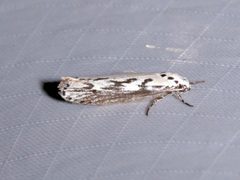
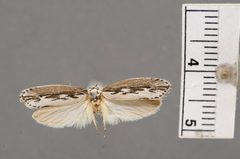
Ethmia semitenebrella is a in the Depressariidae, first described by Dyar in 1902. It is distributed across the southwestern United States and northern Mexico, with a period from April to August. The is characterized by distinct wing patterning with dark gray forewing costal halves contrasting with whitish gray halves. Larvae feed on Cercocarpus ledifolius and likely other Cercocarpus species.
Pronunciation
How to pronounce Ethmia semitenebrella: /ˈɛθ.mi.ə ˌsɛm.i.tɛ.nəˈbrɛl.lə/
These audio files are automatically generated. While they are not always 100% accurate, they are a good starting point.
Identification
Distinguished from other Ethmia by the combination of: forewing with dark gray costal half and whitish gray half; longitudinal whitish streaks on costal half more pronounced beyond the middle of the wing; hindwings pale basally with brownish half. Similar species in the require examination of genitalia for definitive separation.
Images
Habitat
Associated with supporting plant Cercocarpus ledifolius, typically dry, rocky slopes and woodlands in montane and foothill regions.
Distribution
North America: Colorado, Utah, New Mexico, Arizona, southern and eastern California (USA); Nuevo León (Mexico).
Seasonality
active April to August; two per year ().
Diet
Larvae feed on Cercocarpus ledifolius (curl-leaf mountain mahogany, Rosaceae); probably also other Cercocarpus .
Host Associations
- Cercocarpus ledifolius - larval food plantprimary
- Cercocarpus - larval food plantprobable additional
Life Cycle
with two annually. Complete : , larva, pupa, . Larval stage feeds on plant foliage.
Behavior
are attracted to light. Larval feeding occurs on plant foliage.
Ecological Role
Herbivore; larval stage contributes to nutrient cycling through consumption of Cercocarpus foliage.
Human Relevance
No significant economic or medical importance recorded. Occasionally encountered by lepidopterists and naturalists.
Similar Taxa
- Ethmia discostrigellaSimilar size and general appearance; distinguished by forewing pattern details and geographic distribution (discostrigella occurs in oak woodlands and foothills, associated with Mountain Mahogany in Boraginaceae)
- Other Ethmia speciesMany in share black, white, and gray coloration; definitive identification often requires genitalia dissection
More Details
Taxonomic history
The Ethmia was formerly placed in Coleophoridae, but is now classified in Depressariidae ( Ethmiinae) based on molecular and morphological studies.
Genus characteristics
Ethmia are relatively large for microlepidoptera (10–15 mm forewing length), with larvae feeding predominantly on plants in Boraginaceae, Ehretiaceae, and Hydrophyllaceae. Approximately 50 species occur north of Mexico, with highest diversity in the southwestern United States.
Sources and further reading
- BugGuide
- Wikipedia
- GBIF taxonomy match
- iNaturalist taxon
- NCBI Taxonomy
- Catalogue of Life
- What's in a Name? Leslie Saul-Gershenz and Norm Gershenz | Bug Squad
- Bug Eric: My Personal National Moth Week, 2017
- Bug Eric: September 2017
- Bug Eric: New Mexico Night Bugs
- Nota Lepidopterologica goes advanced open access with Pensoft Publishers | Blog
- Uncategorized | Blog - Part 22