
Ethmia discostrigella
(Chambers, 1877)
mountain-mahogany moth
Ethmia discostrigella, commonly known as the mountain-mahogany , is a small moth in the Depressariidae. It occurs across western North America from the western United States south into Mexico. The exhibits notable geographic variation, with two recognized occupying distinct ranges separated by the Sierra Nevada: the nominate subspecies east of the Sierra Nevada and subspecies subcaerulea west of the range. Larvae feed on Cercocarpus species (mountain-mahogany), making this a - moth with clear ecological ties to its namesake plant.
Pronunciation
How to pronounce Ethmia discostrigella: /ˈɛθ.mi.ə ˌdaɪ.skəˌstrɪˈdʒɛl.lə/
These audio files are automatically generated. While they are not always 100% accurate, they are a good starting point.
Identification
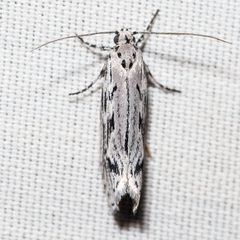
Small size (forewings 10–15 mm), dark gray forewings with scattered whitish speckling, and pale gray hindwings with whitish ocherous anal area distinguish this . Separation from other Ethmia species requires examination of genitalic characters; most North American Ethmia species are externally similar and identification to species level typically requires dissection. The Ethmia itself is recognizable by the combination of relatively large size for microlepidoptera, subdued black-gray-white coloration, and association with Boraginaceae and related plant .
Images
Appearance
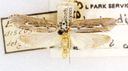
Forewing length 10.4–14.7 mm. Forewings dark gray with scattered whitish creating a speckled appearance. Hindwings pale gray, becoming whitish ocherous toward the anal area. Overall coloration subdued in black, white, and gray tones typical of the Ethmia.
Habitat
Associated with supporting Cercocarpus (mountain-mahogany), a woody shrub. The nominate occupies Great Basin sagebrush and pinyon-juniper woodlands east of the Sierra Nevada. Subspecies subcaerulea occurs in cismontane California chaparral, oak woodlands, and coastal scrub west of the Sierra Nevada and in Coast Ranges.
Distribution
Western United States and Mexico. Nominate (E. d. discostrigella): eastern Oregon and California east of Sierra Nevada, southwestern Idaho, Nevada, Utah, Colorado, eastern New Mexico, western Texas, south to Chihuahua and Nuevo León (Mexico). Subspecies subcaerulea: cismontane California, west slope of Sierra Nevada, Coast Ranges, southern California, and Baja California (Mexico).
Seasonality
active April–September (nominate ) and March–September (subcaerulea). Multiple per year in southern portions of range.
Diet
Larvae feed on Cercocarpus ledifolius (curlleaf mountain-mahogany) and probably other Cercocarpus for the nominate ; larvae of subspecies subcaerulea feed on Cercocarpus betuloides (birchleaf mountain-mahogany) and Cercocarpus minutiflorus. likely do not feed or feed on nectar; specific adult diet unrecorded.
Host Associations
- Cercocarpus ledifolius - larval food plantprimary for nominate
- Cercocarpus betuloides - larval food plant for subcaerulea
- Cercocarpus minutiflorus - larval food plant for subcaerulea
Life Cycle
Complete with , larva, pupa, and stages. Larvae feed internally or on foliage of shrubs. Multiple per year in southern range; presumably single or partial second generation in northern areas. stage not explicitly documented but likely as larva or pupa.
Behavior
attracted to light. Larval feeding concealed; specific unrecorded.
Ecological Role
Herbivore specializing on Cercocarpus shrubs. Role in dynamics poorly documented but likely contributes to nutrient cycling and serves as prey for and .
Human Relevance
No direct economic importance. Subject of ecological and taxonomic study. Light-trapping by enthusiasts and researchers provides most human encounters.
Similar Taxa
- Other Ethmia speciesApproximately 50+ occur in North America, most externally similar in size and coloration; reliable identification requires genitalic examination
- Depressariidae micro-mothsGeneral resemblance in size and form; Ethmia distinguished by association and characteristic wing pattern
- Coleophoridae (case-bearer moths)Formerly classified in this ; now separated by molecular and morphological data, but historical confusion possible
Sources and further reading
- BugGuide
- Wikipedia
- GBIF taxonomy match
- iNaturalist taxon
- NCBI Taxonomy
- Catalogue of Life
- What's in a Name? Leslie Saul-Gershenz and Norm Gershenz | Bug Squad
- Bug Eric: My Personal National Moth Week, 2017
- Bug Eric: September 2017
- Bug Eric: New Mexico Night Bugs
- Nota Lepidopterologica goes advanced open access with Pensoft Publishers | Blog
- Uncategorized | Blog - Part 22