
Eriocampa
Hartig, 1837
woolly sawflies
Species Guides
2- Eriocampa juglandis(Butternut Woollyworm)
- Eriocampa ovata(alder sawfly)
Eriocampa is a small Holarctic of in the Tenthredinidae comprising approximately five to ten described extant . The genus is characterized by larvae that produce conspicuous white waxy secretions, giving them a woolly appearance that likely serves as a defense against and . Several species are economically significant as defoliators of woody plants, including Eriocampa juglandis (butternut woollyworm) on walnut and hickory, and Eriocampa ovata (woolly alder sawfly) on alder. The genus has a debated taxonomic history, with various classifications placing it in different within Tenthredinidae.
Pronunciation
How to pronounce Eriocampa: //ˌɛɹi.oʊˈkæmpə//
These audio files are automatically generated. While they are not always 100% accurate, they are a good starting point.
Identification
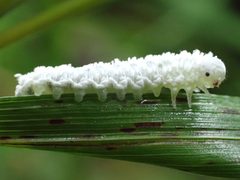
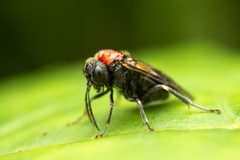
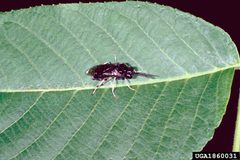
Eriocampa larvae are distinguished from caterpillars (Lepidoptera larvae) by possessing six or more pairs of fleshy on abdominal segments, compared to five or fewer pairs in caterpillars. Larvae are further characterized by dense white waxy filaments secreted from epidermal glands, creating a woolly or flocculent appearance. Eriocampa ovata larvae specifically display a brown spot on the 's vertex. are typical with a saw-like ovipositor used to insert into leaf midveins. The is distinguished from related sawfly genera by a combination of morphological features and Holarctic distribution pattern.
Images
Habitat
Associated with deciduous woody plants in temperate regions; specific vary by . Eriocampa ovata occurs on alder (Alnus spp.) in riparian and wetland edges, recently detected in urban forestry settings on ornamental Alnus hirsuta 'Harbin'. Eriocampa juglandis inhabits forests and landscapes with walnut (Juglans nigra, J. cinerea) and hickory (Carya spp.).
Distribution
Holarctic distribution, with main occurrence in eastern Asia. Documented from Europe (including Switzerland, Scandinavia), North America (including Vermont, Manitoba), and Asia. Eriocampa ovata is introduced to North America and has been recorded in Manitoba, Canada.
Seasonality
emerge in spring (May through July for Eriocampa juglandis). Larval development occurs through summer, with timing varying by and latitude. Larval stage length decreases as summer progresses in laboratory-reared individuals. occurs in some individuals, more common in low humidity conditions.
Diet
Larval stages are folivorous, feeding on leaves of plants. Eriocampa juglandis larvae consume leaves of black walnut, butternut, and hickory. Eriocampa ovata larvae feed on alder leaves. Total leaf consumption per individual varies with rearing , being greatest in groups of 10 larvae per leaf.
Host Associations
- Alnus hirsuta 'Harbin' - Prairie Horizon™ Manchurian alder; first published record for Eriocampa ovata in Manitoba, Canada
- Alnus spp. - alders; primary for Eriocampa ovata
- Juglans nigra - black walnut; for Eriocampa juglandis
- Juglans cinerea - butternut; for Eriocampa juglandis
- Carya spp. - hickories; reported for Eriocampa juglandis
- Cornus racemosa - grey dogwood; for Macremphytus tarsatus (dogwood sawfly), related discussed in same context as Eriocampa
- Cornus amomum - silky dogwood; for dogwood sawfly
- Cornus florida - flowering dogwood; for dogwood sawfly
Life Cycle
Larvae progress through 6-7 instars. Individuals with 7 instars or those entering have longer larval stages than those with 6 instars or diapause-free individuals. Eriocampa juglandis overwinters as a pupa in soil enclosed in a durable case, with emerging in spring. Eriocampa ovata and related may overwinter as larvae in chambers constructed in rotting wood or structural wood. As summer progresses, larval stage length decreases while cocoon stage length increases in laboratory-reared individuals.
Behavior
Larvae are gregarious leaf-feeders. The white waxy secretion may serve multiple functions: mimicry of bird droppings in early instars to reduce , and physical barrier against and in later instars. Wax is shed during molting and may remain attached to leaves, potentially deceiving predators. occurs in soil or wood depending on .
Ecological Role
Herbivore and defoliator of deciduous trees and shrubs. Acts as pest in urban forestry and ornamental plantings, causing visible defoliation of trees. Serves as prey for and , though waxy secretions may provide partial protection.
Human Relevance
Eriocampa juglandis (butternut woollyworm) and Eriocampa ovata (woolly alder ) are recognized as pests of ornamental and forest trees. Defoliation can be conspicuous and concerning to homeowners and arborists. The 2024 detection of E. ovata in Manitoba on a novel (Alnus hirsuta 'Harbin') highlights potential biosecurity concerns for urban forestry. No direct medical or agricultural significance beyond plant damage.
Similar Taxa
- Macremphytus tarsatusDogwood sawfly; also a tenthredinid with waxy larval secretions and similar , but associated with Cornus (dogwood) rather than Juglans or Alnus
- Caliroa cerasiPear slug ; another tenthredinid with slug-like larvae, but lacks dense woolly wax and has different associations (Rosaceae)
- Lepidoptera larvae (caterpillars)Superficially similar larval , but distinguished by 5 or fewer pairs of versus 6 or more in Eriocampa, and lack of waxy secretions in most
Sources and further reading
- BugGuide
- Wikipedia
- GBIF taxonomy match
- iNaturalist taxon
- NCBI Taxonomy
- Catalogue of Life
- What lies beneath the wax? A duo of leaf-eating sawflies: Dogwood sawfly, Macremphytus tarsatus, and Butternut woollyworm, Eriocampa juglandis — Bug of the Week
- Archive — Bug of the Week
- NOTES ON THE LIFE HISTORY AND HABITS OF THE RED-BACKED SAWFLY, ERIOCAMPA OVATA (HYMENOPTERA: TENTHREDINIDAE)
- First detection of the woolly alder sawfly, Eriocampa ovata (Hymenoptera: Tenthredinidae), in Manitoba, Canada, on novel host Alnus hirsuta ‘Harbin’ (Betulaceae)
- The complete mitochondrial genome of Eriocampa ovata Linné, 1760 (Hymenoptera: Tenthredinidae) and phylogenetic analysis.