
Eriocampa ovata
(Linnaeus, 1760)
alder sawfly, woolly alder sawfly
Eriocampa ovata is a in the Tenthredinidae, native to Europe and introduced to North America. Females reproduce primarily by ; males are unknown in North America and rare in Europe. The is notable for its distinctive woolly larvae that feed on alder leaves.
Pronunciation
How to pronounce Eriocampa ovata: /ˌɛrioʊˈkæmpə ˈoʊvətə/
These audio files are automatically generated. While they are not always 100% accurate, they are a good starting point.
Identification
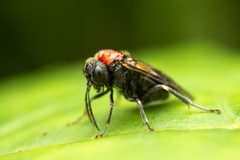
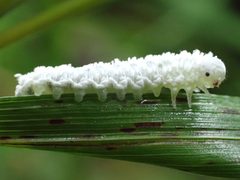
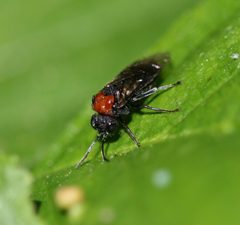
females distinguished by black body with red thoracic segments and specific pale markings on , tibia, and . Larvae identified by white woolly appearance, brown spot, and six or more pairs of . Distinguished from caterpillars by proleg count; from other larvae by woolly secretion and association with alder.
Images
Habitat
Associated with alder trees (Alnus spp.) in riparian zones, wetlands, and urban forestry settings. Larvae feed on foliage; occurs in leaf litter on ground.
Distribution
Native to Europe; introduced to North America. Recorded from Atlantic coast (New York, Massachusetts, Quebec, Ontario) and Pacific coast (Washington, British Columbia, Alaska). First published record in Manitoba, Canada in 2024.
Seasonality
In Quebec, two per year; in England, one generation per year. emerge in spring and summer; larvae present during growing season. Pupae overwinter in leaf litter.
Diet
Larvae feed on leaves of common alder (Alnus glutinosa), grey alder (Alnus incana), and Manchurian alder (Alnus hirsuta 'Harbin'). In Europe, also recorded on elm (Ulmus) and hazel (Corylus).
Host Associations
- Alnus glutinosa - larval common alder
- Alnus incana - larval grey alder
- Alnus hirsuta 'Harbin' - larval Prairie Horizon™ Manchurian alder; first published record 2024
- Ulmus - larval Europe only
- Corylus - larval Europe only
Life Cycle
Females insert ovipositor into upper leaf surface near midrib to deposit . Larvae feed first on upper leaf surface, later transfer to underside. Variable number of instars: 6 or 7; individuals with 7 instars have longer larval stages. Those destined to also have longer larval stages. Diapause more frequent in low humidity. As summer progresses, larval stage duration decreases while cocoon stage duration increases. Fully developed larvae drop to ground and construct cocoon in leaf litter to pupate and overwinter.
Behavior
Females reproduce by ; males absent in North America, rare in Europe. laid in young foliage near base of tree; upper crown usually unaffected. Larval feeding affects individual consumption: greatest leaf consumption per individual occurs at intermediate density (10 larvae per leaf).
Ecological Role
Folivore on alder. Can cause defoliation, sometimes skeletonizing leaves with only remaining. Heavy may reduce tree growth; stressed trees may become more susceptible to alder canker.
Human Relevance
Minor pest of ornamental alder trees in urban forestry. Defoliation can affect aesthetic value and tree health. Detection on newly popular ornamental cultivar (Alnus hirsuta 'Harbin') highlights potential biosecurity considerations for introduced plant material.
Similar Taxa
- Eriocampa juglandisBoth produce woolly larvae with waxy secretions, but E. juglandis feeds on walnut (Juglans) and butternut, not alder; larvae overwinter in soil as pupae rather than in leaf litter.
- Macremphytus tarsatusBoth are Tenthredinidae with waxy larval secretions, but M. tarsatus feeds on dogwood (Cornus) and has different larval coloration (yellow, white, and black when mature, not uniformly white).
- Lepidoptera caterpillarsSimilar body form, but larvae have six or more pairs of versus five or fewer in caterpillars; sawfly larvae lack (hooked spines) on prolegs present in Lepidoptera.
Sources and further reading
- BugGuide
- Wikipedia
- GBIF taxonomy match
- iNaturalist taxon
- NCBI Taxonomy
- Is Jade Lucky? Well, Bumble Bees Like It! | Bug Squad
- What lies beneath the wax? A duo of leaf-eating sawflies: Dogwood sawfly, Macremphytus tarsatus, and Butternut woollyworm, Eriocampa juglandis — Bug of the Week
- Bug Eric: Candystripe Spider
- Two new species of wart sea slugs discovered from Indonesia
- Flatfaced longhorn: Leptostylus transversus | Beetles In The Bush
- These are a few of my favorite trees | Beetles In The Bush
- NOTES ON THE LIFE HISTORY AND HABITS OF THE RED-BACKED SAWFLY, ERIOCAMPA OVATA (HYMENOPTERA: TENTHREDINIDAE)
- First detection of the woolly alder sawfly, Eriocampa ovata (Hymenoptera: Tenthredinidae), in Manitoba, Canada, on novel host Alnus hirsuta ‘Harbin’ (Betulaceae)
- The complete mitochondrial genome of Eriocampa ovata Linné, 1760 (Hymenoptera: Tenthredinidae) and phylogenetic analysis.