
Eriocampa juglandis
Butternut Woollyworm, Butternut Woollyworm Sawfly, Butternut Wooly Worm
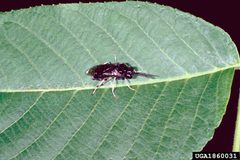
Eriocampa juglandis, commonly known as the butternut woollyworm, is a in the Tenthredinidae. The larvae feed on leaves of butternut, black walnut, and hickory trees, and are notable for their distinctive white, woolly wax coating. Unlike true caterpillars, sawfly larvae possess six or more pairs of on their abdominal segments. The has one per year, with larvae active in mid-summer and occurring in soil over winter.

Pronunciation
How to pronounce Eriocampa juglandis: /ˌɛri.oʊˈkæmpə dʒʌˈɡlændɪs/
These audio files are automatically generated. While they are not always 100% accurate, they are a good starting point.
Identification
are distinguished from other by association with walnut and the characteristic saw-toothed ovipositor that gives Tenthredinidae its . Larvae are distinguished from caterpillars (Lepidoptera larvae) by having six or more pairs of fleshy on abdominal segments rather than five or fewer; they also lack the (hooked spines) found on caterpillar prolegs. The white woolly covering separates them from other sawfly larvae on walnut. The combination of host plant (butternut, black walnut, or hickory) and larval appearance confirms identification.
Images
Habitat
Associated with deciduous forests and wooded areas containing trees in the walnut (Juglandaceae). Larvae feed on foliage of butternut, black walnut, and hickory. are found in and surrounding areas of host trees. occurs in soil beneath or near host trees.
Distribution
Northeastern quadrant of North America, following the historical range of butternut (Juglans cinerea). Documented from Maryland, Michigan, North Carolina, Wisconsin, and eastern Canadian provinces including New Brunswick, Ontario, and Quebec. fluctuate drastically year to year.
Seasonality
emerge in spring to mate and oviposit. Larvae appear in mid-summer, with activity peaking during this period. occurs in soil throughout winter, with adults emerging the following spring. One per year.
Diet
Larvae feed on leaves of butternut (Juglans cinerea), black walnut (Juglans nigra), and hickory (Carya spp.). Young larvae chew random holes in leaves; larger larvae may consume entire leaflets, leaving only larger . do not feed.
Host Associations
- Juglans cinerea - larval food plantButternut, primary
- Juglans nigra - larval food plantBlack walnut
- Carya spp. - larval food plantHickory
Life Cycle
Females use saw-like ovipositor to insert singly into leaf mid-ribs, 20-30 eggs per leaflet, causing leaflets to droop or fold and mid-rib to pale. Eggs hatch into naked larvae that soon develop white wax coating. Larvae feed and develop through summer, molting and shedding wax coats which may remain attached to leaves. Fully grown larvae descend to soil and pupate in durable cases, as pupae. emerge in spring, mate, and cycle repeats. One annually.
Behavior
Larvae curl when disturbed, a common defensive . The white woolly wax coating is believed to function as or deterrence, possibly by mimicking bird droppings when young or by creating a physical barrier. Wax filaments may break off and remain on vegetation, potentially confusing predators. fly to locate mates and trees for oviposition.
Ecological Role
Herbivore that causes temporary cosmetic defoliation of trees. Damage is generally limited because occurs after trees are fully leafed out, and only one occurs annually. Trees typically recover without long-term harm. Serves as prey for and , though wax coating provides defense. Contributes to nutrient cycling through leaf consumption and larval-pupal transition in soil.
Human Relevance
Considered a minor pest of walnut and butternut trees. Damage is primarily cosmetic and temporary; pest control is generally not needed. May cause concern to homeowners and orchard managers when are high, but economic impact is limited. Can be distinguished from more serious walnut pests such as the walnut twig beetle (Pityophthorus juglandis), which causes thousand cankers .
Similar Taxa
- Macremphytus tarsatusDogwood sawfly larva also covered in white wax and resembles butternut woollyworm; distinguished by plant (dogwoods, Cornus spp.) rather than walnut , and by as larva in wood rather than pupa in soil
- Lepidoptera larvae (caterpillars)Many caterpillars feed on walnut and have similar body form; distinguished by having five or fewer pairs of abdominal with , versus six or more pairs without crochets in
- Pityophthorus juglandisWalnut twig beetle is a serious pest of walnut causing thousand cankers ; much smaller (~1.5 mm), bark-feeding , not a foliage-feeder, with entirely different appearance and
More Details
Proleg distinction
The difference in number between larvae (6+ pairs) and caterpillars (≤5 pairs) is a key diagnostic feature for separating these superficially similar herbivores.
Wax function hypotheses
The white wax coating has been hypothesized to mimic bird droppings in young larvae, or to physically deter and from attacking older larvae.
Population variability
can vary drastically from year to year, with some years showing heavy larval presence and other years with minimal activity.
Sources and further reading
- BugGuide
- Wikipedia
- GBIF taxonomy match
- iNaturalist taxon
- NCBI Taxonomy
- Walnut Twig Beetle: How a 'Failed' Research Project Led to Success | Bug Squad
- UC Davis Students Carry on Legacy of Walnut Twig Beetle Expert Steve Seybold | Bug Squad
- Jackson Audley: A Case Study with the Walnut Twig Beetle | Bug Squad
- Jackson Audley: Targeting the Walnut Twig Beetle | Bug Squad
- UC Davis Entomology/Nematology Seminars: What a Wealth of Information | Bug Squad
- What lies beneath the wax? A duo of leaf-eating sawflies: Dogwood sawfly, Macremphytus tarsatus, and Butternut woollyworm, Eriocampa juglandis — Bug of the Week