
Caliroa cerasi
(Linnaeus, 1758)
pear slug, cherry slug, cherry slimy sawfly
Caliroa cerasi, commonly known as the pear slug or cherry slug, is a (Hymenoptera: Tenthredinidae) whose larvae are significant pests of stone and pome fruit trees. The exhibits a complex with and , and can shift between deuterotokous (producing both sexes) and thelytokous (female-only) during cycles. Native to Europe, it has spread to multiple continents including North America, Asia, and Australasia. While capable of causing serious defoliation, it is generally considered a secondary pest in intensive orchards due to susceptibility to .

Pronunciation
How to pronounce Caliroa cerasi: //kəˈlaɪ.rə ˈsɛr.ə.si//
These audio files are automatically generated. While they are not always 100% accurate, they are a good starting point.
Identification
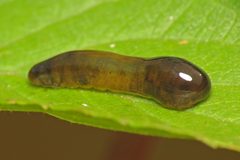
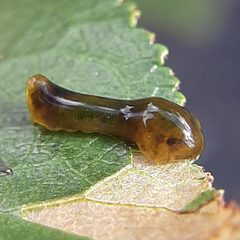
Larvae are readily identified by their slug-like form, greenish slime coating, and characteristic skeletonizing feeding damage on upper leaf surfaces. The combination of legless, broad, flattened body shape and slime distinguishes them from true slugs and from other larvae. require identification; they resemble small black but lack the narrow petiole of Vespidae. When disturbed, larvae exude greenish fluid from the mouth and may drop from leaves on silken threads.
Images
Habitat
Occurs in orchards, gardens, and natural areas with plants. Larvae feed on the foliage of cherry, pear, plum, and related Rosaceae. In situations, concentrate on lower, wind-protected portions of tree crowns. The shows strong site fidelity, with individual trees in a experiencing highly variable infestation levels.
Distribution
Native to Europe, with established across continental Europe, the British Isles, and Scandinavia. Introduced and established in North America (Canada, United States), Asia (Japan, Turkey, Israel, Lebanon, Syria, Iran), North Africa (Algeria, Morocco), South Africa, Australasia (Australia, New Zealand, Tasmania), and South America (Argentina, Chile, Colombia, Uruguay).
Seasonality
In Central Europe, typically with two main and a partial intermediate generation. First generation larvae appear in early summer (May-June), second generation in late summer (July-August). The intermediate generation emerges between these peaks. Exact timing varies with local climate and conditions. are active during spring and summer months.
Diet
Larvae feed on leaves of Rosaceae, primarily cherry (Prunus spp., including sour cherry), pear (Pyrus spp.), and plum (Prunus domestica). Also recorded on Cotoneaster and Chaenomeles . Larvae skeletonize upper leaf surfaces, consuming mesophyll while leaving intact.
Host Associations
- Prunus avium (sweet cherry) - primary Principal in Europe; damage often occurs post-harvest
- Prunus cerasus (sour cherry) - primary
- Pyrus spp. (pear) - primary Significant pest in organic and reduced-spray orchards
- Prunus domestica (plum) -
- Cotoneaster spp. - new record
- Chaenomeles spp. - new record
Life Cycle
are inserted into leaf tissue. Larvae pass through six instars, feeding gregariously on leaf upper surfaces. Mature larvae drop to the soil and form cocoons. The exhibits complex voltinism: primarily in Central Europe, with a partial intermediate . and temperature regulate induction; short day lengths induce diapause in the eonymph stage, which overwinters in soil. High temperatures do not prevent diapause induction under short-day conditions. can shift between deuterotokous and , with male proportion declining during cycles from approximately 27% to 0%.
Behavior
Larvae feed gregariously on upper leaf surfaces. When disturbed, they exude greenish defensive fluid from the mouth and may lower themselves on silken threads to escape. show strong site fidelity, contributing to patchy distribution of within orchards. Larval feeding is concentrated on the lower, wind-protected crown areas of trees.
Ecological Role
Herbivore and occasional pest of fruit trees. Serves as for diverse including ichneumonid wasps (Perilissus luteolator, Rhinotorus congruens, Eridolius rufonotatus) and chalcidoid wasps (Cleptes nitidulus, Aptesis spp.). High rates (up to 90% in some ) indicate substantial support for natural enemy . are regulated primarily by larval and cocoon parasitism rather than by climatic factors.
Human Relevance
Agricultural pest of cherry, pear, and plum. Damage is typically secondary in importance in intensive orchards due to high susceptibility to applied for other pests (e.g., cherry fruit fly). Serious occur irregularly, primarily in neglected orchards or nurseries where direct control may be required. Damage to cherry often occurs after harvest, reducing economic impact. agents and neem-based insecticides have been investigated for management. The has been used as a model for studying type shifts and regulation.
Similar Taxa
- Caliroa annulipes with similar slug-like larval form; distinguished by and geographic distribution (excluded from Japanese fauna where C. cerasi occurs)
- True slugs (Gastropoda)Larvae convergently resemble slugs in form and movement; distinguished by presence of slime coating, skeletonizing feeding damage, and occurrence on tree foliage rather than ground vegetation
More Details
Parthenogenesis plasticity
sex ratio shifts from deuterotokous to during cycles. At the start of an outbreak in Alsace (1961), 27% males were observed; by the end of the retrogradation phase (1966), the population was exclusively thelytokous. This shift is considered an intrinsic factor contributing to outbreak collapse.
Diapause regulation
is induced by short and occurs in the eonymph stage. Young larvae are more sensitive to short-day induction than older larvae. At least three larval instars must experience short days for diapause induction. Long days can suppress diapause, but low temperatures reduce the effectiveness of long-day conditions, explaining variable diapause rates in first- larvae depending on spring temperatures.
Population dynamics
Climate and weather have limited effect on . Major mortality factors are larval (Perilissus luteolator, Rhinotorus congruens) and cocoon parasitoids (Cleptes nitidulus, Aptesis nigrocinctus). Unknown causes of mortality (possibly physiological aging or reduced viability from prolonged thelytoky) contribute to collapse. by Trichogramma is insignificant.
Sources and further reading
- BugGuide
- GBIF taxonomy match
- iNaturalist taxon
- NCBI Taxonomy
- Mining for Bees! | Bug Squad
- Laupala cerasina Archives - Entomology Today
- Nuptial Gifts and Other Romantic Gestures of the Bug World
- Keep your eyes peeled this spring... - Buglife Blog - Buglife
- “The Botanists Among Us: Host plant specialization in insects” | Beetles In The Bush
- Caliroa cerasi . [Distribution map].
- OLCHA SHILLIQ ARRAKASHI (CALIROA CERASI L.) NING BIOEKOLOGIK RIVOJLANISH XUSUSIYATLARI VA HIMOYA QILISH CHORALARI
- The natural enemies of the pear‐slug, Caliroa cerasi (L.) (Hym., Tenthredinidae), in Europe
- On the Biology, Ecology and Population Dynamics of Caliroa cerasi (L.) (Hym., Tenthredinidae)
- Effects of neem oil on feeding behaviour and development of the pear sawfly, Caliroa cerasi
- Pear sawfly (Caliroa cerasi) (Hymenoptera: Tenthredinidae) host preference and larval development on six Pyrus genotypes
- New Host Records and Developmental Notes on the Pear Slug <i>Caliroa Cerasi</i> (Hymenoptera: Tenthredinidae), Feeding on <i>Cotoneaster</i> and <i>Chaenomeles</i> Species.
- Caliroa slug sawflies of Japan (Hymenoptera, Tenthredinidae)
- Investigation of Distribution, Population Development, Flight Period, Infestation and Damage Rate of Cherry Slugworm, Caliroa cerasi (L.) (Hymenoptera: Tenthredinidae) Associated with Cherry and Sour Cherry Orchards
- ПРИНЯТИЕ РЕШЕНИЯ ИСПЫТАНИЙ НОВЫХ БИОЛОГИЧЕСКИХ ПРЕПАРАТОВ ДЛЯ СНИЖЕНИЯ ЧИСЛЕННОСТИ ВИШНЕВОГО СЛИЗИСТОГО ПИЛИЛЬЩИКА (COLIROA CERASI L.)