
Rhagoletis cerasi
(Linnaeus, 1758)
cherry fruit fly, European cherry fruit fly
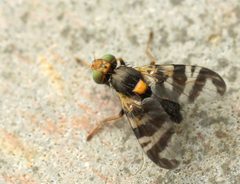
is a tephritid fruit fly native to Europe and Asia, and an in North America since 2016. are small, dark flies with distinctive wing patterns. The is , with larvae developing inside cherry fruits and causing significant agricultural damage. It is considered a major pest of cherry crops across its range.
Pronunciation
How to pronounce Rhagoletis cerasi: /ræˈɡoʊlətɪs səˈrɑːsaɪ/
These audio files are automatically generated. While they are not always 100% accurate, they are a good starting point.
Identification
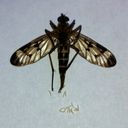
Distinguished from by the combination of four dark transverse wing stripes, green with reddish reflections, and yellow scutellum and legs. Very similar to Rhagoletis berberidis, requiring careful examination for separation. The dark body with silvery mesonotal vittae is distinctive among European Rhagoletis .
Images
Habitat
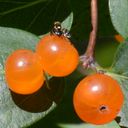
Commercial cherry orchards and wild cherry stands. Requires plants in Prunus for larval development. feed on sugary secretions from cherries or insect honeydew on foliage.
Distribution
Native to Europe (except British Isles), western Siberia to Caucasus, Kazakhstan, Central Asia, and Altai. in North America, first detected in 2016. Present in Uzbekistan and other Central Asian cherry-growing regions.
Seasonality
active from late May to early July. One per year (), with some individuals requiring two years to complete development.
Diet
feed on sugary secretions produced by cherries or honeydew. Larvae feed exclusively on pulp of developing cherry fruits.
Host Associations
- Prunus avium - larval sweet cherry
- Prunus cerasus - larval sour cherry
- Prunus mahaleb - larval
- Lonicera - larval honeysuckle
- Berberis - larval barberry
- Prunus padus - larval bird cherry
- Symphoricarpos - larval snowberry
- Prunus armeniaca - larval apricot
Life Cycle
Overwinters as pupa in soil. emerge in late spring (late May–early July). Females lay 50–80 singly in fruit pulp over 10–15 days. Eggs hatch in 6–12 days; larvae feed on fruit pulp for 2–3 weeks. Mature larvae exit fruit and pupate in soil, where most enter for approximately 10 months. Some pupae extend diapause to two years.
Behavior
Low within orchards, typically less than 5 meters. Strong fidelity to Prunus . Females require firm foothold with forelegs to oviposit, tipping upward to insert ovipositor vertically into fruit. feed on surface secretions rather than penetrating fruit.
Ecological Role
Primary fruit pest causing quantitative yield loss and qualitative degradation of cherry crops. Larval feeding renders fruit unmarketable. Serves as for fungi including bassiana, which has been developed as a biocontrol agent.
Human Relevance
Major agricultural pest of cherries in Europe and Asia, with low market for infested fruit necessitating preventive control measures. Management relies on applications, soil netting, and emerging methods. Invasion of North America in 2016 poses threat to cherry production there.
Similar Taxa
- Rhagoletis berberidisExtremely similar ; requires careful examination to distinguish. Both have dark bodies and banded wings, but R. cerasi has yellow scutellum and legs while R. berberidis differs in scutellum coloration.
- Rhagoletis indifferensWestern cherry fruit fly, native to North America; similar and damage pattern. R. cerasi is distinguished by distribution (European vs. North American native range) and slight morphological differences in wing pattern.
- Rhagoletis cingulataEastern North American cherry fruit fly with similar use; distinguished by geographic range and wing pattern details.
More Details
Control methods
Soil covering nets reduce activity by 77% and fruit by 91%. Crop netting over dwarf tree orchards has become cost-effective in rain-covered cherry production systems. fungus bassiana has been developed for organic agriculture. Research on hydrophobic fruit coatings shows promise for disrupting oviposition .
Invasion history
First detected in North America in 2016, representing a significant range expansion beyond native Palearctic distribution. Establishment in North America threatens both commercial cherry production and native Prunus .
Sources and further reading
- BugGuide
- Wikipedia
- GBIF taxonomy match
- iNaturalist taxon
- NCBI Taxonomy
- Catalogue of Life
- Nuptial Gifts and Other Romantic Gestures of the Bug World
- Organic Coating Gives Cherries a Chance to Fend Off Fruit Flies
- Rhagoletis cerasi . [Distribution map].
- Rhagoletis cerasi . [Distribution map].
- GILOS PASHSHASI – (RHAGOLETIS CERASI L.) BIOEKOLOGIYASI VA ZARARI
- Investigation of Distribution, Population Development, Flight Period, Infestation and Damage Rate of Cherry Fruit Fly, Rhagoletis cerasi L. (Diptera: Tephritidae), Associated with Cherry and Sour Cherry Orchards Untersuchung zu Verbreitung, Populationsentwicklung, Flugdauer, Befall und Schadensrate der Kirschfruchtfliege, Rhagoletis cerasi L. (Diptera: Tephritidae), in Süß- und Sauerkirschanlagen
- Integrated Management of European Cherry Fruit Fly Rhagoletis cerasi (L.): Situation in Switzerland and Europe
- THE BIOLOGY OF THE EUROPEAN CHERRY FRUIT FLY [RHAGOLETIS CERASI L. (DIPTERA: TEPHRITIDAE)]
- Dispersal of Rhagoletis cerasi in Commercial Cherry Orchards: Efficacy of Soil Covering Nets for Cherry Fruit Fly Control