
Rhagoletis indifferens
Curran, 1932
Western Cherry Fruit Fly, Western Cherry Fruitfly
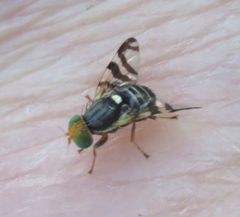
Rhagoletis indifferens, the western cherry fruit fly, is a tephritid fruit fly native to western North America and a major pest of cultivated sweet and sour cherries. are slightly smaller than a housefly with distinctive white abdominal stripes and patterned wings. The exhibits obligate winter as pupae in soil and has been introduced to Switzerland. Climate change poses a threat due to its diapause requirements.
Pronunciation
How to pronounce Rhagoletis indifferens: /ˌræɡəˈliːtɪs ɪnˈdɪfərəns/
These audio files are automatically generated. While they are not always 100% accurate, they are a good starting point.
Identification
Distinguished from Rhagoletis fausta (black cherry fruit fly) by wing pattern: R. indifferens has yellow markings at wing base and black markings on wings, while R. fausta has a dark band across the wing. White abdominal stripes also distinctive. Larvae cannot be reliably distinguished from other Rhagoletis without molecular methods.
Images
Habitat
Cherry orchards and wild cherry . Native Prunus emarginata (bitter cherry) in temperate to alpine climates of the Cascade Mountain range. Overwinters as diapausing pupae in soil at 1–4 inch depth.
Distribution
Native to western North America: Canada (southeastern British Columbia), USA (Arizona, California, Colorado, Idaho, Montana, New Mexico, Oregon, Utah, Washington, Wyoming). Introduced to Switzerland.
Seasonality
peaks June–July in California. timing varies with winter chilling duration; 15–30 weeks of chilling at 3°C produces synchronous emergence at 5–7 weeks post-chill. with potential for extended spanning multiple seasons.
Diet
Larvae feed on cherry pulp. feed on cherry fruit surface.
Host Associations
- Prunus avium - primary cultivated sweet cherry
- Prunus cerasus - cultivated sour cherry
- Prunus emarginata - native bitter cherry
- Prunus virginiana - occasional
- Prunus salicina - occasional
- Prunus subcordata - occasional
Life Cycle
Overwinters as diapausing pupa in soil. Requires winter chilling to terminate ; chilling duration affects synchrony. emerge in late spring/early summer. Females lay in cherries using sharp ovipositor; larvae develop 1–2 weeks within fruit before exiting to pupate in soil. Can diapause for more than one year based on metabolic reserves.
Behavior
Males are highly territorial on fruit surfaces, exhibiting aggressive including wing jerking displays, -on collisions, and boxing with forelegs. Territoriality reduced in confined laboratory conditions. behavior context-dependent: crowded individuals fly 1.5-fold farther than isolated individuals. Females stop more frequently and longer during flight than males. Oviposition requires firm gripping with forelegs and abdominal tipping to insert ovipositor.
Ecological Role
herbivore of Prunus fruits. Serves as for including Diachasma muliebre (Braconidae) and pteromalid wasps. Larval feeding reduces fruit quality and seed viability.
Human Relevance
Major economic pest of cherry production in Pacific Northwest, where crop value exceeds $1 billion annually. pest requiring control for market access. Subject to sterile insect technique research; males irradiated at 8 krad achieve 99% hatch reduction. HydroShield organic coating reduces oviposition by up to 72% by interfering with leg gripping. Neonicotinoid effective against eggs and larvae in postharvest fruit.
Similar Taxa
- Rhagoletis faustaAlso infests cherries; distinguished by dark band across wing versus yellow base and black markings in R. indifferens
- Rhagoletis pomonellaApple maggot; native to eastern North America, introduced west, less tolerant of water deprivation and xeric conditions than R. indifferens
More Details
Climate vulnerability
Climate change likely to reduce due to obligate winter requirement. Upper thermal limit for pupal is 47.8°C; extreme heat waves may impact populations more than with higher thermal .
Reproductive plasticity
Ovarian development regulated by fruit availability; females enter ovarian when cherries unavailable. load positively correlated with cherry access, with additive effects of social crowding.
Irradiation sensitivity
Females more radiation-sensitive than males; infecund at 5 krad versus 8 krad for male sterility. -irradiated males more competitive than pupae-irradiated males for sterile insect release programs.
Sources and further reading
- BugGuide
- Wikipedia
- GBIF taxonomy match
- iNaturalist taxon
- NCBI Taxonomy
- Catalogue of Life
- CDFA to Host Fruit Fly Workshop, Free to Participants | Bug Squad
- Organic Coating Gives Cherries a Chance to Fend Off Fruit Flies
- The Pan-Pacific Entomologist 88(2)—Penrose Memorial issue | Beetles In The Bush
- Rhagoletis indifferens . [Distribution map].
- Ovarian response to resource availability in female Rhagoletis indifferens
- Distribution and phenology of Rhagoletis fausta (Osten Sacken 1877) and Rhagoletis indifferens Curren 1932 (Diptera: Tephritidae) in California
- Radiation biology of the western cherry fruit fly, Rhagoletis indifferens Curran (Diptera: Tephritidae)
- THE WESTERN CHERRY FRUIT FLY, RHAGOLETIS INDIFFERENS (DIPTERA: TEPHRITIDAE): 2. AGGRESSIVE BEHAVIOR
- Relative flight responses of Rhagoletis indifferens as influenced by crowding, sex, and resources
- Seasonal Distributions of Eggs and Larvae of Rhagoletis indifferens Curran (Diptera: Tephritidae) in Cherries
- Low Temperature Duration and Adult Rearing Regimes Affect Eclosion of Rhagoletis indifferens (Tephritidae: Diptera)
- Reduction in Emergence of Rhagoletis indifferens (Diptera: Tephritidae) from Sweet Cherries with Different Egg and Larval Distributions Using Newer Insecticides
- Temperature Effects on Oviposition by Rhagoletis indifferens (Diptera: Tephritidae) Vary in Different Developmental Stages of Sweet Cherry
- Rearing of Diachasma muliebre Muesebeck (Hymenoptera: Braconidae) from Rhagoletis fausta (Osten-Sacken) and Rhagoletis indifferens Curren (Diptera: Tephritidae) Puparia and an Analysis of How the Parasitoid Tracks Its Hosts in a Higher Elevation Habitat in California
- Differential water deprivation tolerances of adult Rhagoletis indifferens and Rhagoletis pomonella (Diptera: Tephritidae) as a possible factor affecting their distributional abundances in Washington State, USA
- Upper thermal limits of Rhagoletis indifferens (Diptera: Tephritidae) pupae and pteromalid parasitoids (Hymenoptera: Pteromalidae) inside fly puparia
- Diapause of the Western cherry fruit fly, Rhagoletis indifferens (Diptera: Tephritidae): metabolic rate and overwintering adaptations
- THE WESTERN CHERRY FRUIT FLY, RHAGOLETIS INDIFFERENS (DIPTERA: TEPHRITIDAE): 1. DISTRIBUTION OF THE DIAPAUSING PUPAE IN THE SOIL