
Caliroa
Costa, 1859
slug sawflies, pear slugs
Species Guides
7- Caliroa cerasi(pear slug)
- Caliroa liturata
- Caliroa lorata
- Caliroa lunata
- Caliroa nyssae(tupelo sawfly)
- Caliroa obsoleta
- Caliroa quercuscoccinae(Oak-skeletonizing sawfly)
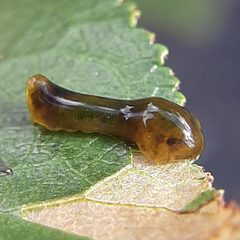
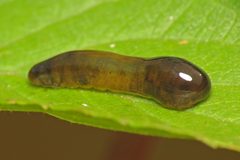
Caliroa is a of in the Tenthredinidae, commonly known as slug sawflies due to the distinctive appearance of their larvae. The larvae are covered in a slimy coating that gives them a slug-like appearance and serves as protection against . Several are economically important pests of fruit trees and ornamental plants, particularly in the genera Prunus, Pyrus, and Quercus. The genus has a wide geographic distribution across Europe, Asia, North America, and other regions, with at least 13 species recognized in Japan alone.
Pronunciation
How to pronounce Caliroa: //kəˈlɪroʊə//
These audio files are automatically generated. While they are not always 100% accurate, they are a good starting point.
Identification
Larvae can be distinguished from true slugs (gastropods) by their presence on tree and shrub foliage and by having more than two pairs of legs. Within the , larval identification relies on slime coloration (dark vs. transparent) and feeding position on leaves (upper vs. lower surface). Caliroa can be separated from the related genus Endelomyia by antennal characters and wing venation in . -level identification of adults requires examination of abdominal and other subtle morphological features.
Images
Habitat
Found in deciduous woodlands, orchards, and urban landscapes where trees and shrubs occur. Larvae feed on leaves of woody plants in the Rosaceae, Fagaceae, Salicaceae, and others. Specific associations depend on host plant distribution.
Distribution
Widespread across the Northern Hemisphere including Europe (widespread), Asia (Japan, China, Middle East), and North America. Introduced established in Australia, New Zealand, South America (Argentina, Chile, Colombia, Uruguay), and South Africa. Records from Vermont (USA) and Scandinavian countries (Denmark, Norway, Sweden) documented.
Seasonality
periods vary by and region, generally occurring in spring and summer. C. cerasi shows complex voltinism with and a intermediate ; populations can shift between these patterns. C. annulipes is bivoltine in northern England. Some individuals of C. limacina emerge the same season to produce a second generation, while others remain in cocoons until the following year.
Diet
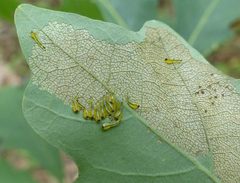
Larvae are folivores feeding on leaves of woody plants. Feeding occurs on upper leaf surfaces in some (e.g., C. limacina) and lower surfaces in others (e.g., C. annulipes). Larvae skeletonize leaves, consuming tissue between .
Host Associations
- Prunus - larval food plantprincipal for C. cerasi (cherry, plum)
- Pyrus - larval food plant for C. cerasi (pear)
- Quercus - larval food plant for C. cinxia (monophagous) and C. annulipes
- Salix - larval food plant for C. annulipes
- Crataegus - larval food plant for C. annulipes
- Zelkova - larval food plant for C. zelkovae
- Staphylea - larval food plant for C. staphyleae
- Vaccinium - larval food plant for C. vaccini
- Cotoneaster - larval food plant for C. cerasi
- Chaenomeles - larval food plant for C. cerasi
- Rosanot a Caliroa ; misattribution in some sources refers to Endelomyia aethiops
Life Cycle
are deposited on leaf surfaces—undersides in C. limacina, upper surfaces in C. annulipes. is 9–15 days depending on . Larval feeding stage lasts 18–27 days. Larvae and shed their slime coating before dropping from the plant to enter the soil and construct cocoons. occurs in soil cocoons. occurs as eonymphs (pre-pupae) in , with diapause induced by short day length. At least three larval stages must experience short days for diapause induction; long days can suppress diapause if six larval stages develop under such conditions. Some show delayed development with individuals remaining in cocoons for extended periods.
Behavior
Larvae feed exposed on leaf surfaces, skeletonizing foliage. The slime coating is a defensive against . When mature, larvae drop from plants and burrow into soil to pupate. show strong site fidelity, resulting in patchy distribution of within areas. Oviposition preference is a key factor influencing host susceptibility; females preferentially select certain host .
Ecological Role
Larvae function as primary consumers in deciduous forest and orchard . They serve as for diverse including ichneumonid wasps (Ctenopelmatinae) and cleptid , which can exert significant mortality and regulate . Larval and cocoon are important mortality factors; parasitism is generally unimportant. A pathogenic flagellate has been observed causing mortality at decline phases.
Human Relevance
Several are significant agricultural and horticultural pests. C. cerasi (pear slug, cherry slug) damages pear, cherry, and plum foliage, with occurring at irregular intervals. Damage is most severe in organic or reduced-spray orchards. C. limacina and C. annulipes also cause defoliation of cultivated trees and shrubs. Control measures include applications, though larvae are sensitive to many insecticides. Neem oil shows antifeedant and developmental effects. Direct control may be needed in nursery settings during rare outbreaks.
Similar Taxa
- EndelomyiaLarvae also appear slug-like but lack prothoracic glands and slime coating; separable by antennal characters and wing venation
- True slugs (Gastropoda)Larvae resemble slugs in appearance and movement but are insects with three pairs of thoracic legs and additional ; found on foliage rather than ground
Misconceptions
The 'slug' leads to frequent misidentification of larvae as gastropod mollusks rather than insect larvae. The is sometimes confused with Endelomyia due to convergent larval , but these are distinct genera with different associations and morphology.
More Details
Reproductive biology
is predominantly parthenogenetic. C. cerasi exhibits both deuterotokous (producing males and females) and thelytokous (producing only females) , with shifting toward thelytoky during phases. Males can be present at low frequencies (e.g., 27% observed at outbreak start) or absent entirely.
Population dynamics
of C. cerasi occur at irregular intervals and are not clearly driven by climate or weather. Intrinsic factors including 'physiological aging' of and reduced viability from prolonged thelytoky may contribute to outbreak collapse. High mortality from unknown causes observed in late outbreak phases.
Taxonomic diversity
The contains substantial , with 13 documented from Japan alone including five described as new in 2020 (C. aizankei, C. bibaiensis, C. ibukii, C. nire, C. ouensis). Species boundaries can be subtle, requiring examination of abdominal and other fine morphological details.
Sources and further reading
- BugGuide
- Wikipedia
- GBIF taxonomy match
- iNaturalist taxon
- NCBI Taxonomy
- Catalogue of Life
- “The Botanists Among Us: Host plant specialization in insects” | Beetles In The Bush
- Caliroa slug sawflies of Japan (Hymenoptera, Tenthredinidae)
- Caliroa cerasi . [Distribution map].
- Zur Biologie der Eichenblattwespen Caliroa cinxia Klug und Caliroa annulipes Klug (Hym., Tenthredinidae) und deren Larvalparasitoiden
- OLCHA SHILLIQ ARRAKASHI (CALIROA CERASI L.) NING BIOEKOLOGIK RIVOJLANISH XUSUSIYATLARI VA HIMOYA QILISH CHORALARI
- The natural enemies of the pear‐slug, Caliroa cerasi (L.) (Hym., Tenthredinidae), in Europe
- A new sawfly species <i>Caliroa crypta</i> sp. nov. from Northern Europe (Hymenoptera, Tenthredinidae)
- On the Biology, Ecology and Population Dynamics of Caliroa cerasi (L.) (Hym., Tenthredinidae)
- BIOLOGICAL STUDIES OF CERTAIN SPECIES OF CALIROA COSTA AND ENDELOMYIA ASHMEAD (HYMENOPTERA SYMPHYTA)
- Nearctic “Slug” Sawfly Larvae of the Genus Caliroa Costa (Hymenoptera: Tenthredinidae): New Rearing Records and a Summary of Hosts, Descriptions, and Distribution Records
- Effects of neem oil on feeding behaviour and development of the pear sawfly, Caliroa cerasi
- Pear sawfly (Caliroa cerasi) (Hymenoptera: Tenthredinidae) host preference and larval development on six Pyrus genotypes
- New Host Records and Developmental Notes on the Pear Slug <i>Caliroa Cerasi</i> (Hymenoptera: Tenthredinidae), Feeding on <i>Cotoneaster</i> and <i>Chaenomeles</i> Species.
- Investigation of Distribution, Population Development, Flight Period, Infestation and Damage Rate of Cherry Slugworm, Caliroa cerasi (L.) (Hymenoptera: Tenthredinidae) Associated with Cherry and Sour Cherry Orchards