
Endelomyia
Ashmead, 1898
roseslug sawfly
Species Guides
1- Endelomyia aethiops(roseslug)
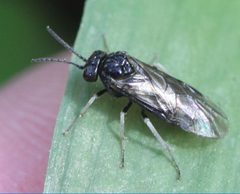
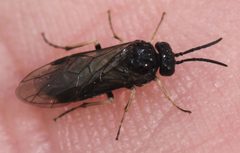
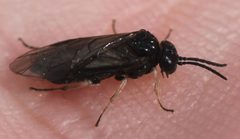
Endelomyia is a of in the Tenthredinidae, containing at least two described . The genus is best known for Endelomyia aethiops, commonly called the roseslug sawfly, a significant pest of cultivated roses. Larvae feed on rose foliage, producing characteristic skeletonization damage by removing soft tissue between leaf . The genus can be distinguished from the related slugworm genus Caliroa by antennal characters and wing venation.
Pronunciation
How to pronounce Endelomyia: //ˌɛn.dɛ.loʊˈmaɪə//
These audio files are automatically generated. While they are not always 100% accurate, they are a good starting point.
Identification
are distinguished from Caliroa by antennal structure and wing venation patterns. Larvae are recognized by their yellowish coloration, enlarged (but not greatly enlarged) , absence of slime coating, and presence of six or more pairs of without . The combination of skeletonization damage on rose leaves with these larval characteristics confirms identification.
Images
Habitat
Associated with Rosa , particularly in cultivated garden settings. Larvae feed on rose foliage; are found on or near plants.
Distribution
Recorded from Europe (Denmark, Norway, Sweden) and North America. Endelomyia aethiops is established in North American rose gardens.
Seasonality
fly in May–June. Larvae are active spring through early summer, with E. aethiops completing development by late June. (one per year), with winter spent as in soil cocoons.
Diet
Larvae feed on rose leaves (Rosa spp.), with E. aethiops showing preference for Rosa canina and R. arvensis. Feeding occurs on the undersides of leaves.
Host Associations
- Rosa canina - preferred
- Rosa arvensis - preferred
- Rosa - -level association
Life Cycle
Winter is spent as a contracted in a soil cocoon. emerge in spring (May–June), mate, and females oviposit along edges of rose leaves using a saw-like ovipositor. hatch in 9–14 days. Larvae feed for 20–27 days, then and enter soil to construct cocoons. ; some related show partial bivoltinism but E. aethiops has one annually.
Behavior
Larvae feed on leaf undersurfaces, producing skeletonization by removing tissue between vascular bundles. When abundant, damage can cause leaves to brown and crinkle as if scorched. are active fliers during spring day period.
Ecological Role
Herbivore on Rosa . In native ranges, likely a minor component of plant-insect ; in gardens, can reach pest densities. Larvae serve as prey for ground beetles and lightning larvae when dislodged from plants.
Human Relevance
Economic pest of cultivated roses. The roseslug (E. aethiops) causes significant aesthetic damage to rose foliage through skeletonization. Management includes hand removal, strong water sprays to dislodge larvae, and OMRI-listed such as insecticidal soap and spinosad. Control timing targets larval stages in May–June.
Similar Taxa
- CaliroaSimilar slugworm with slime-covered larvae; distinguished by antennal characters, wing venation, and larval (Caliroa larvae have greatly enlarged and slime coating)
- Allantus cinctusCurled rose sawfly, another rose-feeding ; larvae curl when not feeding and produce edge defoliation rather than skeletonization
- Cladius pectinicornisBristley rose sawfly, another rose pest; distinguished by larval bristle characteristics and feeding damage pattern
More Details
Taxonomic History
Endelomyia was established by Ashmead in 1898 and has been historically confused with Caliroa due to similar larval habits. The two are now distinguished primarily on morphological characters.
Reproduction
Related Caliroa reproduce primarily by ; the reproductive mode of Endelomyia species has not been explicitly documented in available sources.
Sources and further reading
- BugGuide
- Wikipedia
- GBIF taxonomy match
- iNaturalist taxon
- NCBI Taxonomy
- Catalogue of Life
- Rosie defoliators: Roseslug sawfly, Endelomyia aethiops, Curled rose sawfly, Allantus cinctus, and Bristley rose sawfly, Cladius pectinicornis — Bug of the Week
- Rosie defoliators - Roseslug sawfly, Endelomyia aethiops, Curled rose sawfly, Allantus cinctus, and Cladius pectinicornis — Bug of the Week
- Archive — Bug of the Week
- BIOLOGICAL STUDIES OF CERTAIN SPECIES OF CALIROA COSTA AND ENDELOMYIA ASHMEAD (HYMENOPTERA SYMPHYTA)