
Allantus cinctus
(Linnaeus, 1758)
Curled rose sawfly, Banded rose sawfly
Allantus cinctus, commonly known as the curled rose sawfly or banded rose sawfly, is a of in the Tenthredinidae. The larvae are significant defoliators of rose plants, feeding on leaf margins and capable of reducing foliage to mid-. When not feeding, larvae curl tightly on leaf undersides or buds, providing effective camouflage. The species produces two per year in temperate regions, with larvae boring into twigs to pupate.
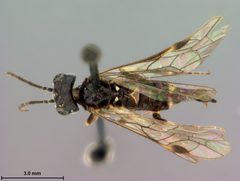
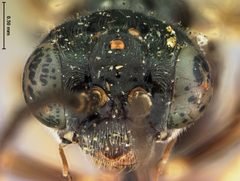
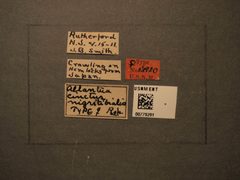
Pronunciation
How to pronounce Allantus cinctus: //əˈlæntəs ˈsɪŋktəs//
These audio files are automatically generated. While they are not always 100% accurate, they are a good starting point.
Identification
Larvae can be distinguished from caterpillars by having six or more pairs of (caterpillars have ≤5 pairs) and lacking on prolegs. The characteristic curled resting posture on leaf undersides separates this from the roseslug sawfly (Endelomyia aethiops), which causes skeletonization rather than marginal defoliation. The bristley rose sawfly (Cladius pectinicornis) is a third sympatric species on roses with different larval .
Images
Appearance
are small, -like insects with impressive . Larvae are caterpillar-like with slender bodies, distinct , and six or more pairs of on abdominal segments—unlike and caterpillars which have five or fewer pairs. Larvae lack (fishhook-like structures) on their prolegs that caterpillars possess. Larvae are cryptically colored to blend with rose foliage.
Habitat
Found in gardens, nurseries, and landscapes where roses (Rosa spp.) are cultivated. Larvae occur on rose foliage; occurs within rose twigs.
Distribution
Native to Europe; introduced to North America including Canada and the United States. GBIF records confirm presence in Belgium and Canada.
Seasonality
emerge in spring to initiate first ; larvae active May through June. Second generation occurs later in summer. Two generations per year in temperate climates.
Diet
Larvae feed exclusively on rose foliage (Rosa spp.), consuming leaf margins and tissue between . do not feed.
Host Associations
- Rosa - primary larval food plant
Life Cycle
Winter spent as or pupae in twigs or soil. emerge in spring, mate, and females use saw-like ovipositor to insert into rose leaf tissue. Larvae feed on foliage, then bore into twigs to pupate. Second follows, with larvae pupating in twigs to overwinter.
Behavior
Larvae exhibit cryptic , curling tightly on leaf undersides or buds when not feeding. This camouflage makes them difficult to detect. Larvae are solitary feeders. are short-lived and do not feed.
Ecological Role
Herbivore and defoliator of roses. Serves as prey for ground beetles, lightning larvae, and other when larvae dislodge or fall from plants. Limited role as ( do not visit flowers for nectar).
Human Relevance
Significant pest of ornamental roses in gardens and commercial production. Heavy can defoliate plants, reducing aesthetic value and plant vigor. Managed through manual removal, water sprays, or OMRI-listed (insecticidal soap, spinosad).
Similar Taxa
- Endelomyia aethiopsAlso called roseslug sawfly; causes skeletonization (removing tissue between ) rather than marginal defoliation; larvae have different feeding pattern and do not curl when resting
- Cladius pectinicornisBristley rose sawfly; third sympatric pest of roses with distinct larval bristle and different damage pattern
- Croesus latitarsusDusky birch sawfly; similar larval but feeds on birch rather than rose; larvae display defensive S-curvature posture when disturbed
More Details
Morphological distinction from caterpillars
larvae are frequently mistaken for caterpillars. Key diagnostic features: count (>6 pairs in sawflies vs ≤5 in caterpillars) and absence of on prolegs. These traits reflect the phylogenetic placement of sawflies (suborder ) as sister to the remainder of Hymenoptera including bees, , and ants.
Pest management timing
Monitoring in May and June is critical for first detection. By late summer, deciduous roses have completed most growth; control efforts provide limited benefit and natural mortality from frost and often suffices.
Sources and further reading
- BugGuide
- Wikipedia
- GBIF taxonomy match
- iNaturalist taxon
- NCBI Taxonomy
- A Good Morning for a Bee | Bug Squad
- Archive — Bug of the Week
- Rosie defoliators: Roseslug sawfly, Endelomyia aethiops, Curled rose sawfly, Allantus cinctus, and Bristley rose sawfly, Cladius pectinicornis — Bug of the Week
- Rosie defoliators - Roseslug sawfly, Endelomyia aethiops, Curled rose sawfly, Allantus cinctus, and Cladius pectinicornis — Bug of the Week
- Sawflies - Curled rose sawfly, Allantus cinctus, and dusky birch sawfly, Croesus latitarsus — Bug of the Week