
Endelomyia aethiops
(Gmelin, 1790)
roseslug, rose slug sawfly, roseslug sawfly
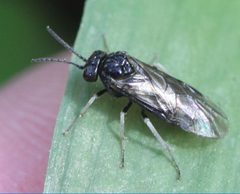
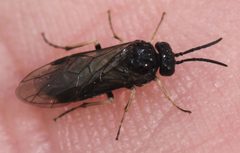
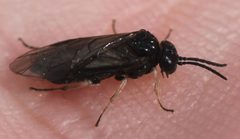
Endelomyia aethiops, commonly known as the roseslug or rose slug , is a of common sawfly in the Tenthredinidae. The larvae are significant pests of cultivated roses, causing characteristic skeletonization damage by feeding on leaf tissue between vascular bundles. are small, -like insects that emerge in spring to lay on rose foliage. The species has a single per year in most regions, with larvae active primarily in May and June.
Pronunciation
How to pronounce Endelomyia aethiops: /ˌɛndɛloʊˈmaɪə ˈiːθiˌɒps/
These audio files are automatically generated. While they are not always 100% accurate, they are a good starting point.
Identification
Larvae resemble small caterpillars but can be distinguished by having six or more pairs of (Lepidoptera caterpillars have five or fewer) and the absence of on prolegs. The characteristic skeletonization damage—leaving only and a thin epidermal layer—helps distinguish this from chewing pests that remove entire leaf sections. are tiny with saw-toothed ovipositors. Similar rose-feeding include Allantus cinctus (curled rose sawfly), which curls tightly when at rest and feeds on leaf margins rather than skeletonizing, and Cladius pectinicornis (bristly rose sawfly), which has distinctive bristle-like .
Images
Habitat
Associated with cultivated and wild rose plants (Rosa spp.) in gardens, nurseries, and landscapes. Larvae feed on rose foliage; are found on or near plants. stages overwinter in soil beneath host plants.
Distribution
Widely distributed across North America and Europe. GBIF records confirm presence in Denmark, Norway, and Sweden. Common throughout the United States and southern Canada.
Seasonality
emerge in spring when rose foliage appears. Larval feeding occurs primarily May through June. Single per year; larvae complete development by early summer. Damaged leaves turn brown and crinkled by mid-summer.
Diet
Larvae feed exclusively on rose leaves (Rosa spp.), consuming soft tissue between leaf and leaving a skeletonized appearance. do not feed; their mouthparts are not adapted for chewing plant material.
Host Associations
- Rosa - obligate herbivorelarval plant; feeding causes skeletonization damage
Life Cycle
Winter is spent as or pupae in soil beneath rose plants. emerge in spring, mate, and females use their saw-like ovipositors to insert into rose leaves. Larvae hatch and feed for several weeks, skeletonizing leaves. Mature larvae drop to soil to pupate. One per year.
Behavior
Larvae feed openly on upper leaf surfaces, moving slowly as they consume tissue between . When disturbed, larvae may drop from plants on silken threads. are weak fliers, typically remaining near plants.
Ecological Role
Herbivore that can significantly defoliate rose plants when abundant. Larvae serve as prey for ground beetles, lightning (firefly) larvae, and other . Contributes to nutrient cycling through herbivory and subsequent leaf .
Human Relevance
Significant pest of ornamental roses in gardens and commercial nurseries. Heavy can render plants unsightly and reduce vigor. Managed through manual removal, water sprays, or OMRI-listed such as insecticidal soap and spinosad. Not a threat to human health.
Similar Taxa
- Allantus cinctusCurled rose sawfly—larvae curl tightly when at rest and feed on leaf margins rather than skeletonizing; has two per year in many regions
- Cladius pectinicornisBristly rose sawfly— have distinctive bristle-like (pectinate) ; larvae feed on leaf edges and between but cause less dramatic skeletonization
- Lepidoptera caterpillarsTrue caterpillars have five or fewer pairs of with ; larvae have six or more prolegs without crochets
More Details
Management considerations
Strong directed water streams can dislodge larvae. Manual removal by squishing or dropping into lawn areas allows natural . Insecticidal applications should target larval stages and avoid harming visiting rose flowers.
Taxonomic note
Authority sometimes cited as (Fabricius) in some databases, though (Gmelin, 1790) is the accepted original combination.
Sources and further reading
- BugGuide
- Wikipedia
- GBIF taxonomy match
- iNaturalist taxon
- NCBI Taxonomy
- Archive — Bug of the Week
- Rosie defoliators: Roseslug sawfly, Endelomyia aethiops, Curled rose sawfly, Allantus cinctus, and Bristley rose sawfly, Cladius pectinicornis — Bug of the Week
- Rosie defoliators - Roseslug sawfly, Endelomyia aethiops, Curled rose sawfly, Allantus cinctus, and Cladius pectinicornis — Bug of the Week
- Bug Eric: Wasp Wednesday: Anoplius aethiops
- Bug Eric: October 2022
- Bug Eric: Moving, Again