
Arge ochropus
(Gmelin, 1790)
rose sawfly
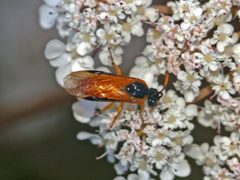
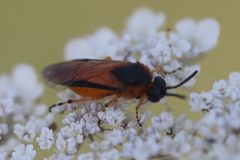
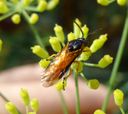
Arge ochropus, commonly known as the rose , is a small sawfly in the Argidae. measure 7–10 mm in length and are active primarily in spring. The species is native to the Palearctic region and has been introduced to northeastern North America. Larvae feed on rose leaves, causing skeletonization damage, while adults consume nectar and pollen from several flowering plants. The species produces two annually in temperate regions.
Pronunciation
How to pronounce Arge ochropus: /ˈɑːrdʒi ˈɒkrəpəs/
These audio files are automatically generated. While they are not always 100% accurate, they are a good starting point.
Identification
Distinguished from the similar Athalia rosae (Tenthredinidae) by structure: Arge ochropus has three-segmented antennae with the third segment greatly elongated, whereas Athalia rosae has 10–11 antennal segments. Distinguished from Arge pagana by coloration: A. ochropus has reddish-orange and wings, while A. pagana is mainly black above.
Images
Habitat
Found in gardens, parks, and natural areas where roses (Rosa ) occur. frequent flowering plants including tansy, wild angelica, and hogweed.
Distribution
Native to Europe, Asia Minor, the Caucasus, Turkmenistan, Northern Iran, and Western Siberia to Lake Baikal. Introduced to the northeastern United States and Eastern Canada.
Seasonality
active from April to May. Two per year in temperate regions; larvae present in spring and again later in summer.
Diet
Larvae feed on leaves of Rosa including Rosa canina, Rosa majalis, and Rosa pimpinellifolia. feed on nectar and pollen of Tanacetum vulgare (tansy), Angelica sylvestris (wild angelica), and Heracleum sphondylium (hogweed).
Life Cycle
Females lay 16–18 on rose stems. Larvae develop through several instars, feeding on rose leaves. occurs in soil. Two complete per year in most of range. stage not explicitly documented in sources.
Behavior
Larvae feed gregariously on rose foliage, producing skeletonization damage by consuming tissue between leaf . visit flowers for nectar and pollen.
Ecological Role
Herbivore; larvae act as defoliators of wild and cultivated roses. Serves as prey for including ground beetles and lightning larvae.
Human Relevance
Considered a minor pest of ornamental roses in gardens. Larval feeding can cause significant aesthetic damage to rose foliage. Control through manual removal or targeted application of insecticidal soap or spinosad is effective.
Similar Taxa
- Athalia rosaeSimilar appearance and shared rose-feeding habit; distinguished by 10–11 segmented versus three-segmented antennae in Arge ochropus
- Arge paganaCongeneric with similar ; distinguished by predominantly black coloration versus reddish-orange and wings in Arge ochropus
- Endelomyia aethiops (Roseslug sawfly)Another rose-feeding causing similar skeletonization damage; distinguished by different (Tenthredinidae) and larval
- Allantus cinctus (Curled rose sawfly)Rose-feeding with similar damage ; distinguished by larval curling and different (Tenthredinidae)
Sources and further reading
- BugGuide
- Wikipedia
- GBIF taxonomy match
- iNaturalist taxon
- NCBI Taxonomy
- Rosie defoliators: Roseslug sawfly, Endelomyia aethiops, Curled rose sawfly, Allantus cinctus, and Bristley rose sawfly, Cladius pectinicornis — Bug of the Week
- Archive — Bug of the Week
- Stalking tigers in Argentina | Beetles In The Bush
- Tiger beetles in Argentina’s Chaco forest | Beetles In The Bush
- Eriopis connexa on soybean in Argentina | Beetles In The Bush
- Stink Bugs on Soybean in Argentina | Beetles In The Bush