
Caliroa nyssae
tupelo sawfly, black gum sawfly
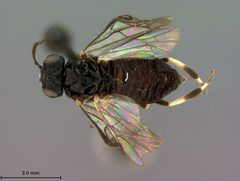
Caliroa nyssae is a in the Tenthredinidae that feeds on Nyssa sylvatica (black tupelo or black gum). The larvae skeletonize leaves, leaving a characteristic lace-like pattern of . This species is part of a of oak-skeletonizing sawflies, though C. nyssae has specialized on tupelo rather than oak. are small, dark-colored sawflies with the typical broad waist characteristic of suborder , distinguishing them from the narrow-waisted in suborder .
Pronunciation
How to pronounce Caliroa nyssae: //ˈkælɪˌroʊ.ə ˈnɪsaɪ//
These audio files are automatically generated. While they are not always 100% accurate, they are a good starting point.
Identification
Larvae can be distinguished from caterpillars by their greater number of (6-8 pairs versus 5 or fewer in Lepidoptera) and lack of (hooked structures on prolegs). The skeletonizing feeding damage on Nyssa leaves—leaving intact while consuming tissue between them—is diagnostic. resemble small black but have a broad waist (no petiole) and short, bead-like . Similar Caliroa feed on oaks (C. annulipes, C. cerasi), making plant association critical for identification.
Images
Appearance
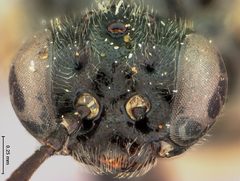
Larvae are slug-like, pale green to yellowish, with a broad, flattened body shape typical of Caliroa . They lack the distinct of caterpillars and instead have sucker-like abdominal legs. are small (approximately 5-8 mm), dark-colored sawflies with clear wings, short , and a broad connection between and . The body is compact and somewhat stout for a sawfly.
Habitat
Deciduous forests and wooded areas where Nyssa sylvatica (black tupelo, black gum, or sour gum) occurs. Found in moist to wet soils along streams, in swamps, and in upland forests. The tree is common in eastern North American forests from southern Ontario to Florida and west to Texas.
Distribution
Eastern North America, coinciding with the range of its plant Nyssa sylvatica. Documented from the northeastern United States through the Midwest and south to the Gulf Coast.
Diet
Larvae feed exclusively on leaves of Nyssa sylvatica (black tupelo), skeletonizing the foliage by eating tissue between leaf while leaving the veins intact. This feeding pattern creates a distinctive lace-like appearance to damaged leaves.
Host Associations
- Nyssa sylvatica - obligate Larval food plant; also known as black tupelo, black gum, or sour gum
Behavior
Larvae feed gregariously on leaves, often on the undersides. When disturbed, they may drop from leaves on silken threads. The slug-like larvae move with a characteristic looping motion. are active during daylight hours and may be found resting on foliage or flying near trees.
Ecological Role
Herbivore that contributes to nutrient cycling through leaf consumption. The skeletonized leaves that fall prematurely add to forest floor detritus. Serves as prey for including birds, predatory , and other .
Human Relevance
Minor aesthetic pest in ornamental plantings of black tupelo. The damage is usually not severe enough to warrant control measures and does not significantly impact tree health. The is of interest to entomologists studying plant specialization, as it represents a shift from the oak-feeding ancestral state typical of the .
Similar Taxa
- Caliroa annulipesOak-feeding with similar larval and skeletonizing ; distinguished by plant association
- Caliroa cerasiAnother oak-feeding ; plant and slight differences in coloration separate the
- Larvae of oak skeletonizer moths (Bucculatrix spp.)Produce similar skeletonizing damage on oaks; Lepidopteran larvae have fewer and , and more cylindrical body form
More Details
Host Plant Specialization
Caliroa nyssae represents an interesting case of plant shift within the Caliroa, which is primarily associated with oaks (Quercus). The has colonized Nyssa sylvatica, a member of Cornaceae (dogwood ), demonstrating the evolutionary plasticity of host associations in plant-feeding insects. This shift parallels similar host transitions seen in other phytophagous insect lineages.
Taxonomic Note
The Caliroa was formerly placed in Tenthredinidae but has been subject to various subfamilial classifications. Some treatments place it in Blennocampinae. The epithet 'nyssae' directly references the genus Nyssa.