
Sphex nudus
Fernald, 1903
Katydid Wasp
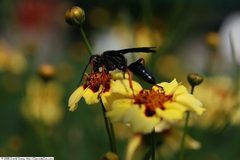
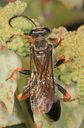
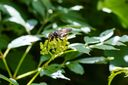
Sphex nudus, commonly known as the , is a solitary digger wasp in the Sphecidae. Females construct subterranean nests in soil or dirt substrates, including the floors of old barns. The is notable for its specialized hunting , targeting leaf-rolling crickets as prey for its larvae. It occurs across the eastern United States.
Pronunciation
How to pronounce Sphex nudus: /sfeɪks ˈnjuːdəs/
These audio files are automatically generated. While they are not always 100% accurate, they are a good starting point.
Identification
Distinguished from other Sphex by morphological characters requiring detailed examination; the identification key by Dörfel and Ohl (2015) for Australian Sphex species demonstrates the -level characters useful for species differentiation, though S. nudus itself is separable from Nearctic by specific diagnostic traits. The species' association with leaf-rolling crickets rather than katydids as prey may aid in field recognition where hunting is observed.
Images
Appearance
Medium-sized thread-waisted wasp with the characteristic slender petiole connecting and typical of the Sphex. Coloration and detailed morphological features require specimen examination; the lacks the striking golden or black coloration of its S. ichneumoneus or S. pensylvanicus.
Habitat
Open rural and prairie ; nests constructed in dirt floors of structures such as old barns, as well as in soil in natural settings. Observed in Adams County, Ohio in a barn environment with nearby rural and prairie habitats.
Distribution
Eastern United States
Seasonality
Active in late summer; observed nesting in late August in Ohio.
Diet
forage for nectar; larvae provisioned with paralyzed leaf-rolling crickets (Camptonotus carolinensis).
Host Associations
- Camptonotus carolinensis - preyCarolina leaf-rolling , paralyzed and stored as larval food
Life Cycle
Solitary nesting; female constructs subterranean nest, provisions with paralyzed crickets, lays on prey, and seals nest entrance. Developmental details undescribed in available sources.
Behavior
Females hunt specifically for Camptonotus carolinensis, paralyzing prey with sting and transporting it to nest entrance. Prey is deposited at nest threshold while female inspects burrow interior, then retrieved and dragged inside. This stereotyped sequence has been experimentally demonstrated to be highly persistent even when interrupted. Nesting observed in loose dirt substrates including barn floors.
Ecological Role
of leaf-rolling crickets; contributes to of this orthopteran group. As a nectar-foraging , may participate in pollination of flowering plants.
Human Relevance
Subject of natural history observation and educational workshops; poses minimal direct interaction with humans, avoiding contact and not displaying aggressive . Nesting in anthropogenic structures (barns) brings it into occasional proximity with human activity.
Similar Taxa
- Sphex ichneumoneusLarger size (15-27 mm), striking golden-orange and black coloration, hunts katydids rather than crickets, transcontinental distribution
- Sphex pensylvanicusLarger size, black coloration with blue wing reflections, also known as 'great black '
- Sphex lucaeWestern North American distribution, with red-abdomened females and all-black males, also hunts katydids
More Details
Nomenclature
The epithet 'nudus' (Latin: naked, bare) may refer to reduced pilosity or other bare morphological features distinguishing it from , though original description requires consultation.
Research history
The has received limited focused study; most behavioral observations derive from incidental encounters during broader hymenopteran surveys rather than dedicated research.