
Phobocampe
Förster, 1869
Species Guides
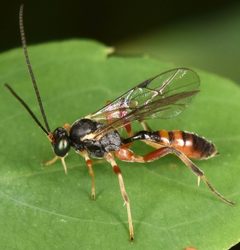
2Phobocampe is a of ichneumonid wasps in the Campopleginae. are solitary endoparasitic koinobiont of lepidopteran larvae. P. confusa is a on Nymphalini butterflies in Europe, particularly Aglais species, and represents a significant mortality factor for these . P. tempestiva parasitizes the winter moth Operophtera brumata in northern Scotland.
Pronunciation
How to pronounce Phobocampe: /foʊ.boʊˈkæm.peɪ/
These audio files are automatically generated. While they are not always 100% accurate, they are a good starting point.
Images
Habitat
Vegetated open land including fields, meadows, and grasslands; proximity to deciduous forests. Artificial surfaces such as buildings and roads negatively affect occurrence. suitability assessed within 10–500 meter buffers around locations.
Distribution
Recorded from Denmark, Norway, and Sweden. P. confusa distributed across at least 500 km latitudinal gradient in Sweden. P. tempestiva recorded from heather moorland on the Orkney Isles, northern Scotland.
Seasonality
Activity constrained by ; phenological overlap with hosts varies between years due to climatic conditions. Partly plurivoltine.
Host Associations
- Aglais urticae - primary Preferred ; significantly higher proportion of larvae parasitized despite equal nest rates with A. io
- Aglais io - primary Nests parasitized equally with A. urticae, but lower proportion of larvae parasitized
- Araschnia levana - confirmed Two confirmed events in study
- Operophtera brumata - primary of P. tempestiva; winter moth (Geometridae)
Life Cycle
Solitary endoparasitic koinobiont: laid in larva, which continues feeding until before host . Overwinters as in cocoon. Haplodiploid sex determination: females from fertilized eggs, males haploid from unfertilized eggs.
Behavior
Female oviposition targets larvae in instars 2–5. Shows host preference at the individual larva level even when nest rates are equivalent across host . tracks host availability; climatic variation can disrupt temporal overlap and reduce parasitism rates.
Ecological Role
Key in natural ; major source of larval mortality for . P. confusa is the second most important parasitoid of Aglais urticae and A. io in Sweden after the tachinid Pelatachina tibialis. Contributes to host and ecosystem stability.
Similar Taxa
- Campopleginae (subfamily)Other campoplegine share koinobiont endoparasitoid ; Phobocampe distinguished by specialization patterns and geographic distribution in northern Europe
- Pelatachina tibialisTachinid fly that is the primary of Aglais in Sweden, causing higher mortality than P. confusa; belongs to different order (Diptera)
More Details
Genetic structure
P. confusa shows low genetic diversity and lack of genetic structure across 500 km in Sweden based on CO1 and AFLP markers. Authors note need for high-resolution genomic tools to better resolve population structure.
Viral associations
P. tempestiva harbors a (Operophtera brumata reovirus, ObRV) that is shared with its lepidopteran , with apparent non-pathogenic or commensal relationship.
Research gaps
feeding habits, detailed , and many -level biological traits remain undocumented for most Phobocampe species.
Sources and further reading
- BugGuide
- GBIF taxonomy match
- iNaturalist taxon
- NCBI Taxonomy
- Catalogue of Life
- Ecology and Genetic Structure of the Parasitoid Phobocampe confusa (Hymenoptera: Ichneumonidae) in Relation to Its Hosts, Aglais Species (Lepidoptera: Nymphalidae)
- Sequence analysis of a reovirus isolated from the winter moth Operophtera brumata (Lepidoptera: Geometridae) and its parasitoid wasp Phobocampe tempestiva (Hymenoptera: Ichneumonidae)
- Ecology and population genetics of the parasitoid Phobocampe confusa (Hymenoptera: Ichneumonidae) in relation to its hosts, Aglais species (Lepidoptera: Numphalidae)