
Aglais urticae
(Linnaeus, 1758)
Small Tortoiseshell
Aglais urticae, commonly known as the Small Tortoiseshell, is a widespread Eurasian in the Nymphalidae. It is one of the most familiar butterflies across Europe, recognized by its distinctive orange and black wing pattern with blue marginal spots. The is strongly associated with nettle patches, which serve as the primary larval foodplant. are frequently observed in gardens, meadows, and woodland edges, and are known for their territorial and extended hibernation as adults.
Pronunciation
How to pronounce Aglais urticae: //ˈæɡleɪs ˈɜr.tɪ.kiː//
These audio files are automatically generated. While they are not always 100% accurate, they are a good starting point.
Identification
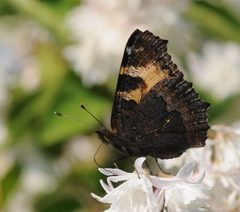
Distinguished from the Large Tortoiseshell (Nymphalis polychloros) by smaller size, more extensive blue markings on the wing margins, and more ragged wing edges. The Painted Lady (Vanessa cardui) has more pointed wings and lacks the bold black basal patches on the hindwings. The Comma (Polygonia c-album) has a characteristic white 'c' or comma mark on the underside of the hindwing and more angular wing margins. The Peacock (Aglais io) displays prominent eyespots on all wings rather than marginal blue spots.
Images
Appearance
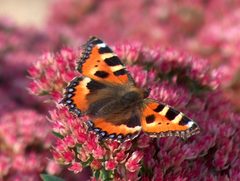
Medium-sized with a wingspan of approximately 45–62 mm. Forewings are orange with thick black markings and a row of blue spots along the outer margin. Hindwings are similarly patterned but with more extensive black at the base. The wing edges are somewhat ragged. Undersides are cryptically colored in mottled brown and grey, providing camouflage when the butterfly is at rest with wings closed. The body is dark and densely hairy.
Habitat
Found in diverse open including gardens, parks, meadows, hedgerows, woodland clearings, and riverbanks. Strongly associated with stands of stinging nettle (Urtica dioica), the larval foodplant. Occurs from sea level to montane elevations. also frequent flowering plants for nectar, particularly thistles, buddleia, and ice plant.
Distribution
Widespread across Europe from the British Isles and Scandinavia to the Mediterranean, extending eastward through temperate Asia to Japan. Present in the European Union, Andorra, Albania, and throughout the Palearctic region. Absent from Iceland and parts of the far north.
Seasonality
are active from early spring through autumn, with peak in late summer. The overwinters as adults, often in buildings, sheds, or hollow trees, and can be seen on warm winter days. Typically produces two per year in most of its range, with partial third generations in favorable southern conditions.
Diet
Larvae feed primarily on Common Nettle (Urtica dioica), and occasionally on Small Nettle (Urtica urens) or related Urticaceae. feed on nectar from a variety of flowering plants including thistles (Cirsium, Carduus), buddleia (Buddleja davidii), ice plant (Sedum spectabile), and bramble (Rubus fruticosus). Adults have also been observed feeding on tree sap and rotting fruit.
Host Associations
- Urtica dioica - primary larval foodplantCommon Nettle; main foodplant throughout European range
- Urtica urens - occasional larval foodplantSmall Nettle; used when available
Life Cycle
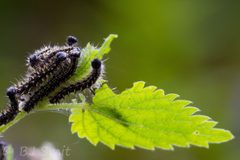
are laid in batches on the underside of nettle leaves. Larvae hatch and feed gregariously in early instars, later dispersing. They are black with yellow longitudinal stripes and spiny. occurs suspended from vegetation. The chrysalis is angular and cryptically colored in grey-brown or gold-green tones. emerge after approximately two weeks. The overwinters as an adult, one of few European butterflies to do so, allowing early spring .
Behavior
are territorial, especially males, which perch on prominent vegetation and chase intruders. They are strong fliers with a direct, gliding pattern. When disturbed, adults may flash their bright upperwings before settling with wings closed to reveal the cryptic underside. Commonly found basking in sunny spots. adults often enter buildings and can become active indoors during warm spells.
Ecological Role
Larvae function as herbivores, consuming nettle foliage and potentially influencing nettle . serve as when visiting flowers. The is a prey item for various birds, spiders, and . As a common and widespread species, it contributes to and serves as a bioindicator of quality in urban and rural landscapes.
Human Relevance
A popular and well-known , frequently featured in conservation outreach and education. are common garden visitors and contribute to diversity in urban environments. The has declined in parts of its range, particularly in the United Kingdom, prompting research into causes including agricultural intensification and climate effects. Larval damage to nettles is generally insignificant to human interests.
Similar Taxa
- Aglais ioPeacock butterfly; similar size and orange base color, but distinguished by large eyespots on all wings rather than blue marginal spots
- Nymphalis polychlorosLarge Tortoiseshell; larger size, less blue on wings, more rounded wing margins, and currently much rarer in northwestern Europe
- Vanessa carduiPainted Lady; more pointed wings, lacks bold black basal patches on hindwings, and has more extensive orange on forewings
- Polygonia c-albumComma; angular wing margins and distinctive white 'c' or comma mark on underside of hindwing
More Details
Population trends
The has experienced significant declines in parts of its range, particularly in the United Kingdom where abundance dropped by approximately 80% between 1976 and 2014. Drivers include agricultural intensification, loss of nettle-rich , and possibly climate-related disruption of success. However, remain stable or locally abundant in many continental European areas.
Hibernation biology
Unlike most temperate butterflies that overwinter as , larvae, or pupae, Aglais urticae overwinters as an . This strategy allows immediate in early spring when nettle growth resumes, but exposes adults to winter mortality risks. Hibernation sites include hollow trees, crevices, and increasingly human structures such as sheds and buildings.
Sources and further reading
- BugGuide
- GBIF taxonomy match
- iNaturalist taxon
- Catalogue of Life
- Provisional checklist of European butterfly larval foodplants
- Mitey troubles for house plants: Twospotted spider mite, Tetranychus urticae — Bug of the Week
- How the Mighty Mite Conquered the Heart of One Entomologist
- How One Entomologist is Breaking Barriers in Crop Protection