
Ectatomminae
Emery, 1895
Ectaheteromorph Ants
Genus Guides
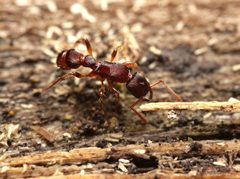
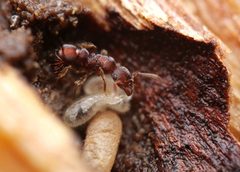
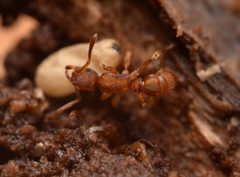
1Ectatomminae is a of ants established in 2003 when Barry Bolton divided the former Ponerinae into six subfamilies. It currently comprises two tribes (Ectatommini and Heteroponerini) with approximately 13 extant and three extinct genera. The subfamily was further consolidated in 2022 when Heteroponerinae was merged into Ectatomminae, and this taxonomic position was upheld by genomic reanalysis in 2024. Members are primarily distributed in tropical and subtropical regions, particularly in the Neotropics.
Pronunciation
How to pronounce Ectatomminae: //ˌɛk.təˈtɒm.ɪˌneɪ//
These audio files are automatically generated. While they are not always 100% accurate, they are a good starting point.
Identification
Ectatomminae ants can be distinguished from other poneromorph by a combination of morphological features including a well-developed sting apparatus, distinct petiole structure, and specific mandibular characteristics. The tribe Heteroponerini (formerly subfamily Heteroponerinae) was merged into Ectatomminae based on phylogenetic analyses. within the subfamily vary considerably in size, with some Gnamptogenys exhibiting gigantism. Detailed morphological identification typically requires examination of specific characters such as mandibular , clypeal structure, and petiolar node shape.
Images
Habitat
occur in diverse including tropical dry forests, Atlantic Forest fragments, Caatinga paleodunes, and agricultural matrix areas. In Colombia, hunting ants of this have been documented in dry forest fragments and surrounding scrub patches. The subfamily shows adaptability to modified landscapes, though species composition differs between natural forests and disturbed habitats.
Distribution
Primarily distributed in tropical and subtropical regions, with strong representation in the Neotropics. Documented from Colombia, Brazil (including Caatinga and Atlantic Forest biomes), Peru, Mexico (Chiapas, Veracruz), and other parts of Central and South America. The Gnamptogenys vriesi was originally known from Colombia and Peru, with subsequent records from Brazil expanding its range.
Seasonality
Activity patterns vary by and region. In Tolima, Colombia, sampling conducted during May-June and October-November 2011 captured active individuals. Seasonal variation in cuticular chemical profiles has been documented in Brazilian of Ectatomma brunneum across different biomes.
Host Associations
- Kapala (Eucharitidae) - Eucharitid wasps in the Kapala attack Ectatomma and Gnamptogenys ants in Chiapas, Mexico
- Myrmecolacidae (Strepsiptera) - endoparasitoidStrepsipteran (stylopization) documented in Ectatomma edentatum in Atlantic Forest, Brazil
- Neodiplothele (Barychelidae) - Trapdoor spiders of Neodiplothele capture Ectatomma muticum in Caatinga, Brazil
Life Cycle
Colonies typically contain winged queens, , and unmated . In Ectatomma vizottoi, functional is the rule despite the presence of several breeding queens. Ovipositing reproductive is an exclusive task of mated queens. Unmated gynes exhibit little-developed compared to queens and perform worker-like activities.
Behavior
Predominantly hunting , earning them the designation 'hunting ants' in ecological studies. Ectatomma brunneum exhibits the 'Dear Enemy Phenomenon'—reduced aggression toward neighboring colonies compared to distant colonies, mediated by cuticular hydrocarbon differences. Ectatomma muticum displays rescue behavior, with nestmates freeing captured individuals from spider traps; this represents the first recorded rescue behavior in the . Ectatomma parasiticum is an social of Ectatomma tuberculatum, showing agonistic interactions with its and morphological reductions typical of parasitic ants.
Ecological Role
Important components of in tropical dry forests, representing 44.7% of reported in some regions. As hunting ants, they likely function as in their . Community structure responds to conversion, with species composition differing between forests and agricultural matrices even when richness is similar.
Similar Taxa
- PonerinaeFormerly included together; separated in 2003 based on phylogenetic analysis. Both are 'hunting ants' with similar ecological roles and are frequently studied together in .
- HeteroponerinaeFormerly recognized as independent but merged into Ectatomminae in 2022 based on phylogenetic evidence; now treated as tribe Heteroponerini within Ectatomminae.
More Details
Taxonomic History
The was erected by Barry Bolton in 2003 during a major reclassification of the former Ponerinae. Heteroponerinae was synonymized under Ectatomminae in 2022, and this classification was supported by genomic reanalysis using alternate methods in 2024.
Chemical Communication
Cuticular hydrocarbons are important for nestmate recognition, discrimination, and territorial . Profiles vary significantly among of Ectatomma brunneum across Brazilian biomes, influenced by environmental factors, and mediate aggression levels between colonies.
Sources and further reading
- BugGuide
- Wikipedia
- iNaturalist taxon
- NCBI Taxonomy
- Catalogue of Life
- Hunting Ants (Ectatomminae Y Ponerinae) in Dry Forest Fragments and Their Matrix (Tolima, Colombia)
- Expanding the Distribution of the Remarkable Ant Gnamptogenys vriesi Brandão & Lattke (Formicidae, Ectatomminae): First Record From Brazil
- Additions to the taxonomy of Gnamptogenys Roger (Hymenoptera: Formicidae: Ectatomminae) with an updated key to the New World species
- Social interactions between an inquiline ant, Ectatomma parasiticum, and its host, Ectatomma tuberculatum (Formicidae, Ectatomminae)
- A new social parasite in the ant genus Ectatomma F. Smith (Hymenoptera, Formicidae, Ectatomminae)
- First host record of stylopization of a worker ant, Ectatomma edentatum (Formicidae: Ectatomminae), by a Myrmecolacidae (Strepsiptera)
- Dear Enemy Phenomenon in the Ant Ectatomma brunneum (Formicidae: Ectatomminae): Chemical Signals Mediate Intraspecific Agressive Interactions
- Gnamptogenys concinna (F. Smith, 1858) : nouvelles données sur sa distribution et commentaires sur ce cas de gigantisme dans le genre Gnamptogenys (Hymenoptera, Formicidae, Ectatomminae)
- Variations in the Cuticular Chemical Profile of the Ant Ectatomma brunneum Smith, F. 1858 (Formicidae: Ectatomminae) Across Different Biomes in Brazil
- Behavioral Differentiation and Ovarian Development of Unmated Gynes, Queens, and Workers ofEctatomma vizottoiAlmeida 1987 (Formicidae, Ectatomminae)
- Biology and Behavior of <I>Kapala</I> (Hymenoptera: Eucharitidae) Attacking <I>Ectatomma</I>, <I>Gnamptogenys</I>, and <I>Pachycondyla</I> (Formicidae: Ectatomminae and Ponerinae) in Chiapas, Mexico
- A new rescue behavior in the ant Ectatomma muticum Mayr, 1870 (Hymenoptera, Formicidae: Ectatomminae) captured by a trapdoor spider of the genus Neodiplothele Mello-Leitão, 1917 (Araneae: Barychelidae)