
Kapala
Cameron, 1884
Species Guides
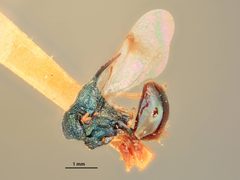
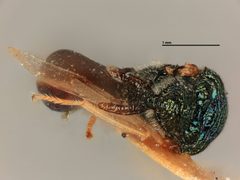
1Kapala is a of in the Eucharitidae, established by Cameron in 1884. The genus is the most common and widely distributed eucharitine genus in the Neotropics, associated with poneromorph ants as . Eucharitid wasps are highly specialized parasitoids whose larvae develop inside colonies.
Pronunciation
How to pronounce Kapala: /kəˈpɑː.lə/
These audio files are automatically generated. While they are not always 100% accurate, they are a good starting point.
Identification
Kapala can be distinguished from other Eucharitidae by mesosomal characters including a reduced lateral axillar surface, internal ridge of the scutoscutellar developed as an internal phragma, and scutellar spines of common derivation. The is characterized by a highly derived mesosoma with fusion of the prepectus to the pronotum and mesothoracic completely enclosed dorsally.
Images
Habitat
Associated with poneromorph colonies in Neotropical forests. In French Guiana, found in association with medium- to large-size poneromorph ants across diverse forest .
Distribution
Neotropics, including Central America, South America, and the Caribbean. Documented in French Guiana with confirmed associations. The shows patterns suggesting possible trans-Atlantic distribution, with one (K. congoana) reported from Africa indicating potential relict or historical wide distribution.
Host Associations
- Ectatomma brunneum - Documented in French Guiana
- Gnamptogenys tortuolosa - Documented in French Guiana
- Odontomachus haematodus - Documented in French Guiana
- Odontomachus mayi - Documented in French Guiana
- Pachycondyla verenae - Documented in French Guiana
- Odontomachus hastatus - Previously reported, confirmed for French Guiana
- Pachycondyla apicalis - Previously reported, confirmed for French Guiana
- Pachycondyla stigma - Previously reported, confirmed for French Guiana
Life Cycle
Eucharitid wasps are specialized of ants. females deposit on or near vegetation; first-instar larvae are (mobile, leg-bearing larvae) that attach to foraging ants and are transported into the nest. Development continues within the colony, with larvae feeding on ant . The specific details for Kapala remain incompletely documented.
Ecological Role
of poneromorph ants, potentially influencing . The high diversity of ant associated with Kapala, combined with the wide distribution of these ant genera in the Neotropics, contributes to the status of Kapala among eucharitine in Central and South America.
Similar Taxa
- OrasemaBoth in Eucharitidae but Orasema belongs to Oraseminae; used as outgroup in phylogenetic analyses due to plesiomorphic character states
- DilocanthaBoth in Eucharitinae; used as ingroup for comparison of mesosomal structures
- PseudochalcuraBoth in Eucharitinae; used as ingroup for comparison of mesosomal structures
- SchizaspidiaBoth in Eucharitinae; used as ingroup for comparison of mesosomal structures
- StilbulaBoth in Eucharitinae; used as ingroup for comparison of mesosomal structures
More Details
Taxonomic history
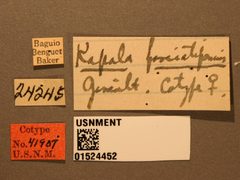
The was established by Cameron in 1884. Few have been described, and the genus remains taxonomically understudied despite being the most common eucharitine genus in the Neotropics.
Phylogenetic significance
Mesosomal of Kapala has been studied for phylogenetic implications, with several synapomorphies proposed for Kapala and related New World including reduced lateral axillar surface and specialized scutellar structures.
Biogeographic patterns
The presence of K. congoana in Africa, while the is otherwise Neotropical, suggests either from South America to Africa (as observed in Chromoteleia) or relict from previously wider distribution, though this remains unresolved.
Sources and further reading
- BugGuide
- Wikipedia
- iNaturalist taxon
- NCBI Taxonomy
- Catalogue of Life
- biodiversity | Blog - Part 35
- Morphology of the mesosoma of Kapala (Hymenoptera: Eucharitidae) with emphasis on its phylogenetic implications
- Poneromorph Ants Associated with Parasitoid Wasps of the GenusKapalaCameron (Hymenoptera: Eucharitidae) in French Guiana