
Orasema
Cameron, 1884
Species Guides
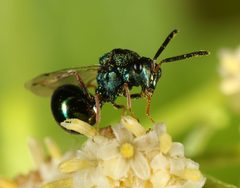
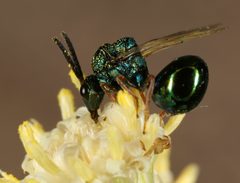
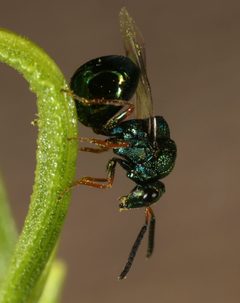
3Orasema is a of chalcid wasps in the Eucharitidae containing at least 50 described . These are specialized of myrmicine ants (Formicidae: Myrmicinae), with documented including Pheidole, Wasmannia, and Solenopsis. The genus is widespread in the New World, ranging from northern Argentina to southern Canada. Several species groups have been established based on and molecular , with the stramineipes group being the most diverse. Some species have been associated with minor agricultural damage when ovipositing into crop plant leaves.
Pronunciation
How to pronounce Orasema: //ɔːˈræsɪmə//
These audio files are automatically generated. While they are not always 100% accurate, they are a good starting point.
Identification
Orasema are small chalcid wasps that can be distinguished from other Eucharitidae by their association with myrmicine and their characteristic involving planidial larvae. Species-level identification requires examination of morphological characters and reference to established species groups; keys are available for several revised groups including the coloradensis, bakeri, tolteca, sixaolae, acuminata, peraltai, johnsoni, and heacoxi groups. The stramineipes species group is the most diverse, containing 29 recognized species. Molecular data from 28S-D2 rDNA and oxidase I (COI) have been used in combination with to establish species concepts.
Images
Habitat
are closely tied to distributions and, for many , to plants bearing extrafloral . Orasema simulatrix has been documented in tree habitats where its host ant Pheidole desertorum is at night. Some species are associated with agricultural settings including tea plantations and banana, yerba mate, and blueberry .
Distribution
New World distribution ranging from northern Argentina to southern Canada. The stramineipes group shows greater diversity in tropical America compared to temperate regions. Documented distribution records include Argentina, Brazil, and the Caribbean (for O. minutissima). GBIF records indicate presence in Georgia, Indiana, and North Carolina in the United States, as well as Queensland, Australia.
Host Associations
- Pheidole - Primary ; includes P. desertorum and undetermined in tea plantations
- Wasmannia - W. auropunctata is for O. minutissima in the Caribbean
- Solenopsis - S. saevissima-complex and fire ants in Argentina; for O. simplex
- Formica - possible F. subnitens referenced but not directly confirmed
- Chilopsis linearis - oviposition plantBignoniaceae; used by O. simulatrix for deposition near extrafloral
Life Cycle
Females deposit into incisions made on plant leaves, often in association with extrafloral . Eggs develop into minute first-instar larvae called . In O. assectator, eggs are laid singly in parallel rows on the underside of leaves. Planidia are concentrated in or on extrafloral nectaries (O. simulatrix) or exist as free-living larvae on leaf surfaces (O. assectator). access occurs when ants feed at nectaries; direct phoretic attachment to host ants has been rejected as the primary mechanism for O. simulatrix. Once in the nest, the planidium transfers to the last-instar ant larva and penetrates its body, remaining inactive until the host reaches the prepupal stage. Endoparasitic feeding begins at the prepupal stage; after host , the emerges and feeds ectoparasitically below the host through two additional instars, completely consuming host contents. Mature larvae pupate in the ant nest and are cared for by ants.
Behavior
employ a novel access mechanism: rather than using phoretic attachment to foraging ants or , they wait in extrafloral for host ants to feed, thereby gaining entry to the nest. In O. minutissima, two distinct size morphs are correlated with host use: a small morph attacks Wasmannia, while medium to large morphs attack different of Pheidole.
Ecological Role
of myrmicine ; potential of ant . May influence ant dynamics through host-specific .
Human Relevance
Some have been regarded as minor agricultural pests due to oviposition damage causing leaf scarring or secondary on banana, yerba mate, blueberry, and tea leaves. The 'sewing blight' of tea in Assam is caused by O. assectator and O. initiator oviposition in young leaves, producing brown spots and premature withering that affects tea quality. However, are rare and threats are usually temporary. O. minutissima has been identified as a potential agent for the Wasmannia auropunctata in areas outside its native Caribbean range.
Similar Taxa
- Other Eucharitidae generaOrasema is distinguished from other Eucharitidae by its specialization on myrmicine ants; other may attack different or employ different access mechanisms
- Orasema susanae-groupSister group to the stramineipes-group; mainly present in temperate regions of Argentina versus tropical distribution of stramineipes-group
Sources and further reading
- BugGuide
- Wikipedia
- GBIF taxonomy match
- iNaturalist taxon
- NCBI Taxonomy
- Catalogue of Life
- Orasema Simulatrix | Entomology Research Museum
- The New World ant parasitoid genus Orasema (Hymenoptera: Eucharitidae)
- Nectary use for gaining access to an ant host by the parasitoid Orasema simulatrix (Hymenoptera, Eucharitidae)
- Bionomics of Orasema simplex (Hymenoptera: Eucharitidae), a parasitoid of Solenopsis fire ants (Hymenoptera: Formicidae) in Argentina
- Distribution, abundance and persistence of species of Orasema (Hym: Eucharitidae) parasitic on fire ants in South America
- Complex diversity in a mainly tropical group of ant parasitoids: Revision of the Orasema stramineipes species group (Hymenoptera: Chalcidoidea: Eucharitidae)
- A species-level association in Pheidole Westwood (Hymenoptera: Formicidae) ants with a parasitoid wasp of the genus Orasema Cameron (Hymenoptera: Eucharitidae) in Brazil
- Preliminary studies on the biology of Orasema assectator Kerrich (Hym., Eucharitidae), parasitic on Pheidole and causing damage to leaves of tea in Assam
- Figure 1 from: Heraty J, Carey B, Visscher K (2012) Nectary use for gaining access to an ant host by the parasitoid Orasema simulatrix (Hymenoptera, Eucharitidae). Journal of Hymenoptera Research 27: 47-65. https://doi.org/10.3897/jhr.27.3067
- Figure 2 from: Heraty J, Carey B, Visscher K (2012) Nectary use for gaining access to an ant host by the parasitoid Orasema simulatrix (Hymenoptera, Eucharitidae). Journal of Hymenoptera Research 27: 47-65. https://doi.org/10.3897/jhr.27.3067
- Figure 5 from: Heraty J, Carey B, Visscher K (2012) Nectary use for gaining access to an ant host by the parasitoid Orasema simulatrix (Hymenoptera, Eucharitidae). Journal of Hymenoptera Research 27: 47-65. https://doi.org/10.3897/jhr.27.3067
- Figure 4 from: Heraty J, Carey B, Visscher K (2012) Nectary use for gaining access to an ant host by the parasitoid Orasema simulatrix (Hymenoptera, Eucharitidae). Journal of Hymenoptera Research 27: 47-65. https://doi.org/10.3897/jhr.27.3067
- Figure 3 from: Heraty J, Carey B, Visscher K (2012) Nectary use for gaining access to an ant host by the parasitoid Orasema simulatrix (Hymenoptera, Eucharitidae). Journal of Hymenoptera Research 27: 47-65. https://doi.org/10.3897/jhr.27.3067