
Pheidole desertorum
Wheeler, 1906
Desert Big-headed Ant
Pheidole desertorum is a desert-dwelling in the hyperdiverse Pheidole, characterized by large colony sizes and pronounced . Colonies contain 2,460–24,814 workers, making them exceptionally large for the genus. The exhibits foraging during summer months and employs multiple nests as an anti- defense strategy. Mating occurs following summer rainfall, with males forming aerial swarms prior to sunrise. Colony foundation is typically haplometrotic, though pleometrotic associations with workers occur.
Pronunciation
How to pronounce Pheidole desertorum: //faɪˈdoʊli dɛzəˈtɔrəm//
These audio files are automatically generated. While they are not always 100% accurate, they are a good starting point.
Identification
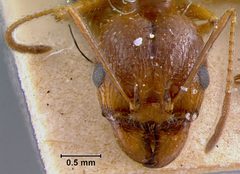
As a member of Pheidole, this exhibits the characteristic big-headed with dimorphic : minor workers with proportionate and major workers with dramatically enlarged, muscular heads housing powerful . Specific diagnostic features distinguishing P. desertorum from are not documented in available sources. The species' desert grassland association may aid in field identification where sympatric with other Pheidole species.
Images
Habitat
Desert grassland . The is specifically adapted to arid environments and has been studied in desert grassland .
Distribution
Desert regions of North America. The has been documented in desert grassland study sites, though precise geographic range boundaries require additional sources.
Seasonality
foraging activity during summer months. Mating season begins following summer rainfall events, with reproductive occurring prior to sunrise.
Diet
and scavengers on arthropods. Both minor and major participate in foraging, though major worker foraging appears concentrated when food is abundant.
Life Cycle
Colony foundation is normally haplometrotic (single ), though pleometrotic queen associations with have been observed. Young major workers may function as (food storage ). Most colonies produce reproductives annually. Colony sex ratios are extremely sex-biased, though direction of is not specified in available sources.
Behavior
foraging during summer. Anti- involves use of multiple nests as a defensive strategy. Both minor and major forage, with major foraging intensity linked to food abundance. Young majors may serve as . Mating behavior involves males forming aerial swarms prior to sunrise; enter swarms, mate on the ground, then fly away to locate colony founding sites.
Ecological Role
and scavenger on arthropods in desert grassland . The ' large colony sizes suggest substantial ecological impact on local through and scavenging pressure.
Similar Taxa
- Pheidole megacephalaBoth are big-headed ants with pronounced , but P. megacephala is a globally distributed supertramp with cold intolerance, whereas P. desertorum is native to desert grasslands with habits and specific arid-adapted .
- Other Pheidole speciesP. desertorum is distinguished by exceptionally large colony sizes for the (up to ~25,000 ), summer foraging, and specific desert grassland association, though precise morphological differentiators from sympatric require additional taxonomic resources.
More Details
Colony Size and Structure
Colonies are exceptionally large for Pheidole, ranging from 2,460–24,814 . The adult major/minor worker ratio varies substantially among colonies, with much of this variance explained by colony size and maturity of reproductive .
Reproductive Biology
Mating occur prior to sunrise following summer rainfall. Males form aerial swarms that enter; mating occurs on the ground, after which gynes disperse to found new colonies.
Research History
The has been subject to detailed natural history study in desert grassland , with particular attention to colony demography, ratios, and anti- involving multiple nest use.
Sources and further reading
- BugGuide
- GBIF taxonomy match
- iNaturalist taxon
- NCBI Taxonomy
- Catalogue of Life
- Grasshoppers of Colorado
- Grasshoppers of Colorado
- Big-headed Ants Are Biggest in Australia Due to Competition
- During Quarantine, an Entomologist Takes a Closer Look at a New Invasive Ant Species
- Fire ant winged reproductives: male and female | Beetles In The Bush
- alien | Blog
- Anti-predator behaviour in the ant Pheidole desertorum: The importance of multiple nests
- Natural History of the Ant Pheidole desertorum Wheeler in a Desert Grassland Habitat