
Pheidole megacephala
(Fabricius, 1793)
big-headed ant, coastal brown ant, African big-headed ant
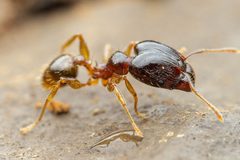
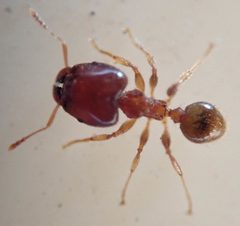
Pheidole megacephala is a highly successful native to tropical Africa, considered among the world's worst invasive organisms. It exhibits true dimorphism with distinct major and minor worker , the former bearing disproportionately large used for crushing food. The species forms expansive supercolonies through , enabling rapid territorial expansion. It has spread globally to tropical and subtropical regions, where it aggressively displaces native ant faunas and disrupts function through and mutualistic associations with sap-sucking insects.
Pronunciation
How to pronounce Pheidole megacephala: /faɪˈdoʊli ˌmɛɡəˈsɛfələ/
These audio files are automatically generated. While they are not always 100% accurate, they are a good starting point.
Identification
Distinguished from other Pheidole by the combination of: major with disproportionately large relative to body size; smooth head surface contrasting with sculptured ; two-segmented petiole with swollen anterior node; presence of short, upward-facing spines on the waist. In Florida, distinguished from Pheidole navigans by head shape and petiole structure. Superficially similar to other dimorphic Pheidole species, but the extreme head size disparity in majors is diagnostic.
Images
Habitat
Nests primarily in soil, creating underground colonies with multiple entrances. Constructs debris-covered foraging tunnels on the ground surface. Occupies diverse including native prairie, agricultural land, forest edges, and urban environments. In invaded ranges, frequently associated with human-disturbed habitats. Can inhabit indoor spaces. Rainforest patches in northern Australia represent significant centers.
Distribution
Native to tropical Africa (first described from Mauritius, with 1775 records from Egypt). Introduced and established throughout tropical and subtropical regions worldwide including: Australia (widespread, particularly coastal and northern areas), Florida and Hawaii (USA), Bermuda, Caribbean islands, Japan, Taiwan, Mexico, and numerous Pacific and Atlantic islands. Absent from cold climates due to temperature intolerance.
Seasonality
occur during winter and spring in Florida; timing likely varies by region. Year-round activity in suitable climates with continuous production. Foraging activity occurs throughout the year in tropical and subtropical .
Diet
omnivore. Preys upon dead insects, small , and insect (including eggs such as African sugarcane borer). Harvests seeds, which major crush with for transport by minors. Consumes honeydew excreted by sap-sucking hemipterans including aphids, soft scale insects, , whiteflies, and planthoppers; attends these insects for resources. Scavenges larger food items, which may be dissected before transport.
Life Cycle
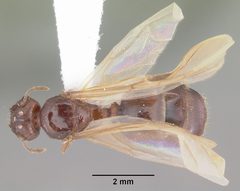
Colonies are polygynous, typically containing multiple queens. occurs through followed by colony founding, or more commonly through —where queens and depart to establish new nests nearby without swarming. Queens lay up to 290 per month. Eggs hatch in 2–4 weeks; legless larvae fed by workers pupate after approximately one month; workers emerge 10–20 days later. Worker determined developmentally through differential nutrition and levels, not genetic differences.
Behavior
Highly aggressive forager with sophisticated recruitment systems. Minor perform most tasks including foraging; major workers specialize in colony defense, food processing, and crushing large items. Short-range recruitment via for large prey, with spread-eagling by multiple workers. Long-range recruitment from nest based on prey size. Scouts use long-range recruitment when detecting or competing landmarks, avoiding solitary confrontation. Forms extensive foraging trails up tree trunks and into . Constructs conspicuous surface tunnels that may be mistaken for termite tubes.
Ecological Role
that profoundly reduces diversity in invaded . In northern Australia, densities reached 37–110 times native abundance, with other reduced to 15% of natural levels. Forms mutualistic relationships with honeydew-producing hemipterans, protecting them from predators and while facilitating their increase. Competitively superior to most native ants; in Bermuda, gradually displaced by Argentine ant (Linepithema humile) in some contexts. Proficient raider of other ant colonies, with higher success rates in introduced versus native ranges.
Human Relevance
Listed among the 100 "World's Worst" . Major agricultural pest through seed harvesting and protection of crop-damaging hemipterans. Chews irrigation, telephone, and electrical cabling causing infrastructure damage. Significant threat to biodiversity conservation, particularly on islands. Subject to and control efforts using chemical treatments and fire management. Potential target for microbial control using recently characterized viruses.
Similar Taxa
- Pheidole navigansOccurs sympatrically in Florida; distinguished by shape and petiole node structure
- Linepithema humile (Argentine ant)Competing with which it interacts aggressively; distinguished by uniform size, lack of major worker , and different petiole structure
- Solenopsis invicta (red imported fire ant)Another with ; distinguished by sting presence, different shape, and more aggressive defensive
Misconceptions
Sources and further reading
- BugGuide
- Wikipedia
- GBIF taxonomy match
- iNaturalist taxon
- NCBI Taxonomy
- Catalogue of Life
- Big-headed Ants Are Biggest in Australia Due to Competition
- During Quarantine, an Entomologist Takes a Closer Look at a New Invasive Ant Species
- Hunting the Great Plains giant tiger beetle | Beetles In The Bush
- A “Really” Big-headed Tiger Beetle | Beetles In The Bush
- Fire ant winged reproductives: male and female | Beetles In The Bush
- pest | Blog
- The predatory behavior of Pheidole megacephala
- Bigheaded Ant, Pheidole megacephala (Fabricius) (Insecta: Hymenoptera: Formicidae: Myrmicinae)
- Pheidole Megacephala and Iridomyrmex Humilis in Bermuda‐Equilibrium or Slow Replacement?
- Five novel RNA viruses of the invasive big-headed ant (Pheidole megacephala)
- The Big-headed Ant Pheidole megacephala: a new threat to monsoonal northwestern Australia
- Bermudian Ants Revisited: The Status and Interaction of Pheidole Megacephala and Iridomyrmex Humilis
- Genetics, behaviour and chemical recognition of the invading ant Pheidole megacephala
- Does the Coastal brown ant (Pheidole megacephala Fabricius) eliminate other ants? Some preliminary morphological, physiological and behavioural studies.
- Homoptera associated with the ants Crematogaster clariventris, Pheidole megacephala and Tetramorium aculeatum (Hymenoptera: Formicidae) on cocoa in Ghana
- Taxonomic revision of the Pheidole megacephala species-group (Hymenoptera, Formicidae) from the Malagasy Region
- The raiding success of Pheidole megacephala on other ants in both its native and introduced ranges