
Pheidole navigans
Forel, 1901
Navigating Big-headed Ant, Wandering Big-headed Ant
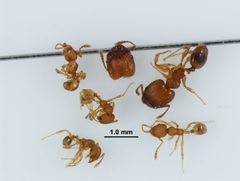
Pheidole navigans is a small, dimorphic big-headed ant native to the Neotropics and established as across multiple regions including the southeastern United States, California, Hawaii, Bermuda, Madeira, Tenerife, and Vanuatu. Formerly synonymized with Pheidole flavens, it was restored to full status in 2015. The species exhibits a dimorphic system with major and minor , and is characterized by small size, , and flexible nesting habits. Its ecological impacts in invaded regions are currently considered limited.
Pronunciation
How to pronounce Pheidole navigans: /ˈfaɪdoʊli nævɪˈɡænz/
These audio files are automatically generated. While they are not always 100% accurate, they are a good starting point.
Identification
Major can be distinguished from closely related P. flavens and P. moerens by: longitudinal rugae on lobes (versus absent or weak); longer, narrower, more distinct antennal scrobe with stronger, more continuous frontal carina; more scrobe depression; and transverse on promesonotum surface. Minor workers cannot be reliably distinguished from other P. flavens complex . Previously misidentified as P. moerens in range prior to 2015.
Images
Habitat
Highly with flexible nest preferences. Nests in diverse microhabitats including under boards, at bases of fence posts and oak trees, in rotten wood, wall crevices, hollow twigs, nuts, leaf litter, and occasionally arboreally. Nest chambers have small openings and are constructed with soil and debris.
Distribution
Native to the Neotropics, recorded from Brazil, Colombia, Venezuela, and Paraguay. established in: southeastern United States (Alabama since 1967, Florida since 1975, later Georgia, Mississippi, North Carolina, Texas by 2018), southern California (by 1995), Hawaii (by 2003), Vanuatu (2011), Madeira (2014), Bermuda (2016), Canary Islands/Tenerife (2020), and continental Spain/Málaga (2021). Type locality is Germany due to interception record from orchids originating from Veracruz, Mexico.
Seasonality
primarily occur in July in Florida.
Diet
omnivore consuming small arthropods, seeds, sugars, and human food. Attracted to both sugar and protein baits; responds rapidly to tuna baits with recruitment of both major and minor .
Host Associations
- Mealybugs - Observed feeding on honeydew produced by mealybugs on plants
Life Cycle
Colony foundation: monogynous but undergoes pleometrosis (multiple queens cooperate to found colony, with only one surviving past founding) and dependent colony foundation (), where existing colonies split to form autonomous daughter groups. Mature colonies contain over 100 majors and 500 . in July. Development includes , larva, pupa, and stages for all .
Behavior
Foraging occurs very close to nest. Major often forage alongside minor workers. Rapid recruitment response to food sources, particularly protein baits. Colonies exhibit cooperative defense and territorial expansion through . Workers patrol plants and aggressively defend resources.
Ecological Role
In Florida, partially successful in displacing native Pheidole dentigula and Pheidole bilimeki. May compete for nesting space with native southeastern U.S. including Aphaenogaster, Camponotus, Nylanderia, Solenopsis, Hypoponera, Strumigenys, and Brachymyrmex. Classified as category D2 : capable of surviving, reproducing, and sustaining stable in introduced regions. Ecological impacts currently considered limited as of 2022.
Human Relevance
Not reported as major house pest despite occasional indoor presence. Subject of frequent interception records worldwide due to strong pressure. Misidentification in range complicated historical tracking of its spread.
Similar Taxa
- Pheidole flavensFormerly synonymized; major distinguished by weaker sculpturing, less distinct antennal scrobe, and lack of transverse promesonotal
- Pheidole moerensFrequently misidentified as this prior to 2015; major distinguished by longitudinal rugae on lobes and more distinct antennal scrobe in P. navigans
- Pheidole glomericepsMorphologically similar member of P. flavens group; reliable distinction requires examination of major sculpturing and scrobe characteristics
Misconceptions
Long considered a synonym of Pheidole flavens (1901–2003 as , fully synonymized 2003–2015); restoration to full status in 2015 clarified its distinct identity and distribution.
More Details
Taxonomic History
Originally described as Pheidole flavens navigans by Auguste Forel in 1901; fully synonymized under Pheidole flavens by E.O. Wilson in 2003; restored to full status by Sarnat et al. in 2015 based on morphological and genetic evidence. The P. flavens species group, to which it belongs, was not recovered as monophyletic in 2015 phylogenetic analyses.
Genetic Relationships
Appears to be closely related to P. moerens and P. flavens sensu stricto, forming a relatively basal clade within Pheidole as a whole.
Caste-Specific Brain Morphology
Minor allocate more space for the than major workers, suggesting more complex task performance, while major workers possess more integrated brains and greater muscle mass.
Sources and further reading
- BugGuide
- Wikipedia
- GBIF taxonomy match
- iNaturalist taxon
- NCBI Taxonomy
- Catalogue of Life
- During Quarantine, an Entomologist Takes a Closer Look at a New Invasive Ant Species
- Big-headed Ants Are Biggest in Australia Due to Competition
- Fire ant winged reproductives: male and female | Beetles In The Bush
- Hymenoptera | Blog - Part 7
- Bichos Argentinos #2 – Pseudomyrmex sp. | Beetles In The Bush
- Ants in the Nest: A Possible Emerging Pressure on Sea Turtles