
Kapala floridana
(Ashmead, 1885)
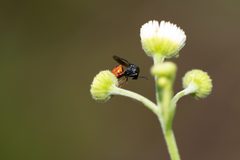
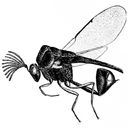
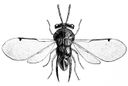
Kapala floridana is a of in the Eucharitidae, originally described by Ashmead in 1885 as Thoracantha floridana. The Kapala comprises parasitoid wasps that are among the largest in their family, with species ranging from 3 to 9 mm in length. Members of this genus are presumed to parasitize the of orthopterans, including grasshoppers, crickets, and katydids. The specific and relationships of K. floridana remain poorly documented.
Pronunciation
How to pronounce Kapala floridana: /kəˈpɑːlə flɔːrɪˈdɑːnə/
These audio files are automatically generated. While they are not always 100% accurate, they are a good starting point.
Images
Distribution
The epithet "floridana" suggests an association with Florida, USA. The Kapala has a primarily Neotropical distribution, with most species occurring in continental Mesoamerica, Central America, and South America.
Host Associations
- Orthoptera - presumed Based on -level assumption; not confirmed for K. floridana specifically
More Details
Taxonomic history
Originally described as Thoracantha floridana by Ashmead in 1885, later transferred to the Kapala. The genus Kapala is part of the Eucharitinae within Eucharitidae.
Genus characteristics
Kapala are distinguished from other Eucharitidae by their relatively large size (3-9 mm), robust and elongated bodies, and often vivid coloration. These traits contrast sharply with the typical 1-2 mm size of most platygastrid .
Sources and further reading
- BugGuide
- GBIF taxonomy match
- iNaturalist taxon
- NCBI Taxonomy
- Catalogue of Life
- Rediscovery of Cicindela scabrosa floridana | Beetles In The Bush
- Photographing the Newly Rediscovered Cicindelidia floridana | Beetles In The Bush
- The (almost) Florida-endemic Cicindelidia scabrosa | Beetles In The Bush
- Mini-review of the Cicindelidia abdominalis species-group | Beetles In The Bush
- Why I Roamed the Marsh at Night | Beetles In The Bush
- species distribution | Blog