
Myrmecolacidae
Saunders, 1872
Genus Guides
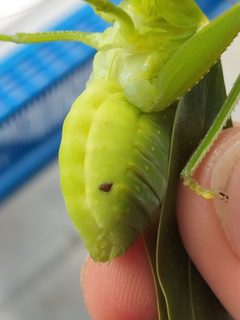
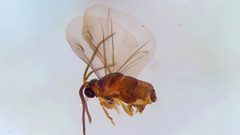
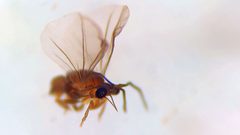
1is a of twisted-wing (order Strepsiptera) comprising four and approximately 98 . The family exhibits extreme : males are free-living with functional wings and parasitize ants (Formicidae), while females are neotenic, legless, and develop inside Orthoptera (grasshoppers, crickets, and katydids). This dual system is unique among strepsipterans and makes matching females to males exceptionally difficult. The family has a fossil record extending to the Eocene, with specimens known from Baltic and Chinese amber.
Pronunciation
How to pronounce Myrmecolacidae: //mɨrmɛkoʊˈlæsɪdiː//
These audio files are automatically generated. While they are not always 100% accurate, they are a good starting point.
Identification
Males possess large, fan-shaped hind wings and reduced forewings modified into -like structures (pseudohalteres), with branched and divided into large and smaller components. Females are , lacking wings, legs, eyes, and distinct segmentation, appearing as amorphous sacs within tissues. is so extreme that females and males were historically described as separate . Identification to relies primarily on male , particularly genitalic structures and antennal branching patterns.
Images
Habitat
Associated with supporting both groups: ants for male development and Orthoptera for female development. Collection records indicate presence in tropical and subtropical forests, grasslands, and disturbed areas where host ants (including Solenopsis, Camponotus, Ectatomma, and Megalomyrmex) occur. Fossil evidence from Eocene amber suggests ancient presence in forested environments.
Distribution
Worldwide distribution excluding the Palearctic and Antarctic regions. Documented from the Neotropics (Brazil, Colombia, Rica, Mexico), Nearctic (southern United States), Afrotropics, Indomalaya, and Australasia. Fossil records from Eocene Baltic amber (39–50 Ma) and Eocene Chinese amber (~52 Ma) extend the known geological range from Miocene to Eocene.
Host Associations
- Formicidae - PARASITOID_OFMales parasitize ants; documented include Solenopsis invicta, Camponotus planatus, Ectatomma edentatum, Megalomyrmex cyendyra, and Prionomyrmex (fossil)
- Orthoptera - PARASITOID_OFFemales parasitize grasshoppers, crickets, and katydids (Ensifera and Caelifera)
Life Cycle
Endoparasitic development with free-living first-instar larvae () that actively seek . Males complete development within hosts, emerging as winged . Females remain within Orthoptera hosts, becoming neotenic and releasing planidia through a canal opening to the host exterior. Adult males live only a few hours, do not feed, and seek females for mating.
Behavior
males exhibit positive and are attracted to lights, facilitating collection. Stylopized ants (those parasitized by strepsipterans) display altered including reduced foraging, modified locomotion, and clustering near nest entrances. Yellow pan traps have proven effective for collecting stylopized ants. Males use their branched to detect female .
Ecological Role
regulating of ants and Orthoptera. The dual system creates indirect ecological linkages between and orthopteran . of this are poorly understood due to cryptic female development and the difficulty of detecting in Orthoptera.
Human Relevance
Potential for of pest ants, particularly such as Solenopsis invicta (red imported fire ant). Research interest centers on understanding specificity and developing collection methods for stylopized ants. No direct economic importance or medical significance.
Similar Taxa
- StylopidaeAlso parasitize Hymenoptera but lack the dual system; both sexes develop in the same host type (bees or ). Males have similar wing but differ in antennal structure and host associations.
- HalictophagidaeParasitize leafhoppers and planthoppers (Hemiptera); males have four hind wing hooks (myrmecolacids have two), and lack the extreme and dual system of .
- ElenchidaeParasitize planthoppers (Fulgoroidea); males have reduced wing venation and different antennal ; females develop in the same type as males.
Sources and further reading
- BugGuide
- Wikipedia
- GBIF taxonomy match
- iNaturalist taxon
- NCBI Taxonomy
- Catalogue of Life
- New host record for Caenocholax fenyesi sensu lato (Strepsiptera: Myrmecolacidae) from Costa Rica
- New Host Association, Distribution, and Morphological Variation in Caenocholax fenyesi (Strepsiptera: Myrmecolacidae)
- The first twisted-wing parasitoid in Eocene amber from north-eastern China (Strepsiptera: Myrmecolacidae)
- First host record of stylopization of a worker ant, Ectatomma edentatum (Formicidae: Ectatomminae), by a Myrmecolacidae (Strepsiptera)
- First record of a female stylopid (Strepsiptera: ?Myrmecolacidae) parasite of a prionomyrmecine ant (Hymenoptera: Formicidae) in Baltic amber
- Strepsiptera from Colombia: First record of the genus Strichotrema Hofeneder (Myrmecolacidae) and a new host-parasitoid association with <br />Megalomyrmex cyendyra (Hymenoptera: Formicidae)
- Distribution of Caenocholax fenyesi (Strepsiptera: Myrmecolacidae) and the Habitats Most Likely To Contain Its Stylopized Host, Solenopsis invicta (Hymenoptera: Formicidae)
- <I>Caenocholax fenyesi</I> (Strepsiptera: Myrmecolacidae) Parasitic in <I>Camponotus planatus</I> (Hymenoptera: Formicidae) in Mexico: Is This the Original Host?