
Gnamptogenys
Roger, 1863
Species Guides
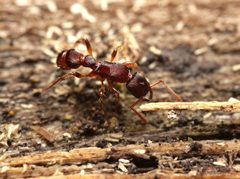
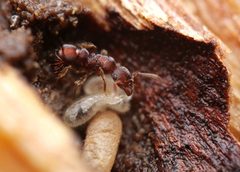
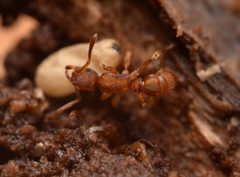
2Gnamptogenys is a of ants in the Ectatomminae containing approximately 32 extant and 5 fossil species following a major 2022 revision. The genus exhibits wide geographic distribution across the Nearctic, Neotropical, Indomalayan, and Australasian realms. Species occupy diverse from soil and decaying wood to arboreal environments, with most species being predatory on small arthropods. The genus was substantially reduced in scope when Camacho et al. (2022) reinstated four formerly synonymized genera (Alfaria, Holcoponera, Poneracantha, and Stictoponera) to accommodate many former Gnamptogenys species.
Pronunciation
How to pronounce Gnamptogenys: //ɡnæmptoʊˈdʒɛnɪs//
These audio files are automatically generated. While they are not always 100% accurate, they are a good starting point.
Identification
Distinguished from related by combination of mandibular structure and body sculpturing; following the 2022 revision, Gnamptogenys sensu stricto is distinguished from the reinstated genera Alfaria, Holcoponera, Poneracantha, and Stictoponera by specific morphological characters detailed in Camacho et al. (2022). are generally small (approximately 3 mm, rarely exceeding 7 mm), though G. concinna exhibits gigantism at 9–12 mm.
Images
Habitat
Humid forests of tropical and subtropical regions; microhabitats include dead or decaying wood, soil, and suspended soils at bases of epiphytes. Some are obligately arboreal (e.g., G. concinna in ), while others are primarily ground-nesting with limited arboreal foraging (e.g., G. acuta forages up to 3 m high while nesting on ground).
Distribution
Nearctic, Neotropical, Indomalayan, and Australasian realms. Specific records include: southeastern United States (Texas, Louisiana), Mexico, Central America, South America (Brazil, French Guiana, Argentina), and Oriental/Australian regions.
Diet
Predatory on small arthropods including ants, beetles, , and millipedes; diet ranges from strict to omnivore including scavenging and occasional plant-derived products.
Behavior
Solitary hunting by ; flexible retrieval strategies with solitary transport of small prey items and group recruitment of 3–12 workers for large items. Recruitment involves location information transmission via substrate tapping (sting tapping). Foraging activity shows seasonal variation with greater activity and longer distances in warm periods versus cool seasons. Some restrict foraging almost entirely to nest microhabitat (e.g., bromeliad).
Ecological Role
of small arthropods; some function as agro-predators attacking fungus-growing colonies (e.g., G. hartmani).
Human Relevance
G. hartmani has been studied as a of fungus-growing ants with potential implications for understanding dynamics; otherwise minimal direct human interaction documented.
Similar Taxa
- AlfariaFormerly synonymized with Gnamptogenys, reinstated as separate in 2022 revision
- HolcoponeraFormerly synonymized with Gnamptogenys, reinstated as separate in 2022 revision
- PoneracanthaFormerly synonymized with Gnamptogenys, reinstated as separate in 2022 revision
- StictoponeraFormerly synonymized with Gnamptogenys, reinstated as separate in 2022 revision
Sources and further reading
- BugGuide
- Wikipedia
- GBIF taxonomy match
- iNaturalist taxon
- NCBI Taxonomy
- Catalogue of Life
- Gnamptogenys concinna (F. Smith, 1858) : nouvelles données sur sa distribution et commentaires sur ce cas de gigantisme dans le genre Gnamptogenys (Hymenoptera, Formicidae, Ectatomminae)
- Patterns in foraging and nesting ecology in the neotropical ant, Gnamptogenys moelleri (Formicidae, Ponerinae)
- Recruitment Behavior During Foraging in the Neotropical Ant Gnamptogenys moelleri (Formicidae: Ponerinae): Does the Type of Food Matter?
- Expanding the Distribution of the Remarkable Ant Gnamptogenys vriesi Brandão & Lattke (Formicidae, Ectatomminae): First Record From Brazil
- Geographic distribution of Gnamptogenys hartmani (Hymenoptera, Formicidae), an agro-predator that attacks fungus-growing ants
- Colony Reproduction and Arboreal Life in the Ponerine Ant Gnamptogenys Menadensis (Hymenoptera: Formicidae)