
Philanthus gibbosus
(Fabricius, 1775)
Hump-backed Beewolf, Beewolf
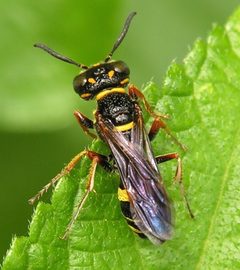
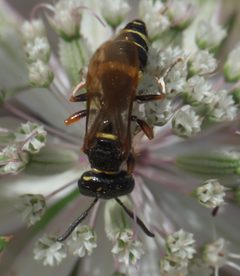
Philanthus gibbosus, commonly known as the hump-backed beewolf, is a solitary bee-hunting wasp and the most common and widespread member of its in North America. Females construct underground burrows in sandy soils and provision them with paralyzed bees as food for their larvae. The exhibits a with two per year, and shows a tendency toward temporary communal nesting unusual for solitary .
Pronunciation
How to pronounce Philanthus gibbosus: /fɪˈlænθəs ˈdʒɪbəsəs/
These audio files are automatically generated. While they are not always 100% accurate, they are a good starting point.
Identification
The deep, large punctures on the are diagnostic for this and readily distinguish it from other Philanthus species. The combination of a broad , shiny black coloration with yellow spots on the head and striped abdomen and , plus the hump-backed appearance, allows reliable field identification. Males can be recognized by their reduced head markings compared to females.
Images
Habitat
Prefers sandy soils in deciduous forest and coastal areas where burrowing is feasible. Nesting sites are typically located near supporting structures such as tree roots, bricks, or cement. Requires well-drained, sandy or sandy-loam soil composition suitable for excavating burrows 15–60 cm deep.
Distribution
Widely distributed across North America from the Atlantic to the Pacific, and from Canada to Mexico. Most common in the central Midwestern United States, with highest concentrations in Missouri and Tennessee. Range extends west to Kansas and south to Georgia.
Seasonality
Active primarily from May through September. First emerge in mid-July; second generation overwinters as larvae in cocoons from October through April, pupates, and emerges in May to begin the nesting cycle.
Diet
feed on nectar from flowers. Larvae are , provisioned with paralyzed bees (primarily Halictidae, also Colletidae and Andrenidae) and occasionally other . Recorded prey includes at least 35 of bees and wasps.
Host Associations
- Halictidae - preySweat bees are the majority of prey items
- Colletidae - preyYellow-faced bees
- Andrenidae - preyMining bees
- Pemphredon - preyAphid wasps in Crabronidae
- Cucochodaeus sparsus - prey occasionally taken
- Senotainia trilineata - Miltogrammid fly, nest
- Metopia - Satellite fly
- Hilarella - Satellite fly
- Dasymutilla nigripes - probable Velvet ant
- Hedychrydium dimidiatum - suspected Cuckoo wasp
- Streptomyces - -producing bacteria in
Life Cycle
with two per year. First generation: emerge mid-July, disperse and nest, die by early September. Second generation: larvae remain in cocoons October–April, pupate in April, emerge May. Females excavate burrows 15–24 cm long (sometimes to 1 m), construct oval , provision with 3+ paralyzed bees per cell, lay single , and seal cell. Developmental stages: egg, larva (feeding on provisioned prey), pupa (in cocoon), adult.
Behavior
Females are solitary nesters that excavate burrows in sandy soil using and , standing on hind legs while digging. They hunt bees by stalking flowers, paralyzing prey with a sting between the front legs, and carrying victims beneath the body using middle legs. Males are highly territorial, perching on low vegetation and scent-marking with abdominal brushes to defend mating territories. Males may return to the same burrow nightly and occasionally cohabit with females. Sibling females may temporarily share natal nests before dispersing, representing a transitional stage toward sociality.
Ecological Role
of bees and that helps regulate . function as pollinators while foraging for nectar. Serves as for parasitic flies and wasps. Contributes to soil turnover through burrowing activity.
Human Relevance
of some plants including carrot. Poses challenges for operations due to on honey bees. Subject of scientific research on navigation, presocial , and venom biochemistry.
Similar Taxa
- Philanthus triangulumEuropean beewolf that also preys on bees; distinguished by geographic range and specific markings
- Philanthus ventilabrisAnother North American beewolf ; P. gibbosus distinguished by deeper abdominal punctures
- NomadaCuckoo bees that mimic beewolves in appearance but lack the predatory and punctured
- AphilanthopsRelated philanthine with straight inner margins (notched in Philanthus) and different prey ( queens)
More Details
Navigation
Females use subtle landmarks to locate buried nest entrances, a studied by Nikolaas Tinbergen in the European P. triangulum and confirmed in P. gibbosus.
Venom
The sting delivers venom that blocks somatic neuromuscular transmission, rapidly paralyzing prey without killing it. The presents armored body portions to prey during capture to avoid retaliation stings.
Mimicry
Participates in a Müllerian mimicry complex with other black-and-yellow banded . Mimicry frequency peaks in spring and late summer, declining in midsummer when insectivorous birds are abundant and have not yet learned avoidance.
Presocial Tendencies
Temporary communal nesting by sibling females and multi-generational nest expansion represent a unique stage in the evolution of sociality, more pronounced in some than others.
Sources and further reading
- BugGuide
- Wikipedia
- GBIF taxonomy match
- iNaturalist taxon
- NCBI Taxonomy
- Catalogue of Life
- The Amazing World of 'Gwentomologist' Gwen Erdosh | Bug Squad
- Bug Eric: Wasp Wednesday: Beewolves
- Bug Eric: August 2011
- Bug Eric: June 2012
- Bug Eric: Wasp Wednesday: Ant-queen Kidnappers
- a citizen scientist’s journey into botany