
Dasymutilla nigripes
(Fabricius, 1787)
velvet ant
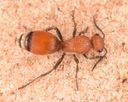
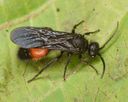
Dasymutilla nigripes is a of velvet ant ( Mutillidae) native to North America. Females are wingless and possess a powerful sting, while males are winged. The species has been documented as a likely of beewolf nests. It is widespread across the United States and occurs in Alberta, Canada.
Pronunciation
How to pronounce Dasymutilla nigripes: /ˌdæsɪmjʊˈtɪlə ˈnaɪgrɪˌpiːz/
These audio files are automatically generated. While they are not always 100% accurate, they are a good starting point.
Identification
As a velvet ant, females can be recognized by their wingless condition, dense velvety , and -like body form. Males are winged and may be colored differently from females. -level identification of Dasymutilla requires specialized knowledge; the is taxonomically complex with many species recently synonymized. D. nigripes specifically may be distinguished by characters related to leg coloration (black feet), though detailed diagnostic features are not provided in available sources.
Images
Appearance
Velvet ants exhibit strong . Females are wingless with a robust, -like body covered in dense setae. Males possess two pairs of wings. The specific coloration and patterning of D. nigripes is not detailed in available sources, though the epithet "nigripes" refers to black feet or legs.
Habitat
Specific preferences for D. nigripes are not documented. Velvet ants in the Dasymutilla are generally associated with open, sandy or arid habitats including prairies, deserts, and dry grasslands where their nest.
Distribution
Widespread throughout the United States. Also recorded from Alberta, Canada.
Host Associations
- Philanthus gibbosus - likely The velvet ant Dasymutilla nigripes is identified as a likely of beewolf nests.
Life Cycle
As with other velvet ants, the involves of other or bees. Females likely deposit in nests, with larvae feeding on host pupae or larvae. Specific details for D. nigripes are not documented.
Behavior
Females are known to run rapidly across the ground in search of nests. Both sexes of velvet ants can produce audible squeaking sounds (stridulation) by rubbing abdominal segments together, which serves as a defensive warning.
Ecological Role
of other solitary , contributing to of .
Human Relevance
Females can deliver a painful sting if handled. The poses no agricultural or medical significance beyond this defensive capability.
Similar Taxa
- Dasymutilla bioculataBoth are common, widespread Dasymutilla ; D. bioculata has been subject to recent taxonomic revision lumping multiple former species, suggesting similar challenges in species-level identification.
- Dasymutilla occidentalisAnother common eastern velvet ant with aposematic coloration; both are part of Müllerian mimicry complexes and share the general "velvet ant" .
- Dasymutilla gloriosaSame with extreme sexual dichromacy; however, D. gloriosa females are uniquely covered in long white hairs resembling thistledown, distinguishing them from D. nigripes.
More Details
Taxonomic complexity
The Dasymutilla has undergone significant taxonomic revision. A 2010 molecular study resulted in synonymizing 21 former and under D. bioculata, demonstrating that morphological variation in this genus can be misleading for species delineation. Similar revisions may affect other species including D. nigripes.
Stridulation
Both male and female velvet ants can produce squeaking sounds by rubbing abdominal segments together. This stridulation serves as an auditory warning in addition to visual aposematic signals.
Sources and further reading
- BugGuide
- Wikipedia
- iNaturalist taxon
- NCBI Taxonomy
- Bug Eric: Wasp Wednesday: Beewolves
- Bug Eric: August 2011
- Bug Eric: Wasp Wednesday: Dasymutilla bioculata
- The gloriously dichromatic Dasymutilla gloriosa | Beetles In The Bush
- A sting to kill a cow? Red velvet ant, a.k.a. cow killer, Dasymutilla occidentalis — Bug of the Week