
Dasymutilla occidentalis
(Linnaeus, 1758)
Common Eastern Velvet Ant, Red Velvet Ant, Cow Killer, Cow Ant, Eastern Velvet Ant
Dasymutilla occidentalis is a large, solitary in the Mutillidae, commonly known as the eastern or cow killer. Females are wingless, densely covered in velvety red and black hairs, and possess an extremely painful sting. Males are winged and less conspicuously colored. The is an external parasitoid of ground-nesting bees and wasps, with females actively searching for nests to lay on or near developing larvae. Despite its , it is not an but a true wasp, and its sting, while intensely painful, cannot actually kill a cow.
Pronunciation
How to pronounce Dasymutilla occidentalis: /ˌdæsɪˈmjuːtɪlə ˌɒksɪˈdɛntəlɪs/
These audio files are automatically generated. While they are not always 100% accurate, they are a good starting point.
Identification
Unmistakable in eastern North America due to large size, wingless females with dense red-and-black velvety hair, and erratic, rapid running . The combination of bright red , black , and complete absence of wings in females separates it from all true ants (which have elbowed and a constricted petiole with one or two nodes) and from other velvet ants (which are smaller or differently colored). Males can be distinguished from other by the mutillid body plan and wing venation.
Images
Appearance
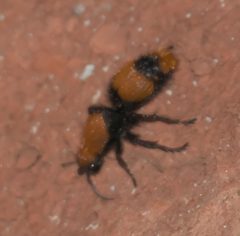
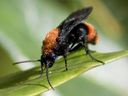
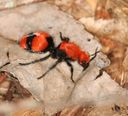
Females are large (up to 25 mm), wingless, and densely covered in velvety aposematic hairs: bright red on the and , black on the abdomen. The dense pilosity gives a plush, -like appearance. Males are winged, generally smaller, with less striking coloration—typically black with some reddish markings. Both sexes have powerful . Females possess an extraordinarily long, flexible stinger (modified ovipositor) that can be nearly half the body length.
Habitat
Open, sunny with sandy or loose soil suitable for ground-nesting bees and . Frequently encountered in lawns, pastures, meadows, forest edges, and along roadsides. Often observed running rapidly across bare ground or sparse vegetation while searching for host nests.
Distribution
Eastern United States, ranging from Connecticut and Missouri northward to Florida and Texas southward. Absent from the western United States.
Seasonality
Active primarily during warm months; most commonly observed from June through September. Peak activity coincides with peak abundance of colonies.
Host Associations
- Bombus spp. - primary ground-nesting bumble bees
- Sphex ichneumoneus - possible single record of female exiting burrow, requires confirmation
- Nomada fervida - possible based on proximity observation, unconfirmed
Life Cycle
Females deposit a single on or near a larva within a or nest. The emerging larva consumes the host, then pupates within the host . Development is holometabolous with complete . Males emerge, fly to seek mates and nectar sources; females emerge, mate, and immediately begin ground-dwelling host-seeking .
Behavior
Females exhibit rapid, erratic, non-stop running across open ground while searching for nests—a distinctive trait that makes them difficult to capture or photograph. When handled or threatened, females stridulate (produce audible squeaking sounds) by rubbing abdominal segments together, and extrude their long stinger. Neither sex is social; all interactions are solitary.
Ecological Role
External (parasitoid ) that regulates of ground-nesting bees and wasps. Part of a large Müllerian mimicry complex with other aposematically colored velvet ants and unrelated insects, reinforcing avoidance of red-and-black warning patterns.
Human Relevance
Infrequently encountered but memorable due to aposematic coloration and reputation. The sting is among the most painful of any North American insect, rated 3.0 on the Schmidt Sting Pain Index, described as 'explosive and long-lasting.' No medical significance beyond acute pain; not aggressive but will sting if handled. 'cow killer' is a folkloric exaggeration with no factual basis.
Similar Taxa
- Dasymutilla gloriosaSimilar but female has dense white thistledown-like hairs rather than red-and-black; occurs in southwestern US, not overlapping range
- Dasymutilla quadriguttataSmaller, with four white spots on black background; less strikingly colored
- Pseudomethoca simillimaSmaller, different color pattern (orange and black bands), more restricted distribution
- True ants (Formicidae)Ants have elbowed , constricted petiole with nodes, and different body proportions; wingless females of D. occidentalis lack these features despite convergent appearance
Misconceptions
The 'cow killer' falsely implies the sting can kill cattle; this is biologically impossible. The is frequently mistaken for a true due to wingless females and common name, but it is a solitary with no social structure.
Sources and further reading
- BugGuide
- GBIF taxonomy match
- iNaturalist taxon
- NCBI Taxonomy
- A sting to kill a cow? Red velvet ant, a.k.a. cow killer, Dasymutilla occidentalis — Bug of the Week
- Mutillidae | Beetles In The Bush
- Bees vs wasps: what's the difference? - Buglife Blog - Buglife
- AN ABERRANT FEMALE AND POSSIBLE NEW HOST RECORD FOR DASYMUTILLA OCCIDENTALIS (HYMENOPTERA: MUTILLIDAE)