
Dasymutilla quadriguttata
(Say, 1823)
Four-spotted Velvet Ant
Dasymutilla quadriguttata is a of velvet ant in the Mutillidae, commonly known as the Four-spotted Velvet Ant. Like other mutillids, females are wingless and possess a powerful sting, while males have wings. The species has been noted as a potential model for Müllerian mimicry, with its bright coloration serving as aposematic warning signals to . It occurs in Missouri and surrounding regions, where it has been reported more frequently than some related species.
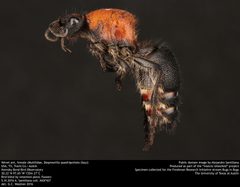
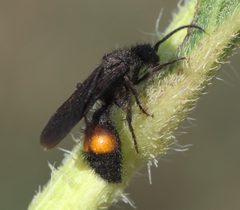
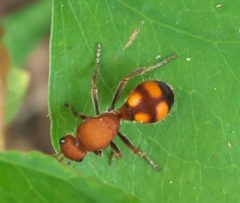
Pronunciation
How to pronounce Dasymutilla quadriguttata: //ˌdeɪsɪmjʊˈtɪlə ˌkwɒdrɪˌɡʌˈteɪtə//
These audio files are automatically generated. While they are not always 100% accurate, they are a good starting point.
Images
Habitat
Has been observed in dry sand deposits along river systems, such as the Mississippi River in southeastern Missouri. Associated with open, sandy typical of many Dasymutilla .
Distribution
Recorded from Missouri and surrounding regions in the central United States. The Dasymutilla is broadly distributed across North America, with many in arid and prairie .
Behavior
Females are known to move rapidly and continuously when active, making them difficult to photograph. Like other velvet ants, they are solitary and do not form colonies.
Ecological Role
Has been proposed as a potential model for Müllerian mimicry, specifically suggested as a possible visual model for the checkered beetle Enoclerus ichneumoneus ( Cleridae).
Similar Taxa
- Pseudomethoca simillimaBoth have been proposed as potential Müllerian mimicry models for Enoclerus ichneumoneus; however, D. quadriguttata is larger and more commonly encountered in Missouri.
- Dasymutilla bioculataCongeneric with similar and ; D. bioculata was subject to extensive taxonomic lumping in 2010, demonstrating the complexity of species-level identification in this .
More Details
Mimicry relationships
The has been specifically mentioned in the context of Müllerian mimicry rings involving velvet ants and their mimics, though definitive studies confirming this relationship have not been identified.
Taxonomic note
The epithet is sometimes misspelled as 'quadriquttata' in informal sources; the correct spelling is quadriguttata (Say, 1823).
Sources and further reading
- BugGuide
- Wikipedia
- iNaturalist taxon
- NCBI Taxonomy
- Cleridae | Beetles In The Bush | Page 2
- Bug Eric: Wasp Wednesday: Dasymutilla bioculata
- A sting to kill a cow? Red velvet ant, a.k.a. cow killer, Dasymutilla occidentalis — Bug of the Week
- The Relationship of Dasymutilla Permista Mickel to Dasymutilla Quadriguttata (Say) and Behavior Notes on the Species