
Pseudomethoca simillima
(Smith, 1855)
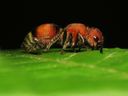
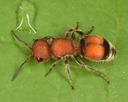
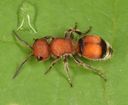
Pseudomethoca simillima is a of velvet ant in the Mutillidae, a group of solitary in which females are wingless and often brightly colored with aposematic coloration. The species has been proposed as a potential model for Müllerian or by the checkered beetle Enoclerus ichneumoneus (family Cleridae), which shares a similar orange-and-black banded color pattern. Females are reportedly fast-moving and difficult to photograph, exhibiting urgent, zigzagging locomotion on sandy substrates. The species appears to be relatively uncommon in at least parts of its range compared to its suggested mimic.
Pronunciation
How to pronounce Pseudomethoca simillima: //suˌdoʊməˈθoʊkə sɪˈmɪlɪmə//
These audio files are automatically generated. While they are not always 100% accurate, they are a good starting point.
Identification
Identification to level requires examination by a mutillid ; the specimen discussed in the source was identified by Kevin Williams (Utah State University). The species resembles other Pseudomethoca and related mutillid in general body form: females are wingless, -like in appearance, with dense . The specific color pattern that may distinguish it from and serve as the basis for mimicry involves orange and black banding similar to that of Enoclerus ichneumoneus. Photographic comparison with vouchered specimens at BugGuide and in collections is recommended for field identification.
Images
Habitat
Dry sand deposits along river systems, specifically recorded from sandy areas along the Mississippi River in southeastern Missouri.
Distribution
Southeastern Missouri, USA (Mississippi River lowlands). The Pseudomethoca occurs in North America; specific range boundaries for P. simillima are not well documented in available sources.
Behavior
Females exhibit rapid, zigzagging, non-stop movement on sandy substrates, making photography extremely difficult. This was described as the "most uncooperative" the observer had encountered among insects. No information on male behavior or patterns is available.
Ecological Role
Proposed as a potential model for mimicry complexes involving aposematic coloration. If the mimicry hypothesis is correct, the species' bright coloration would serve as a warning signal to , with the Enoclerus ichneumoneus potentially gaining protection through resemblance. The species' actual or unpalatability to predators has not been confirmed in available sources.
Human Relevance
Of interest to entomologists studying mimicry systems and . No agricultural, medical, or economic significance is documented.
Similar Taxa
- Dasymutilla quadriguttataAnother Missouri mutillid with similar coloration that has been proposed as an alternative or additional model for Enoclerus ichneumoneus mimicry; larger than E. ichneumoneus and reportedly more commonly encountered than P. simillima in Missouri.
- Enoclerus ichneumoneusNot a congeneric but the proposed mimic; a checkered beetle (Cleridae) with strikingly similar orange-banded coloration that may have evolved to resemble P. simillima or other mutillids.
More Details
Mimicry hypothesis caveats
The identification of P. simillima as the specific model for E. ichneumoneus mimicry remains tentative. The observer noted that P. simillima appears uncommon in Missouri relative to the abundance of E. ichneumoneus, which raises questions about the frequency-dependent dynamics of the proposed mimicry relationship. Mawdsley (1994) documented mimicry of mutillids by Cleridae generally without specifying particular model .
Taxonomic authority
described by Smith in 1855.