
Enoclerus ichneumoneus
(Fabricius, 1777)
Orange-banded Clerid, Orange-banded Checkered Beetle
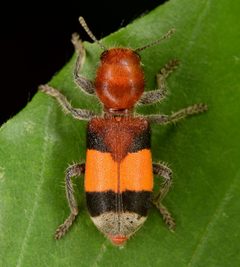
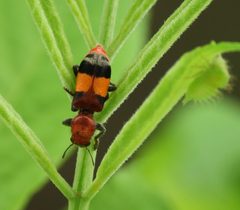
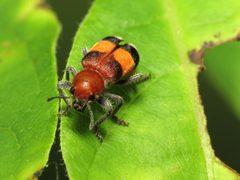
Enoclerus ichneumoneus is a conspicuous of checkered beetle ( Cleridae) found in eastern North America. It is distinguished by a wide orange band across the middle of the and an elongate scutellum. The species is commonly encountered on dead or dying hardwood trees, where it hunts woodboring beetles and their larvae. Its bright coloration and fuzzy appearance have been suggested to represent mimicry of velvet ants (Mutillidae), though this hypothesis remains incompletely tested.
Pronunciation
How to pronounce Enoclerus ichneumoneus: /ˌɛnəˈklɛrəs ɪkˈnjuːməniəs/
These audio files are automatically generated. While they are not always 100% accurate, they are a good starting point.
Identification
The wide orange band across the middle of the combined with the elongate scutellum distinguishes this from all other North American Enoclerus. No other species in the shares this particular combination of features.
Images
Habitat
Dead or dying hardwood trees, including recently fallen timber. Has been recorded from mockernut hickory (Carya alba), dead willow (Salix caroliniana), and dead grapevine (Vitis sp.). Associated with wood inhabited by woodboring beetles.
Distribution
Eastern North America. Documented from Missouri, Oklahoma, Colorado, and Ontario, Canada. Range appears centered in the eastern and central United States.
Diet
of woodboring beetles, particularly bark beetles in the weevil Scolytinae. Specific prey records include association with the buprestid Anthaxia viridicornis in willow, though direct was not confirmed.
Behavior
actively search for prey on dead and dying wood. Readily beaten from dead branches and vines. Often found in association with other woodboring beetles (Buprestidae, Cerambycidae) that are mating or ovipositing on newly available dead wood resources.
Ecological Role
of woodboring beetles, potentially regulating of bark beetles and other saproxylic . May contribute to nutrient cycling in forest through on wood-inhabiting insects.
Human Relevance
Subject of macrophotography due to striking coloration. Occasionally encountered by entomologists and naturalists investigating dead wood fauna. No significant economic impact documented.
Similar Taxa
- Other Enoclerus speciesLack the distinctive wide orange band across middle of and elongate scutellum
- Trichodes species (Cleridae)Flower-visiting clerids with different color patterns and body proportions; not primarily associated with dead wood
- Dasymutilla quadriguttata (Mutillidae)Suggested model for mimicry; larger size and different microhabitat (ground-dwelling vs. arboreal)
More Details
Mimicry hypothesis
Mawdsley (1994) suggested that E. ichneumoneus mimics velvet ants (Mutillidae). The 's fuzzy appearance and orange-and-dark color pattern resemble such as Pseudomethoca simillima and Dasymutilla quadriguttata. However, the mimicry type (Batesian vs. Müllerian) remains unresolved, as does the specific model species. The beetle's abundance relative to potential mutillid models complicates simple interpretations.
Collection records
One of the most commonly encountered clerids in Missouri and surrounding regions. Frequently reared from dead wood collected for Buprestidae and Cerambycidae rearing.