
Trichodes
Herbst, 1792
checkered beetles
Species Guides
8- Trichodes apivorus(checkered beetle)
- Trichodes bibalteatus(checkered beetle)
- Trichodes bicinctus(checkered beetle)
- Trichodes nuttalli(Red-blue Checkered Beetle)
- Trichodes oresterus(checkered beetle)
- Trichodes ornatus(Ornate Checkered Beetle)
- Trichodes peninsularis(checkered beetle)
- Trichodes simulator(checkered beetle)
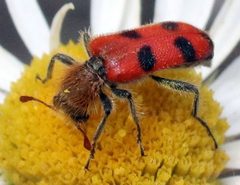
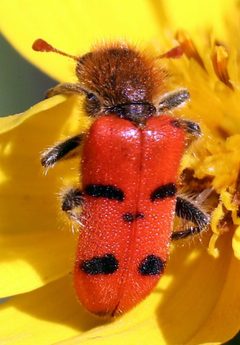
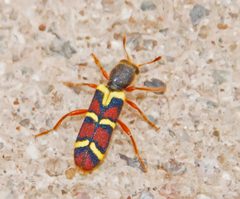
Trichodes is a of checkered beetles ( Cleridae) containing approximately 64 , with 11 species occurring in North America. The genus includes some of the largest and most strikingly colored members of the family. are frequently found on flowers where they feed on pollen and nectar, while larvae are specialized that develop within the nests of bees and .
Pronunciation
How to pronounce Trichodes: /ˈtrɪkoʊdiːz/
These audio files are automatically generated. While they are not always 100% accurate, they are a good starting point.
Identification
Trichodes are among the largest clerid beetles and exhibit bold, contrasting color patterns typically combining black with orange, red, or yellow markings. The can be distinguished from other Cleridae by its relatively large size and frequent association with flowers. North American species are primarily western in distribution, with T. nuttalli and T. apivorus occurring in the eastern United States. T. bibalteatus is characterized by distinct transverse bands across the .
Images
Habitat
are commonly found on flowers of herbaceous plants, particularly yellow composites (Asteraceae) and other native wildflowers. Larval is restricted to the nests of bees and . In North America, occur in diverse habitats including prairie grasslands, rocky exposures, and pine woodlands.
Distribution
Predominantly Holarctic in distribution. In North America, 11 occur primarily in western regions, with two species (T. nuttalli and T. apivorus) extending into the eastern United States. Specific collection records include Oklahoma (Wichita Mountains, Gloss Mountains), Colorado, and Arkansas.
Seasonality
have been observed in early July in Oklahoma and during summer months in Colorado. Activity appears to peak during the flowering season of associated plants.
Diet
feed on pollen and nectar of flowers. Larvae are obligate of bees and (, larvae, and pupae) within nests, and also consume pollen provisions stored by the hosts.
Host Associations
- bees (Hymenoptera: Apoidea) - larval /preyLarvae attach to bees visiting flowers, hitchhike to nests, and prey on
- wasps (Hymenoptera: Vespoidea) - larval /preySame phoretic mechanism as with bees; larvae prey on developing
Life Cycle
Females lay on flowers. Upon hatching, larvae attach themselves to visiting bees or and are transported to the 's nest. Larvae then prey on the host's stages and consume stored provisions. Development occurs entirely within the host nest.
Behavior
serve as while foraging on flowers. Larvae exhibit phoretic , actively attaching to hymenopteran visitors to gain transport to nests. This represents an evolutionary strategy combining pollination mutualism with .
Ecological Role
function as of native plant . Larvae act as specialized that regulate of bees and . The occupies a unique ecological position linking floral resources with hymenopteran nest .
Human Relevance
No direct economic importance established. May incidentally affect of beneficial through larval . are subjects of ecological and behavioral research due to their distinctive .
Similar Taxa
- EnoclerusBoth are of Cleridae with bright coloration, but Enoclerus are generally smaller, more commonly associated with dead wood and bark beetles rather than flowers, and lack the specialized larval transport on hymenopterans.
- ClerusEuropean of similar large, colorful clerids; distinguished by distribution and subtle morphological differences in antennal structure and elytral .
More Details
Phoretic transport mechanism
The larval strategy of attaching to hymenopterans represents a highly derived form of that ensures transport to an appropriate developmental . This was first documented in detail for T. ornatus by Linsley & MacSwain (1943).
Pollination significance
Research by Mawdsley (2004) documented that North American Trichodes are significant pollen transporters, with visiting diverse native plant species. This creates an ecological paradox where the same individuals contribute to plant while their offspring destroy offspring.
Sources and further reading
- BugGuide
- Wikipedia
- iNaturalist taxon
- NCBI Taxonomy
- Catalogue of Life
- Cleridae | Beetles In The Bush | Page 2
- 2019 Arkansas/Oklahoma Insect Collecting Trip iReport | Beetles In The Bush
- Sunset beetles | Beetles In The Bush
- Observations on the Life History of Trichodes Ornatus (Coleoptera, Cleridae), a Larval Predator in the Nests of Bees and Wasps