
Trichodes bibalteatus
LeConte, 1858
checkered beetle
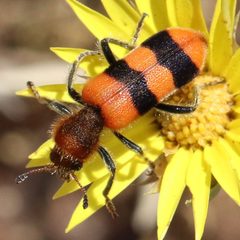
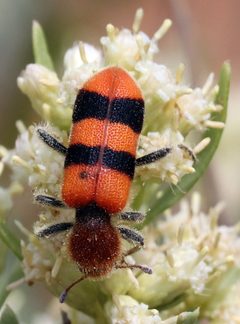
Trichodes bibalteatus is a of checkered beetle in the Cleridae. It is among the largest and most strikingly-colored species in its , which contains 11 North American species. are frequently found on flowers where they feed on pollen and nectar, and also use flowers as mating sites. The species has been documented in Oklahoma and other parts of western North America.
Pronunciation
How to pronounce Trichodes bibalteatus: /ˈtɹɪkoʊdiːz ˌbɪbɔlˈtiːətəs/
These audio files are automatically generated. While they are not always 100% accurate, they are a good starting point.
Identification
Trichodes bibalteatus can be recognized by its large size relative to other checkered beetles and its striking coloration. The specific epithet "bibalteatus" refers to the two-banded pattern. Specimens from the Gloss Mountains of northwestern Oklahoma have been matched to the in the LeConte Collection at the Museum of Comparative Zoology, Harvard University.
Images
Habitat
Has been found in sandstone glades and mesa tops in northwestern Oklahoma. are associated with yellow composite flowers (Asteraceae) for feeding and mating. Also observed on flowers of Ratibida columnifera, Achillea millefolium, and Rudbeckia hirta in the Wichita Mountains of Oklahoma.
Distribution
North America. Documented occurrences include northwestern Oklahoma (Gloss Mountains) and the Wichita Mountains of southwestern Oklahoma. The Trichodes is primarily western in distribution in North America.
Seasonality
have been observed in early July in Oklahoma. Activity coincides with blooming periods of composite flowers.
Diet
feed on pollen and nectar of flowers. Larvae are predatory, preying on developing of bees and in their nests and consuming pollen provisions.
Host Associations
- Ratibida columnifera - feeding/mating siteobserved in Wichita Mountains, Oklahoma
- Achillea millefolium - feeding/mating siteobserved in Wichita Mountains, Oklahoma
- Rudbeckia hirta - feeding/mating siteobserved in Wichita Mountains, Oklahoma
- Ratibida pinnata - feeding/mating siteobserved in Wichita Mountains, Oklahoma
- yellow composites (Asteraceae) - feeding/mating sitegeneral association in northwestern Oklahoma
Life Cycle
Females lay on flowers. Larvae hatch and attach themselves to bees and visiting the flower. Larvae are carried to the hymenopteran's nest where they prey on the developing and consume pollen provisions.
Behavior
are flower visitors, serving as of native plant . They use flowers as mating sites. Larvae exhibit phoretic , hitchhiking on bees and to reach nests.
Ecological Role
function as of native plants. Larvae act as /nest of bees and , potentially regulating hymenopteran .
Human Relevance
May contribute to pollination of native plants. No significant documented economic impact. Of interest to entomologists and macro-photographers due to striking appearance.
Similar Taxa
- Trichodes apivorusalso occurs in western North America and visits flowers; differs in distribution and specific color pattern
- Trichodes nuttallieastern North American ; T. bibalteatus is western in distribution
- other Trichodes species contains 11 North American with similar flower-visiting ; identification requires examination of color pattern and banding
More Details
Taxonomic reference
The was described by LeConte in 1858. The is deposited in the LeConte Collection at the Museum of Comparative Zoology, Harvard University.
Photographic documentation
Photographed specimens from the Gloss Mountains, Oklahoma were compared directly to the to confirm identification.