
Trichodes apivorus
Germar, 1824
checkered beetle
Trichodes apivorus is a of checkered beetle in the Cleridae, native to Central and North America. It has been documented visiting flowers, including those of Sabal palmetto (cabbage palm) and Dionaea muscipula (Venus flytrap). The species is known to have two : T. a. apivorus and T. a. borealis. Its colorful appearance and flower-visiting make it a notable subject for entomological observation.
Pronunciation
How to pronounce Trichodes apivorus: /ˈtrɪkoʊdiːz ˈeɪpɪˌvɔːrəs/
These audio files are automatically generated. While they are not always 100% accurate, they are a good starting point.
Identification
Distinguished from similar Cleridae by its specific association with flowers and geographic range in Central and North America. The two recognized (T. a. apivorus and T. a. borealis) may show geographic variation in appearance, with the nominate subspecies in Central America and T. a. borealis described from more northern regions.
Images
Appearance
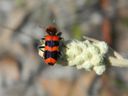
A colorful checkered beetle with distinctive patterning typical of the Cleridae. The exhibits bright coloration that has been described as "very colorful" in field observations.
Habitat
Found in diverse including pine rocklands, wet meadows, and coastal hammocks. Documented in fire-dependent where its plants occur. Associated with flowering vegetation in subtropical and temperate regions.
Distribution
Native to Central America and North America. Present in the southeastern United States, including Florida and the Carolinas, with records extending through Central America. The T. a. borealis occurs in more northern parts of the range.
Seasonality
Active during spring and early summer; observed in Florida in late April to early May. Flower-visiting activity coincides with blooming periods of associated plant .
Diet
have been observed visiting flowers, suggesting nectar or pollen feeding. The specific diet of larvae is not documented in available sources.
Host Associations
- Sabal palmetto - flower visitorCollected on flowers in Everglades National Park
- Dionaea muscipula - flower visitorObserved on Venus flytrap flowers in the Carolinas
Behavior
are active flower visitors, moving among blooming plants. The has been documented through direct observation and video surveillance at floral resources. No information available on larval or mating habits.
Ecological Role
Potential or pollen/nectar consumer; contributes to flower-visiting insect in its native . Part of the pollination interaction network for rare and endangered plant including Venus flytrap.
Human Relevance
Subject of ecological research, particularly in studies of rare plant- interactions. Collected by entomologists for scientific study. No documented economic importance or pest status.
Similar Taxa
- Other Trichodes speciesShared characteristics including checkered patterning and flower-visiting ; distinguished by specific geographic range and subtle morphological differences
- Other Cleridae-level resemblance in body form and coloration; T. apivorus distinguished by its specific flower associations and documented preferences
More Details
Subspecies
Two are recognized: Trichodes apivorus apivorus (nominate subspecies) and Trichodes apivorus borealis Wolcott & E.A.Chapin, 1918, described from more northern localities.
Research significance
Featured in ecological studies examining rare interactions, particularly pollination networks involving endangered plants. Its presence on Venus flytrap flowers highlights the importance of conserving insect-plant interactions even in specialized .