
Trichodes ornatus
Say, 1823
Ornate Checkered Beetle
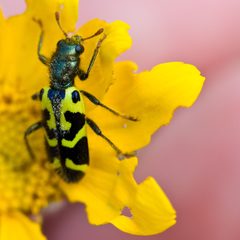
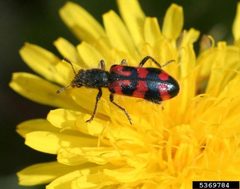
Trichodes ornatus is a checkered beetle in the Cleridae, found in western North America. are medium-sized with distinctive coloration and are frequently observed on flowers, particularly yellow composites. The has a complex involving larval development as a / in the nests of bees and , where larvae feed on stages and pollen provisions.

Pronunciation
How to pronounce Trichodes ornatus: /ˈtrɪk.oʊˌdiːz ɔrˈneɪ.təs/
These audio files are automatically generated. While they are not always 100% accurate, they are a good starting point.
Identification
are medium-sized clerids with bold coloration. Males measure 5–11 mm and females 7–15 mm. The can be distinguished from other Trichodes by its patterning; T. bibalteatus is similar but differs in elytral banding pattern. Adults are often found on yellow flowers, which aids in field recognition.
Images
Habitat
occur in open including pinyon-juniper woodland, shortgrass prairie, and oak woodland. Larval habitat is restricted to nests of bees (primarily Megachilidae) and .
Distribution
Western North America, including southwestern United States (Oklahoma, Colorado, Utah, Arizona, New Mexico) and adjacent regions. Records from Oklahoma, Colorado, Utah, Arizona, and New Mexico are documented.
Seasonality
are active during summer months, with records from June and July. Activity coincides with flowering periods of plants and availability of nests for larval development.
Diet
feed on pollen and nectar from flowers, particularly yellow-flowered plants such as yarrow (Achillea), milkweed (Asclepias), and composites. Larvae are predatory, feeding on stages (, larvae, pupae) of bees and within nests, as well as pollen provisions.
Host Associations
- Megachilidae - primary for larval development
- bees - larvae develop in nests
- wasps - larvae also develop in nests
Life Cycle
Females lay on or near flowers visited by bees and . First instar larvae attach to visiting hymenopterans and are transported to nests. Larvae develop through multiple instars within host nests, feeding on host immatures and pollen provisions. occurs within the host nest. emerge and disperse to flowers for feeding and mating.
Behavior
are and frequently found on flowers, where they feed, mate, and oviposit. Larvae exhibit phoretic , attaching to adult bees and to gain transport to nests. Within nests, larvae are aggressive of host .
Ecological Role
serve as of native flowering plants. Larvae function as or that regulate of solitary bees and . The occupies a distinctive as a /predator within hymenopteran nesting .
Similar Taxa
- Trichodes bibalteatussimilar size, coloration, and flower-visiting ; differs in elytral banding pattern and geographic distribution
- Trichodes oresterussimilar and general appearance; T. oresterus has different color pattern and more restricted distribution