
Philanthus ventilabris
Fabricius, 1798
Flat-collared Beewolf
Philanthus ventilabris is a solitary bee-hunting wasp ("beewolf") in the Crabronidae. It occurs throughout North America and has been documented visiting flowers for nectar. Like other beewolves, females provision underground nests with paralyzed bees as food for their larvae. The was first described by Fabricius in 1798.
Pronunciation
How to pronounce Philanthus ventilabris: //fɪˈlænθəs ˌvɛntɪˈlæbrɪs//
These audio files are automatically generated. While they are not always 100% accurate, they are a good starting point.
Identification
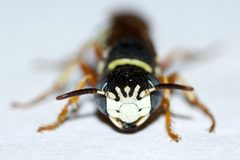
Distinguished from similar Philanthus by the straight (not notched) inner margins; males have all-pale and lack the "tarsal rake" (digging spines on front legs) present in females. The specific epithet "ventilabris" refers to the flat collar-like structure. Most North American beewolves are small (under 10 mm) with black and yellow or white patterns.
Images
Habitat
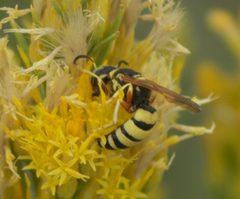
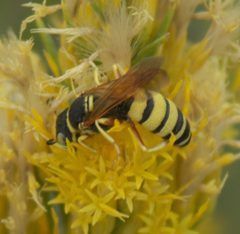
Observed in prairie and grassland , including shortgrass prairie fields. Documented visiting flowering plants such as White Prairie Clover (Dalea candida) in Colorado. Nests excavated in sandy or sandy-clay soils.
Distribution
North America; specifically documented from Colorado and widespread across the continent based on GBIF records. Also recorded from Middle America.
Seasonality
active during summer months; observed in Colorado in July. Male territorial occurs during mating season.
Diet
feed on nectar from flowers. Females hunt bees as larval provisions, paralyzing victims with a sting between the front legs. Specific prey records for this are not documented in available sources, but related species target small bees in Halictidae, Colletidae, and Andrenidae.
Life Cycle
Solitary nesting . Females excavate burrows in soil with individual radiating from main tunnels. Cells are provisioned with multiple paralyzed bees; a single is laid on one victim. Larvae feed on the stored bees and pupate in the nest. Some evidence of burrow sharing by sibling females in related species.
Behavior
Males are highly territorial, perching on low vegetation to intercept females and repel competing males. Males scent-mark twigs and foliage using abdominal brushes to communicate territory ownership. Males may spend nights in female burrows. Females actively stalk bees at flowers, carrying paralyzed prey beneath them using middle legs.
Ecological Role
of bees, contributing to of . serve as pollinators when visiting flowers for nectar. Prey for crab spiders, robber flies, and parasitic satellite flies (Sarcophagidae: Metopia, Senotainia, Hilarella) and possibly cuckoo wasps.
Human Relevance
Potential in native plant gardens. Like other beewolves, may be mistaken for more conspicuous social but poses minimal direct threat to humans.
Similar Taxa
- Philanthus gibbosusMost common North American beewolf; differs in having emarginated (notched) inner margins and more widespread distribution from Atlantic to Pacific
- Aphilanthops frigidusSimilar appearance and same (Philanthinae), but has straight inner margins like P. ventilabris; distinguished by preying on queens rather than bees
- Nomada (cuckoo bees)Often mistaken for beewolves; bees in Nomada are of other bees, not , and lack the -waisted body form
More Details
Nomenclature
The specific epithet 'ventilabris' (Latin: 'flat lip' or 'fan lip') refers to a morphological feature of the , likely the collar-like structure.
Research history
Less well-studied than the European beewolf Philanthus triangulum (subject of Tinbergen's Nobel Prize-winning research) or the common North American P. gibbosus. Natural history details largely inferred from -level studies.
Sources and further reading
- BugGuide
- Wikipedia
- GBIF taxonomy match
- iNaturalist taxon
- NCBI Taxonomy
- Catalogue of Life
- The Amazing World of 'Gwentomologist' Gwen Erdosh | Bug Squad
- Bug Eric: White Prairie Clover: An Awesome Blossom
- Bug Eric: June 2012
- Bug Eric: Wasp Wednesday: Beewolves
- Bug Eric: August 2011
- Bug Eric: Wasp Wednesday: Ant-queen Kidnappers