
Trachypus
Reinw. & Hornsch.
bee-hunting wasp
Species Guides
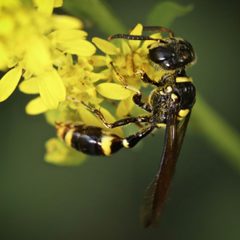
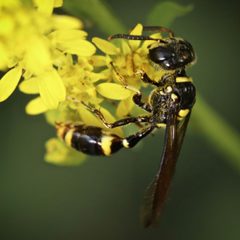
1Trachypus is a Neotropical of digger wasps in the Crabronidae, comprising 31 described . Species are ground-nesting and may be solitary or communal. The genus is notable for its specialized on bees, with some species exhibiting narrow prey specialization on (Meliponini). Trachypus species harbor symbiotic streptomycete bacteria in antennal glands, a trait shared with their close relative Philanthus.
Pronunciation
How to pronounce Trachypus: //ˈtrækɪpəs//
These audio files are automatically generated. While they are not always 100% accurate, they are a good starting point.
Identification
Medium-sized digger wasps with antennal glands containing symbiotic bacteria. Distinguished from the closely related Philanthus by geographic distribution (Neotropical vs. primarily Holarctic) and greater 16S rRNA sequence divergence in their antennal . -level identification requires examination of morphological characters not detailed in available sources.
Images
Habitat
Ground-nesting in sloped soil; observed in urban and suburban environments in at least parts of range.
Distribution
Neotropical region; documented from southern Brazil (Curitiba, Paraná) and more broadly in South America.
Seasonality
Observed activity varies by : some species active most of the year with marked seasonality in late spring and early summer; others with restricted activity periods (e.g., January only for T. varius in one study).
Diet
Predatory on bees; -level diet ranges from (several and ) to on (Meliponini). Documented prey includes Trigona spinipes, Paratrigona subnuda drones, and Paratrigona subnuda .
Host Associations
- Trigona spinipes - preyspecialized prey of T. elongatus
- Paratrigona subnuda - preydrones preyed upon by T. taschenbergi; preyed upon by T. varius
- Streptomyces - antennal gland related to 'Candidatus Streptomyces philanthi'; confirmed in T. denticollis and T. boharti
Life Cycle
Ground-nesting; females provision with paralyzed prey. Symbiotic bacteria transferred to subterranean brood cells where they produce protecting larvae from .
Behavior
Solitary nesting documented in multiple ; communal nesting also known in . Specialized hunting observed: T. elongatus and T. taschenbergi show prey specialization on particular species or .
Ecological Role
of bees, particularly ; contributes to regulation of meliponine . -producing protect developing larvae from soil-borne in subterranean nests.
Similar Taxa
- PhilanthusClosest relative; both harbor antennal streptomycete , but Philanthus is primarily Holarctic and has less divergent symbiont lineages.