
Tachytes guatemalensis
Cameron, 1889
Guatemalan green-eyed wasp
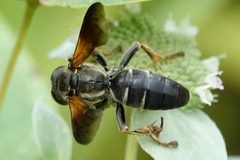
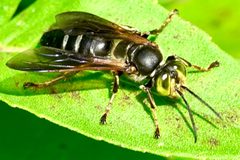
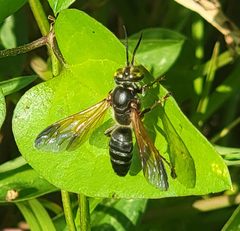
Tachytes guatemalensis is a solitary in the Crabronidae, tribe Larrini. It belongs to a commonly known as 'green-eyed wasps' due to the large, vivid green present in many , especially males. As with other Tachytes, this species is a ground-nesting that provisions its burrows with paralyzed orthopteran prey. The species was described from Guatemala and occurs in Central and North America.
Pronunciation
How to pronounce Tachytes guatemalensis: /ˈtækɪtiːz ˌɡwɑːtəˈmeɪlɛnsɪs/
These audio files are automatically generated. While they are not always 100% accurate, they are a good starting point.
Identification
The combination of large green (in most individuals), stocky build, reduced ocellar scars shaped like golf clubs with long tails, and ground-nesting distinguishes Tachytes from similar . T. guatemalensis specifically requires examination of male genitalia or other subtle morphological characters for definitive identification, as -level separation within the genus depends on structural features not visible in field observations. Distinguished from Liris by shorter, less parallel , more robust body, and green ; distinguished from Tachysphex by larger size and lack of red abdominal coloration.
Images
Appearance
Members of the Tachytes typically exhibit large that are bright green in life, particularly pronounced in males. The body is generally stocky and robust compared to related genera such as Liris. The ocelli are reduced to scar-like structures shaped like golf clubs with long 'tails' running partway down the . The is predominantly black. Males have conspicuously enlarged relative to females, an for detecting mates and rivals while perching.
Habitat
Nests in various soil types, not restricted to sand. Burrows excavated in ground, sometimes utilizing pre-existing burrow entrances made by rodents, lizards, or other such as cicada killers. Nesting sites typically in open, sunny areas with bare or sparsely vegetated ground.
Distribution
Central America and North America. Records indicate presence in Middle America and North America broadly; the was originally described from Guatemala.
Diet
of orthopteran insects. Female paralyze prey with their sting, transport it to the nest by grasping the with their , and provision underground . Prey includes grasshoppers (Acrididae), pygmy grasshoppers (Tetrigidae), nymphs (Tettigoniidae), and pygmy mole crickets (Tridactylidae).
Life Cycle
Females excavate burrows 7–100 cm deep with tunnels 7 cm to nearly 1 m in length. Multiple are arranged along the main burrow or at the ends of branching tunnels. Each cell receives 1–13 paralyzed prey items, with an laid on the final victim. Larvae develop on the provisioned prey. Males emerge before females and initially defend territories near female sites, later shifting to territories around nesting sites and nectar resources.
Behavior
Males employ two sequential mating strategies: first defending territories where females will emerge, then shifting to territories around active nesting sites. Males perch on stones, leaves, flowers, or twigs, returning repeatedly to the same or nearby perches. Upon detecting a female, the male pounces on her back, pins her wings, and commences courtship involving rapid antennal waving over the female's . Females forage actively, flitting rapidly between flowers when feeding on nectar, and seldom perch. At least one in the has been observed nesting nocturnally.
Ecological Role
As a of orthopteran insects, Tachytes contribute to of grasshoppers, crickets, and related insects. Their ground-nesting activity may provide soil aeration. serve as when visiting flowers for nectar, though their rapid movement between blossoms may limit pollen transfer .
Human Relevance
Generally beneficial due to on potential agricultural pests, particularly grasshoppers. Non-aggressive toward humans; stings occur only if the is directly handled. Solitary nature means defensive colony stinging does not occur. Sometimes mistaken for more dangerous wasps due to general resemblance.
Similar Taxa
- LirisMore slender body, longer held parallel and straight from , silvery reflective , lacks green , slower movement
- TachysphexUsually smaller, frequently with red or partially red , very pointed , more rapid movement than Liris but distinct from Tachytes
- BembixDifferent prey (flies rather than orthopterans), different nest architecture, often with pale abdominal bands
More Details
Taxonomic note
The Tachytes contains approximately 35 in North America north of Mexico, with additional species in Central America. Species-level identification typically requires dissection and examination of male genitalia (, gonostyles, volsella) or detailed examination of female and antennal sensory structures.
Nesting ecology
Some Tachytes are known to usurp or utilize burrow entrances constructed by other animals; the extent to which T. guatemalensis exhibits this specifically has not been documented.