
Tachytes aurulentus
(Fabricius, 1804)
square-headed wasp, green-eyed wasp, sand-loving wasp
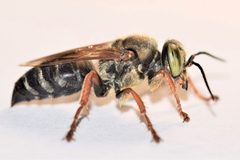
Tachytes aurulentus is a of solitary square-headed wasp in the Crabronidae. Like other members of its , it is characterized by notably large green , particularly in males. The species is part of a diverse North American of approximately 35 Tachytes species. These are ground-nesting that provision their burrows with paralyzed orthopteran prey for their offspring.
Pronunciation
How to pronounce Tachytes aurulentus: /ˈtækɪtiːz ˌɔːrʊˈlɛntəs/
These audio files are automatically generated. While they are not always 100% accurate, they are a good starting point.
Identification
Tachytes aurulentus can be recognized by the -defining trait of large green , especially prominent in males. The ocellar scars are shaped like golf clubs with long 'tails' running partway down the —a distinctive feature of the Larrini tribe. Males have proportionately larger than females and are more commonly observed perching on stones, leaves, flowers, or twigs. -level identification within Tachytes typically requires examination of male genitalia, making field identification to species challenging without specimen collection.
Images
Habitat
Sandy soils and other ground substrates suitable for burrow excavation. Nests are constructed in a variety of soil types, sometimes utilizing pre-existing burrows of rodents, lizards, or other insects including cicada killer .
Distribution
North America; recorded from Canada (Alberta) and the United States. The Tachytes is widespread across North America north of Mexico.
Seasonality
are active during the warmer months. Males emerge before females and establish territories near anticipated female sites and later around nesting areas.
Life Cycle
Females excavate burrows 7 cm to nearly 1 meter in length, reaching depths of 7.5 to 70 cm. Multiple are arranged along the main tunnel or at the ends of branching tunnels. Each cell is provisioned with 1 to 13 paralyzed orthopteran prey items— grasshoppers (Acrididae), pygmy grasshoppers (Tetrigidae), nymphs (Tettigoniidae), or pygmy mole crickets (Tridactylidae). The female paralyzes prey with her sting, grasps it by the with her jaws, and transports it to the nest. An is laid on the last prey item placed in each cell.
Behavior
Males employ territorial defense strategies, initially establishing small territories near female sites, then shifting to defend areas around nesting sites and nectar resources. Males perch on elevated substrates and return repeatedly to the same or nearby perches. Courtship involves the male pouncing on the female's back, pinning her wings, and waving his frantically over her . Males have been observed defending territories around isolated blooming trees such as saltcedar (Tamarix sp.). The are rapid, restless fliers when foraging on flowers.
Ecological Role
of orthopteran insects, contributing to of grasshoppers, crickets, and related . serve as when visiting flowers for nectar.
Human Relevance
Generally harmless to humans; solitary nature means defensive stinging is rare. May occasionally cause concern when nesting in high-traffic areas, but poses minimal risk.
Similar Taxa
- Liris argentatusBoth are Crabronidae in tribe Larrini with similar body plans, but Liris has proportionately longer held parallel and straight from the , a silvery appearance from reflective hairs, and moves more slowly than the restless Tachytes.
- Tachysphex spp.Smaller than most Tachytes, often with red abdominal coloration and a very pointed ; lacks the distinctive green of Tachytes.
- Other Tachytes speciesRequire dissection of male genitalia for definitive identification; T. aurulentus distinguished by specific and gonostyle .
Sources and further reading
- BugGuide
- GBIF taxonomy match
- iNaturalist taxon
- Catalogue of Life
- Bug Eric: Green-eyed Wasps, Tachytes
- Bug Eric: Wasp Wednesday: Liris
- Bug Eric: About
- Bug Eric: White Prairie Clover: An Awesome Blossom
- Hover Flies Identified: Researchers Tackle 20,000 Syrphid Specimens in Illinois Collection
- Bug Eric: June 2012